

46
4 Perturbation Theory for the Electron Propagator
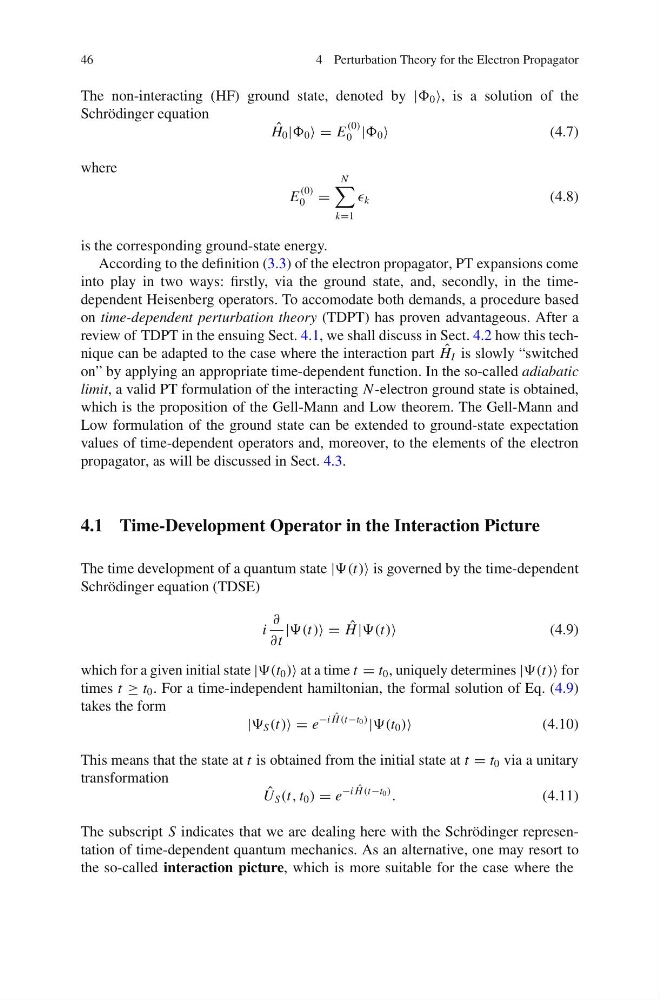
The non-interacting (HF) ground state, denoted by | 0 , is a solution of the
Schrödinger equation
ˆ
H 0 | 0 = E
(0)
0 | 0
(4.7)
where
E
(0)
0 =
N
k=1
k
(4.8)
is the corresponding ground-state energy.
According to the definition (3.3) of the electron propagator, PT expansions come
into play in two ways: firstly, via the ground state, and, secondly, in the timedependent Heisenberg operators. To accomodate both demands, a procedure based
on time-dependent perturbation theory (TDPT) has proven advantageous. After a
review of TDPT in the ensuing Sect. 4.1, we shall discuss in Sect. 4.2 how this technique can be adapted to the case where the interaction part ˆ
H I is slowly “switched
on” by applying an appropriate time-dependent function. In the so-called adiabatic
limit, a valid PT formulation of the interacting N -electron ground state is obtained,
which is the proposition of the Gell-Mann and Low theorem. The Gell-Mann and
Low formulation of the ground state can be extended to ground-state expectation
values of time-dependent operators and, moreover, to the elements of the electron
propagator, as will be discussed in Sect. 4.3.
4.1 Time-Development Operator in the Interaction Picture
The time development of a quantum state |(t) is governed by the time-dependent
Schrödinger equation (TDSE)
i
∂
∂t
|(t) = ˆ
H |(t)
(4.9)
which for a given initial state |(t 0 ) at a time t = t 0 , uniquely determines |(t) for
times t ≥ t 0 . For a time-independent hamiltonian, the formal solution of Eq. (4.9)
takes the form
| S (t) = e
−i ˆ
H (t−t 0 )
|(t 0 )
(4.10)
This means that the state at t is obtained from the initial state at t = t 0 via a unitary
transformation
ˆ
U S (t, t 0 ) = e
−i ˆ
H (t−t 0 )
.
(4.11)
The subscript S indicates that we are dealing here with the Schrödinger representation of time-dependent quantum mechanics. As an alternative, one may resort to
the so-called interaction picture, which is more suitable for the case where the
4 Perturbation Theory for the Electron Propagator
The non-interacting (HF) ground state, denoted by | 0 , is a solution of the
Schrödinger equation
ˆ
H 0 | 0 = E
(0)
0 | 0
(4.7)
where
E
(0)
0 =
N
k=1
k
(4.8)
is the corresponding ground-state energy.
According to the definition (3.3) of the electron propagator, PT expansions come
into play in two ways: firstly, via the ground state, and, secondly, in the timedependent Heisenberg operators. To accomodate both demands, a procedure based
on time-dependent perturbation theory (TDPT) has proven advantageous. After a
review of TDPT in the ensuing Sect. 4.1, we shall discuss in Sect. 4.2 how this technique can be adapted to the case where the interaction part ˆ
H I is slowly “switched
on” by applying an appropriate time-dependent function. In the so-called adiabatic
limit, a valid PT formulation of the interacting N -electron ground state is obtained,
which is the proposition of the Gell-Mann and Low theorem. The Gell-Mann and
Low formulation of the ground state can be extended to ground-state expectation
values of time-dependent operators and, moreover, to the elements of the electron
propagator, as will be discussed in Sect. 4.3.
4.1 Time-Development Operator in the Interaction Picture
The time development of a quantum state |(t) is governed by the time-dependent
Schrödinger equation (TDSE)
i
∂
∂t
|(t) = ˆ
H |(t)
(4.9)
which for a given initial state |(t 0 ) at a time t = t 0 , uniquely determines |(t) for
times t ≥ t 0 . For a time-independent hamiltonian, the formal solution of Eq. (4.9)
takes the form
| S (t) = e
−i ˆ
H (t−t 0 )
|(t 0 )
(4.10)
This means that the state at t is obtained from the initial state at t = t 0 via a unitary
transformation
ˆ
U S (t, t 0 ) = e
−i ˆ
H (t−t 0 )
.
(4.11)
The subscript S indicates that we are dealing here with the Schrödinger representation of time-dependent quantum mechanics. As an alternative, one may resort to
the so-called interaction picture, which is more suitable for the case where the