

38
3 One-Particle Green’s Function
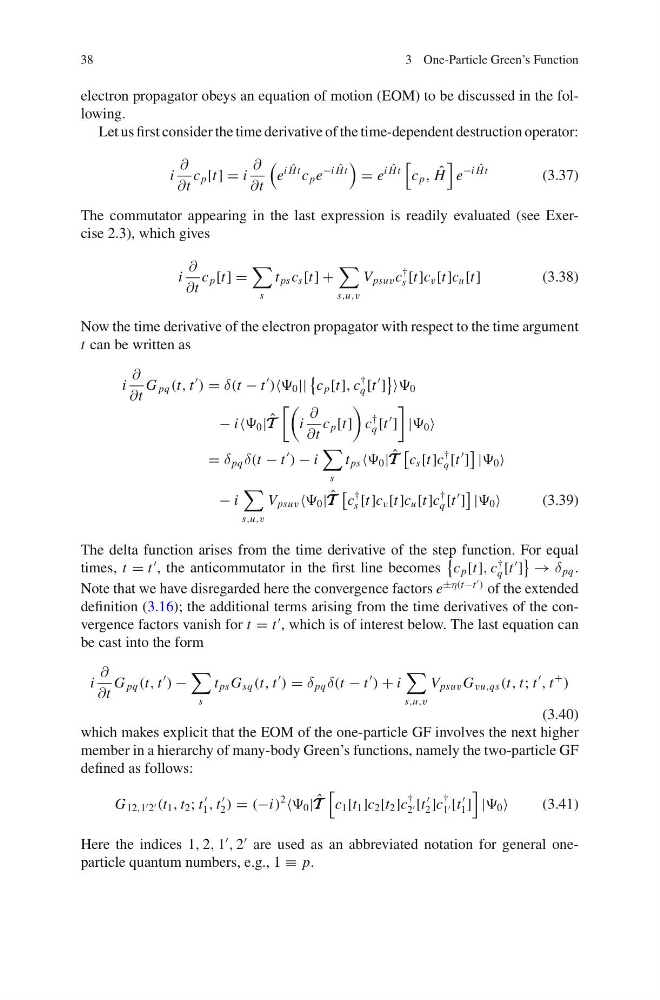
electron propagator obeys an equation of motion (EOM) to be discussed in the following.
Let us first consider the time derivative of the time-dependent destruction operator:
i
∂
∂t
c p [t] = i
∂
∂t
e
i ˆ
Ht c p e
−i ˆ
Ht
= e
i ˆ
Ht
c p , ˆ
H
e
−i ˆ
Ht
(3.37)
The commutator appearing in the last expression is readily evaluated (see Exercise 2.3), which gives
i
∂
∂t
c p [t] =
s
t ps c s [t] +
s,u,v
V psuv c
†
s [t]c v [t]c u [t]
(3.38)
Now the time derivative of the electron propagator with respect to the time argument
t can be written as
i
∂
∂t
G pq (t, t
) = δ(t − t
) 0 ||
c p [t], c
†
q [t
]
0
− i 0 | ˆ
T T T
i
∂
∂t
c p [t]
c
†
q [t
]
| 0
= δ pq δ(t − t
) − i
s
t ps 0 | ˆ
T T T
c s [t]c
†
q [t
]
| 0
− i
s,u,v
V psuv 0 | ˆ
T T T
c
†
s [t]c v [t]c u [t]c
†
q [t
]
| 0
(3.39)
The delta function arises from the time derivative of the step function. For equal
times, t = t
, the anticommutator in the first line becomes
c p [t], c
†
q [t
]
→ δ pq .
Note that we have disregarded here the convergence factors e
±η(t−t
) of the extended
definition (3.16); the additional terms arising from the time derivatives of the convergence factors vanish for t = t
, which is of interest below. The last equation can
be cast into the form
i
∂
∂t
G pq (t, t
) −
s
t ps G sq (t, t
) = δ pq δ(t − t
) + i
s,u,v
V psuv G vu,qs (t, t; t
, t
+
)
(3.40)
which makes explicit that the EOM of the one-particle GF involves the next higher
member in a hierarchy of many-body Green’s functions, namely the two-particle GF
defined as follows:
G 12,1 2 (t 1 , t 2 ; t
1 , t
2 ) = (−i)
2
0 | ˆ
T T T
c 1 [t 1 ]c 2 [t 2 ]c
†
2 [t
2 ]c
†
1 [t
1 ]
| 0
(3.41)
Here the indices 1, 2, 1
, 2
are used as an abbreviated notation for general oneparticle quantum numbers, e.g., 1 ≡ p.
3 One-Particle Green’s Function
electron propagator obeys an equation of motion (EOM) to be discussed in the following.
Let us first consider the time derivative of the time-dependent destruction operator:
i
∂
∂t
c p [t] = i
∂
∂t
e
i ˆ
Ht c p e
−i ˆ
Ht
= e
i ˆ
Ht
c p , ˆ
H
e
−i ˆ
Ht
(3.37)
The commutator appearing in the last expression is readily evaluated (see Exercise 2.3), which gives
i
∂
∂t
c p [t] =
s
t ps c s [t] +
s,u,v
V psuv c
†
s [t]c v [t]c u [t]
(3.38)
Now the time derivative of the electron propagator with respect to the time argument
t can be written as
i
∂
∂t
G pq (t, t
) = δ(t − t
) 0 ||
c p [t], c
†
q [t
]
0
− i 0 | ˆ
T T T
i
∂
∂t
c p [t]
c
†
q [t
]
| 0
= δ pq δ(t − t
) − i
s
t ps 0 | ˆ
T T T
c s [t]c
†
q [t
]
| 0
− i
s,u,v
V psuv 0 | ˆ
T T T
c
†
s [t]c v [t]c u [t]c
†
q [t
]
| 0
(3.39)
The delta function arises from the time derivative of the step function. For equal
times, t = t
, the anticommutator in the first line becomes
c p [t], c
†
q [t
]
→ δ pq .
Note that we have disregarded here the convergence factors e
±η(t−t
) of the extended
definition (3.16); the additional terms arising from the time derivatives of the convergence factors vanish for t = t
, which is of interest below. The last equation can
be cast into the form
i
∂
∂t
G pq (t, t
) −
s
t ps G sq (t, t
) = δ pq δ(t − t
) + i
s,u,v
V psuv G vu,qs (t, t; t
, t
+
)
(3.40)
which makes explicit that the EOM of the one-particle GF involves the next higher
member in a hierarchy of many-body Green’s functions, namely the two-particle GF
defined as follows:
G 12,1 2 (t 1 , t 2 ; t
1 , t
2 ) = (−i)
2
0 | ˆ
T T T
c 1 [t 1 ]c 2 [t 2 ]c
†
2 [t
2 ]c
†
1 [t
1 ]
| 0
(3.41)
Here the indices 1, 2, 1
, 2
are used as an abbreviated notation for general oneparticle quantum numbers, e.g., 1 ≡ p.