

36
3 One-Particle Green’s Function
where μ pq (E) is a function of the energy E.
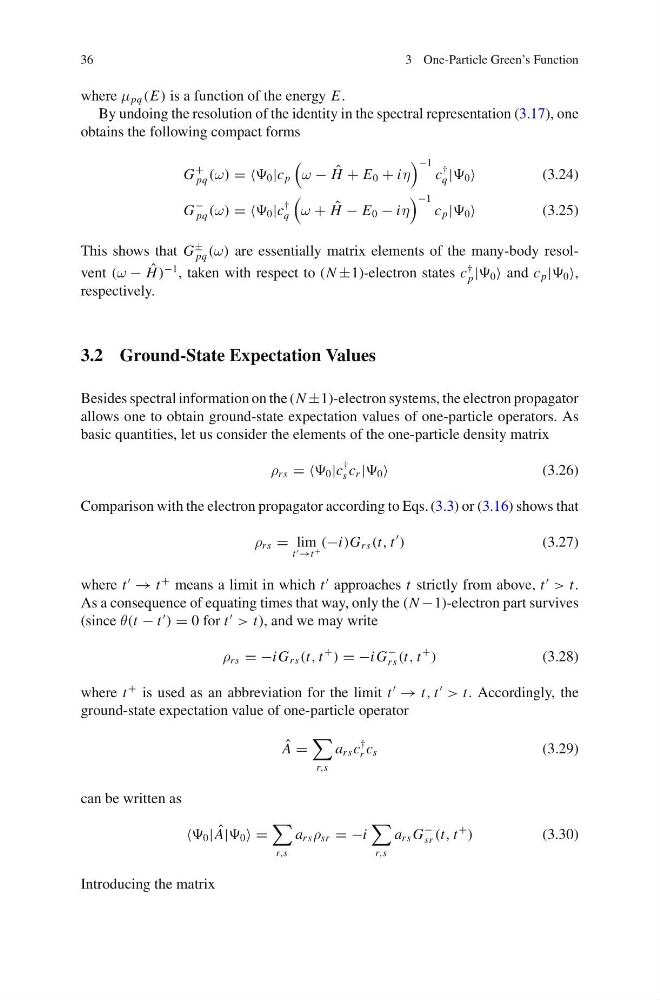
By undoing the resolution of the identity in the spectral representation (3.17), one
obtains the following compact forms
G
+
pq (ω) = = 0 |c p
ω − ˆ
H + E 0 + iη
−1
c
†
q | 0
(3.24)
G
−
pq (ω) = = 0 |c
†
q
ω + ˆ
H − E 0 − iη
−1
c p | 0
(3.25)
This shows that G
±
pq (ω) are essentially matrix elements of the many-body resolvent (ω − ˆ
H )
−1 , taken with respect to (N ±1)-electron states c
†
p | 0 and c p | 0 ,
respectively.
3.2 Ground-State Expectation Values
Besides spectral information on the (N ±1)-electron systems, the electron propagator
allows one to obtain ground-state expectation values of one-particle operators. As
basic quantities, let us consider the elements of the one-particle density matrix
ρ rs = = 0 |c
†
s c r | 0
(3.26)
Comparison with the electron propagator according to Eqs. (3.3) or (3.16) shows that
ρ rs = lim
t →t +
(−i)G rs (t, t
)
(3.27)
where t
→ t
+ means a limit in which t
approaches t strictly from above, t
> t.
As a consequence of equating times that way, only the (N −1)-electron part survives
(since θ(t − t
) = 0 for t
> t), and we may write
ρ rs = −i G rs (t, t
+
) = −i G
−
rs (t, t
+
)
(3.28)
where t
+ is used as an abbreviation for the limit t
→ t, t
> t. Accordingly, the
ground-state expectation value of one-particle operator
ˆ
A =
r,s
a rs c
†
r c s
(3.29)
can be written as
0 | ˆ
A| 0 =
r,s
a rs ρ sr = −i
r,s
a rs G
−
sr (t, t
+
)
(3.30)
Introducing the matrix
3 One-Particle Green’s Function
where μ pq (E) is a function of the energy E.
By undoing the resolution of the identity in the spectral representation (3.17), one
obtains the following compact forms
G
+
pq (ω) = = 0 |c p
ω − ˆ
H + E 0 + iη
−1
c
†
q | 0
(3.24)
G
−
pq (ω) = = 0 |c
†
q
ω + ˆ
H − E 0 − iη
−1
c p | 0
(3.25)
This shows that G
±
pq (ω) are essentially matrix elements of the many-body resolvent (ω − ˆ
H )
−1 , taken with respect to (N ±1)-electron states c
†
p | 0 and c p | 0 ,
respectively.
3.2 Ground-State Expectation Values
Besides spectral information on the (N ±1)-electron systems, the electron propagator
allows one to obtain ground-state expectation values of one-particle operators. As
basic quantities, let us consider the elements of the one-particle density matrix
ρ rs = = 0 |c
†
s c r | 0
(3.26)
Comparison with the electron propagator according to Eqs. (3.3) or (3.16) shows that
ρ rs = lim
t →t +
(−i)G rs (t, t
)
(3.27)
where t
→ t
+ means a limit in which t
approaches t strictly from above, t
> t.
As a consequence of equating times that way, only the (N −1)-electron part survives
(since θ(t − t
) = 0 for t
> t), and we may write
ρ rs = −i G rs (t, t
+
) = −i G
−
rs (t, t
+
)
(3.28)
where t
+ is used as an abbreviation for the limit t
→ t, t
> t. Accordingly, the
ground-state expectation value of one-particle operator
ˆ
A =
r,s
a rs c
†
r c s
(3.29)
can be written as
0 | ˆ
A| 0 =
r,s
a rs ρ sr = −i
r,s
a rs G
−
sr (t, t
+
)
(3.30)
Introducing the matrix