

24
2 Second Quantization
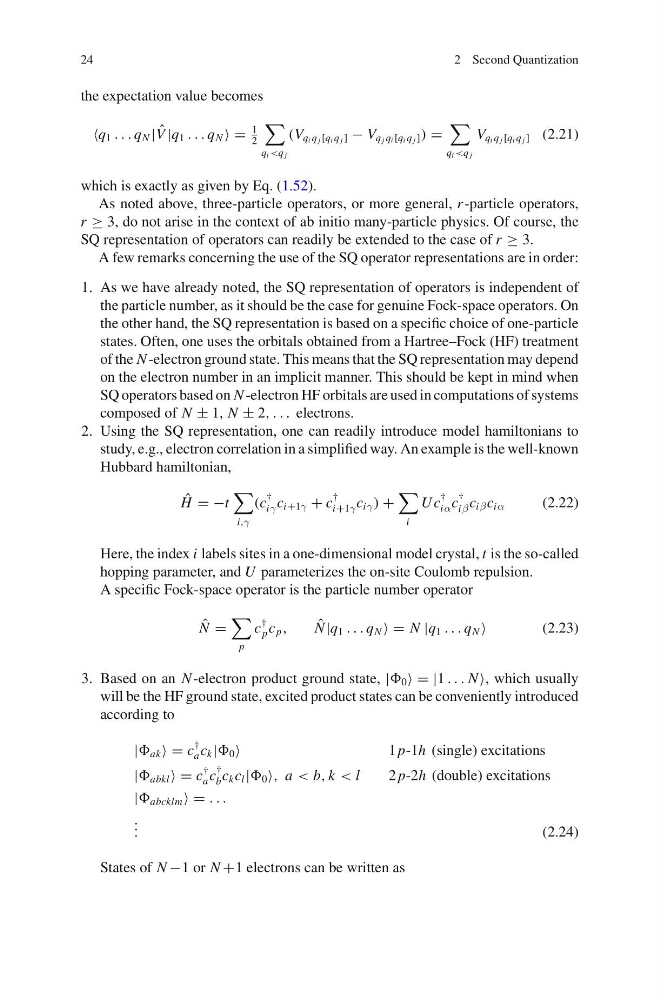
the expectation value becomes
q 1 . . . q N | ˆ
V |q 1 . . . q N =
1
2
q i (V q i q j [q i q j ] − V q j q i [q i q j ] ) =
q i V q i q j [q i q j ] (2.21)
which is exactly as given by Eq. (1.52).
As noted above, three-particle operators, or more general, r -particle operators,
r ≥ 3, do not arise in the context of ab initio many-particle physics. Of course, the
SQ representation of operators can readily be extended to the case of r ≥ 3.
A few remarks concerning the use of the SQ operator representations are in order:
1. As we have already noted, the SQ representation of operators is independent of
the particle number, as it should be the case for genuine Fock-space operators. On
the other hand, the SQ representation is based on a specific choice of one-particle
states. Often, one uses the orbitals obtained from a Hartree–Fock (HF) treatment
of the N -electron ground state. This means that the SQ representation may depend
on the electron number in an implicit manner. This should be kept in mind when
SQ operators based on N -electron HF orbitals are used in computations of systems
composed of N ± 1, N ± 2, . . . electrons.
2. Using the SQ representation, one can readily introduce model hamiltonians to
study, e.g., electron correlation in a simplified way. An example is the well-known
Hubbard hamiltonian,
ˆ
H = −t
i,γ
(c
†
iγ c i+1γ + c
†
i+1γ c iγ ) +
i
U c
†
iα c
†
iβ c iβ c iα
(2.22)
Here, the index i labels sites in a one-dimensional model crystal, t is the so-called
hopping parameter, and U parameterizes the on-site Coulomb repulsion.
A specific Fock-space operator is the particle number operator
ˆ
N =
p
c
†
p c p ,
ˆ
N |q 1 . . . q N = N |q 1 . . . q N
(2.23)
3. Based on an N -electron product ground state, | 0 = |1 . . . N , which usually
will be the HF ground state, excited product states can be conveniently introduced
according to
| ak = c
†
a c k | 0
1 p-1h (single) excitations
| abkl = c
†
a c
†
b c k c l | 0 , a < b, k < l
2 p-2h (double) excitations
| abcklm = . . .
. . .
(2.24)
States of N −1 or N +1 electrons can be written as
2 Second Quantization
the expectation value becomes
q 1 . . . q N | ˆ
V |q 1 . . . q N =
1
2
q i (V q i q j [q i q j ] − V q j q i [q i q j ] ) =
q i V q i q j [q i q j ] (2.21)
which is exactly as given by Eq. (1.52).
As noted above, three-particle operators, or more general, r -particle operators,
r ≥ 3, do not arise in the context of ab initio many-particle physics. Of course, the
SQ representation of operators can readily be extended to the case of r ≥ 3.
A few remarks concerning the use of the SQ operator representations are in order:
1. As we have already noted, the SQ representation of operators is independent of
the particle number, as it should be the case for genuine Fock-space operators. On
the other hand, the SQ representation is based on a specific choice of one-particle
states. Often, one uses the orbitals obtained from a Hartree–Fock (HF) treatment
of the N -electron ground state. This means that the SQ representation may depend
on the electron number in an implicit manner. This should be kept in mind when
SQ operators based on N -electron HF orbitals are used in computations of systems
composed of N ± 1, N ± 2, . . . electrons.
2. Using the SQ representation, one can readily introduce model hamiltonians to
study, e.g., electron correlation in a simplified way. An example is the well-known
Hubbard hamiltonian,
ˆ
H = −t
i,γ
(c
†
iγ c i+1γ + c
†
i+1γ c iγ ) +
i
U c
†
iα c
†
iβ c iβ c iα
(2.22)
Here, the index i labels sites in a one-dimensional model crystal, t is the so-called
hopping parameter, and U parameterizes the on-site Coulomb repulsion.
A specific Fock-space operator is the particle number operator
ˆ
N =
p
c
†
p c p ,
ˆ
N |q 1 . . . q N = N |q 1 . . . q N
(2.23)
3. Based on an N -electron product ground state, | 0 = |1 . . . N , which usually
will be the HF ground state, excited product states can be conveniently introduced
according to
| ak = c
†
a c k | 0
1 p-1h (single) excitations
| abkl = c
†
a c
†
b c k c l | 0 , a < b, k < l
2 p-2h (double) excitations
| abcklm = . . .
. . .
(2.24)
States of N −1 or N +1 electrons can be written as