

2.3 Operators in Second Quantization
23
q 1 . . . q N |q 1 . . . q i−1 pq i+1 . . . q N = δ pq i
the expectation value is given by
q 1 . . . q N | ˆ
W
|q 1 . . . q N =
N
i=1
w q i q i
(2.16)
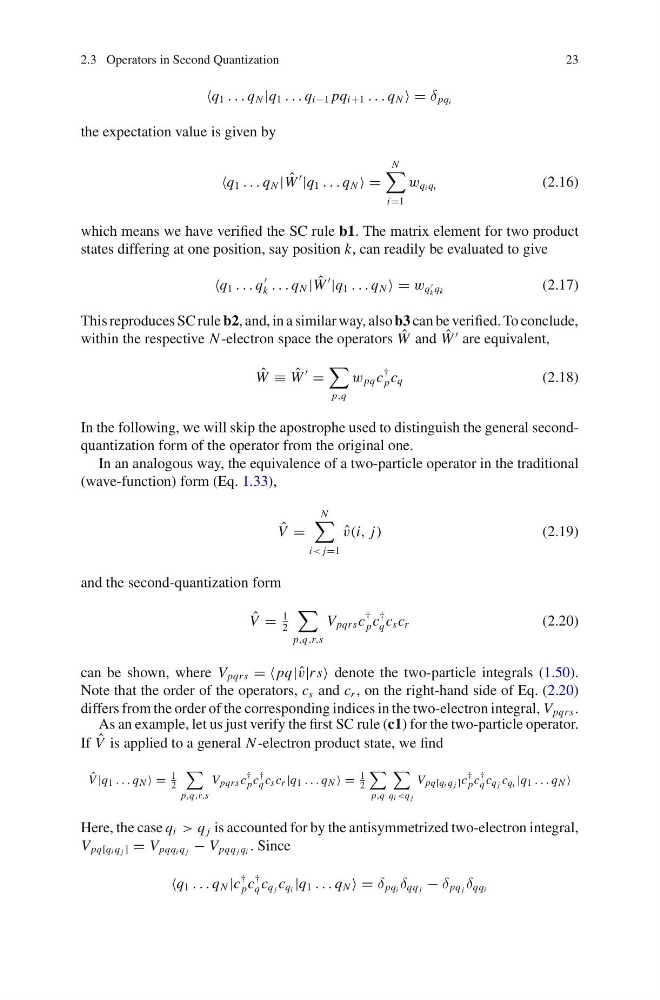
which means we have verified the SC rule b1. The matrix element for two product
states differing at one position, say position k, can readily be evaluated to give
q 1 . . . q
k . . . q N | ˆ
W
|q 1 . . . q N = w q
k q k
(2.17)
This reproduces SC rule b2, and, in a similar way, also b3 can be verified. To conclude,
within the respective N -electron space the operators ˆ
W and ˆ
W
are equivalent,
ˆ
W ≡ ˆ
W
=
p,q
w pq c
†
p c q
(2.18)
In the following, we will skip the apostrophe used to distinguish the general secondquantization form of the operator from the original one.
In an analogous way, the equivalence of a two-particle operator in the traditional
(wave-function) form (Eq. 1.33),
ˆ
V =
N
i< j=1
ˆ
v(i, j)
(2.19)
and the second-quantization form
ˆ
V =
1
2
p,q,r,s
V pqrs c
†
p c
†
q c s c r
(2.20)
can be shown, where V pqrs = =pq| ˆ
v|rs denote the two-particle integrals (1.50).
Note that the order of the operators, c s and c r , on the right-hand side of Eq. (2.20)
differs from the order of the corresponding indices in the two-electron integral, V pqrs .
As an example, let us just verify the first SC rule (c1) for the two-particle operator.
If ˆ
V is applied to a general N -electron product state, we find
ˆ
V |q 1 . . . q N =
1
2
p,q,r,s
V pqrs c
†
p c
†
q c s c r |q 1 . . . q N =
1
2
p,q
q i V pq[q i q j ] c
†
p c
†
q c q j c q i |q 1 . . . q N
Here, the case q i > q j is accounted for by the antisymmetrized two-electron integral,
V pq[q i q j ] = V pqq i q j − V pqq j q i . Since
q 1 . . . q N |c
†
p c
†
q c q j c q i |q 1 . . . q N = δ pq i δ qq j − δ pq j δ qq i
23
q 1 . . . q N |q 1 . . . q i−1 pq i+1 . . . q N = δ pq i
the expectation value is given by
q 1 . . . q N | ˆ
W
|q 1 . . . q N =
N
i=1
w q i q i
(2.16)
which means we have verified the SC rule b1. The matrix element for two product
states differing at one position, say position k, can readily be evaluated to give
q 1 . . . q
k . . . q N | ˆ
W
|q 1 . . . q N = w q
k q k
(2.17)
This reproduces SC rule b2, and, in a similar way, also b3 can be verified. To conclude,
within the respective N -electron space the operators ˆ
W and ˆ
W
are equivalent,
ˆ
W ≡ ˆ
W
=
p,q
w pq c
†
p c q
(2.18)
In the following, we will skip the apostrophe used to distinguish the general secondquantization form of the operator from the original one.
In an analogous way, the equivalence of a two-particle operator in the traditional
(wave-function) form (Eq. 1.33),
ˆ
V =
N
i< j=1
ˆ
v(i, j)
(2.19)
and the second-quantization form
ˆ
V =
1
2
p,q,r,s
V pqrs c
†
p c
†
q c s c r
(2.20)
can be shown, where V pqrs = =pq| ˆ
v|rs denote the two-particle integrals (1.50).
Note that the order of the operators, c s and c r , on the right-hand side of Eq. (2.20)
differs from the order of the corresponding indices in the two-electron integral, V pqrs .
As an example, let us just verify the first SC rule (c1) for the two-particle operator.
If ˆ
V is applied to a general N -electron product state, we find
ˆ
V |q 1 . . . q N =
1
2
p,q,r,s
V pqrs c
†
p c
†
q c s c r |q 1 . . . q N =
1
2
p,q
q i V pq[q i q j ] c
†
p c
†
q c q j c q i |q 1 . . . q N
Here, the case q i > q j is accounted for by the antisymmetrized two-electron integral,
V pq[q i q j ] = V pqq i q j − V pqq j q i . Since
q 1 . . . q N |c
†
p c
†
q c q j c q i |q 1 . . . q N = δ pq i δ qq j − δ pq j δ qq i