

260
17 Coupled-Cluster Methods for Generalized Excitations
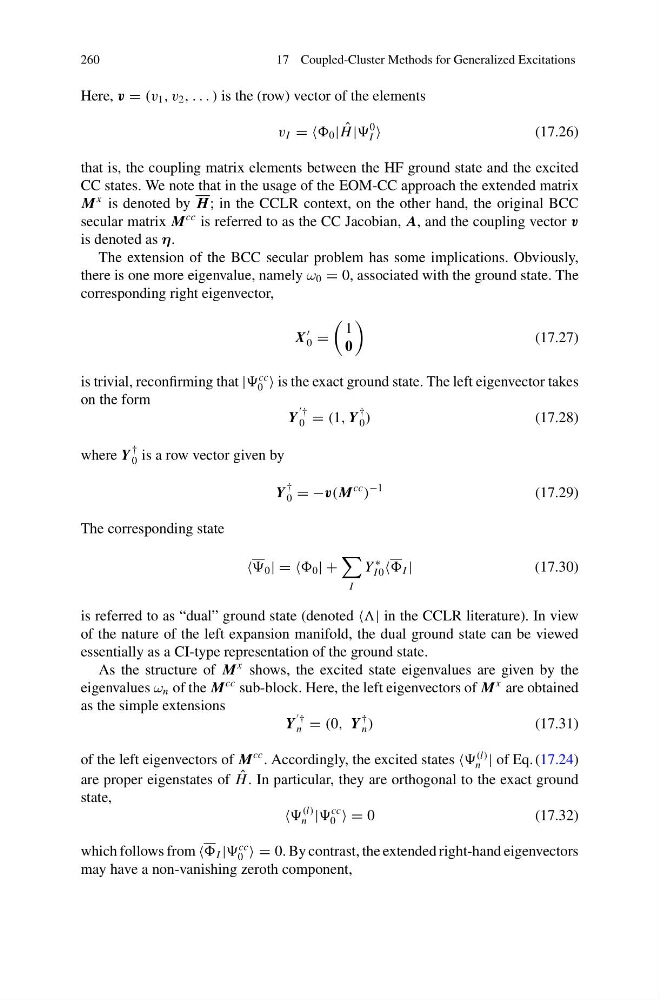
Here, v = (v 1 , v 2 , . . . ) is the (row) vector of the elements
v I = = 0 | ˆ
H |
0
I
(17.26)
that is, the coupling matrix elements between the HF ground state and the excited
CC states. We note that in the usage of the EOM-CC approach the extended matrix
M
x is denoted by H; in the CCLR context, on the other hand, the original BCC
secular matrix M
cc is referred to as the CC Jacobian, A, and the coupling vector v
is denoted as η.
The extension of the BCC secular problem has some implications. Obviously,
there is one more eigenvalue, namely ω 0 = 0, associated with the ground state. The
corresponding right eigenvector,
X
0 =
1
0
(17.27)
is trivial, reconfirming that |
cc
0 is the exact ground state. The left eigenvector takes
on the form
Y
†
0 = (1, Y
†
0 )
(17.28)
where Y
†
0 is a row vector given by
Y
†
0 = −v(M
cc
)
−1
(17.29)
The corresponding state
0 | = = 0 | +
I
Y
∗
I 0 I |
(17.30)
is referred to as “dual” ground state (denoted | in the CCLR literature). In view
of the nature of the left expansion manifold, the dual ground state can be viewed
essentially as a CI-type representation of the ground state.
As the structure of M
x shows, the excited state eigenvalues are given by the
eigenvalues ω n of the M
cc sub-block. Here, the left eigenvectors of M
x are obtained
as the simple extensions
Y
†
n = (0, Y
†
n )
(17.31)
of the left eigenvectors of M
cc . Accordingly, the excited states
(l)
n | of Eq. (17.24)
are proper eigenstates of ˆ
H . In particular, they are orthogonal to the exact ground
state,
(l)
n |
cc
0 = 0
(17.32)
which follows from I |
cc
0 = 0. By contrast, the extended right-hand eigenvectors
may have a non-vanishing zeroth component,
17 Coupled-Cluster Methods for Generalized Excitations
Here, v = (v 1 , v 2 , . . . ) is the (row) vector of the elements
v I = = 0 | ˆ
H |
0
I
(17.26)
that is, the coupling matrix elements between the HF ground state and the excited
CC states. We note that in the usage of the EOM-CC approach the extended matrix
M
x is denoted by H; in the CCLR context, on the other hand, the original BCC
secular matrix M
cc is referred to as the CC Jacobian, A, and the coupling vector v
is denoted as η.
The extension of the BCC secular problem has some implications. Obviously,
there is one more eigenvalue, namely ω 0 = 0, associated with the ground state. The
corresponding right eigenvector,
X
0 =
1
0
(17.27)
is trivial, reconfirming that |
cc
0 is the exact ground state. The left eigenvector takes
on the form
Y
†
0 = (1, Y
†
0 )
(17.28)
where Y
†
0 is a row vector given by
Y
†
0 = −v(M
cc
)
−1
(17.29)
The corresponding state
0 | = = 0 | +
I
Y
∗
I 0 I |
(17.30)
is referred to as “dual” ground state (denoted | in the CCLR literature). In view
of the nature of the left expansion manifold, the dual ground state can be viewed
essentially as a CI-type representation of the ground state.
As the structure of M
x shows, the excited state eigenvalues are given by the
eigenvalues ω n of the M
cc sub-block. Here, the left eigenvectors of M
x are obtained
as the simple extensions
Y
†
n = (0, Y
†
n )
(17.31)
of the left eigenvectors of M
cc . Accordingly, the excited states
(l)
n | of Eq. (17.24)
are proper eigenstates of ˆ
H . In particular, they are orthogonal to the exact ground
state,
(l)
n |
cc
0 = 0
(17.32)
which follows from I |
cc
0 = 0. By contrast, the extended right-hand eigenvectors
may have a non-vanishing zeroth component,