

17.2 Biorthogonal Coupled-Cluster Representation
261
X
n =
x n
X n
(17.33)
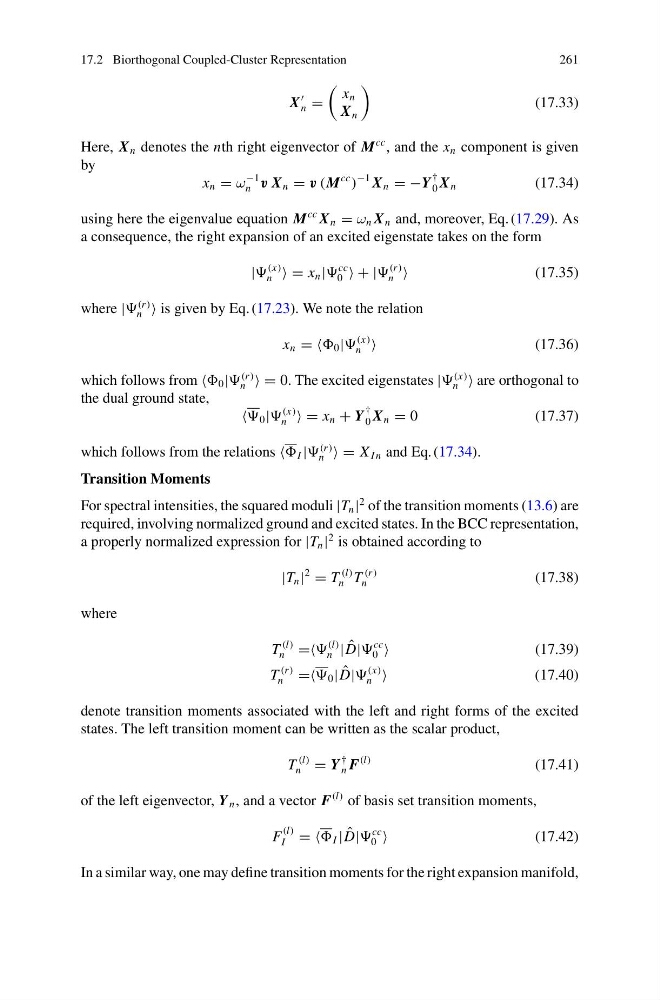
Here, X n denotes the nth right eigenvector of M
cc , and the x n component is given
by
x n = ω
−1
n v X n = v (M
cc
)
−1 X n = −Y
†
0 X n
(17.34)
using here the eigenvalue equation M
cc X n = ω n X n and, moreover, Eq. (17.29). As
a consequence, the right expansion of an excited eigenstate takes on the form
|
(x)
n = x n |
cc
0 + |
(r )
n
(17.35)
where |
(r )
n is given by Eq. (17.23). We note the relation
x n = = 0 |
(x)
n
(17.36)
which follows from 0 |
(r )
n = 0. The excited eigenstates |
(x)
n are orthogonal to
the dual ground state,
0 |
(x)
n = x n + Y
†
0 X n = 0
(17.37)
which follows from the relations I |
(r )
n = X I n and Eq. (17.34).
Transition Moments
For spectral intensities, the squared moduli |T n |
2 of the transition moments (13.6) are
required, involving normalized ground and excited states. In the BCC representation,
a properly normalized expression for |T n |
2 is obtained according to
|T n |
2
= T
(l)
n T
(r )
n
(17.38)
where
T
(l)
n ==
(l)
n | ˆ
D|
cc
0
(17.39)
T
(r )
n == 0 | ˆ
D|
(x)
n
(17.40)
denote transition moments associated with the left and right forms of the excited
states. The left transition moment can be written as the scalar product,
T
(l)
n = Y
†
n F
(l)
(17.41)
of the left eigenvector, Y n , and a vector F
(l) of basis set transition moments,
F
(l)
I = = I | ˆ
D|
cc
0
(17.42)
In a similar way, one may define transition moments for the right expansion manifold,
261
X
n =
x n
X n
(17.33)
Here, X n denotes the nth right eigenvector of M
cc , and the x n component is given
by
x n = ω
−1
n v X n = v (M
cc
)
−1 X n = −Y
†
0 X n
(17.34)
using here the eigenvalue equation M
cc X n = ω n X n and, moreover, Eq. (17.29). As
a consequence, the right expansion of an excited eigenstate takes on the form
|
(x)
n = x n |
cc
0 + |
(r )
n
(17.35)
where |
(r )
n is given by Eq. (17.23). We note the relation
x n = = 0 |
(x)
n
(17.36)
which follows from 0 |
(r )
n = 0. The excited eigenstates |
(x)
n are orthogonal to
the dual ground state,
0 |
(x)
n = x n + Y
†
0 X n = 0
(17.37)
which follows from the relations I |
(r )
n = X I n and Eq. (17.34).
Transition Moments
For spectral intensities, the squared moduli |T n |
2 of the transition moments (13.6) are
required, involving normalized ground and excited states. In the BCC representation,
a properly normalized expression for |T n |
2 is obtained according to
|T n |
2
= T
(l)
n T
(r )
n
(17.38)
where
T
(l)
n ==
(l)
n | ˆ
D|
cc
0
(17.39)
T
(r )
n == 0 | ˆ
D|
(x)
n
(17.40)
denote transition moments associated with the left and right forms of the excited
states. The left transition moment can be written as the scalar product,
T
(l)
n = Y
†
n F
(l)
(17.41)
of the left eigenvector, Y n , and a vector F
(l) of basis set transition moments,
F
(l)
I = = I | ˆ
D|
cc
0
(17.42)
In a similar way, one may define transition moments for the right expansion manifold,