

17.2 Biorthogonal Coupled-Cluster Representation
259
that is, a linear combination of I | and CI excitations of lower classes, [K ] =
1, . . . , [I ] − 1 (including | 0 as a zeroth class in the case of N -electron excitations).
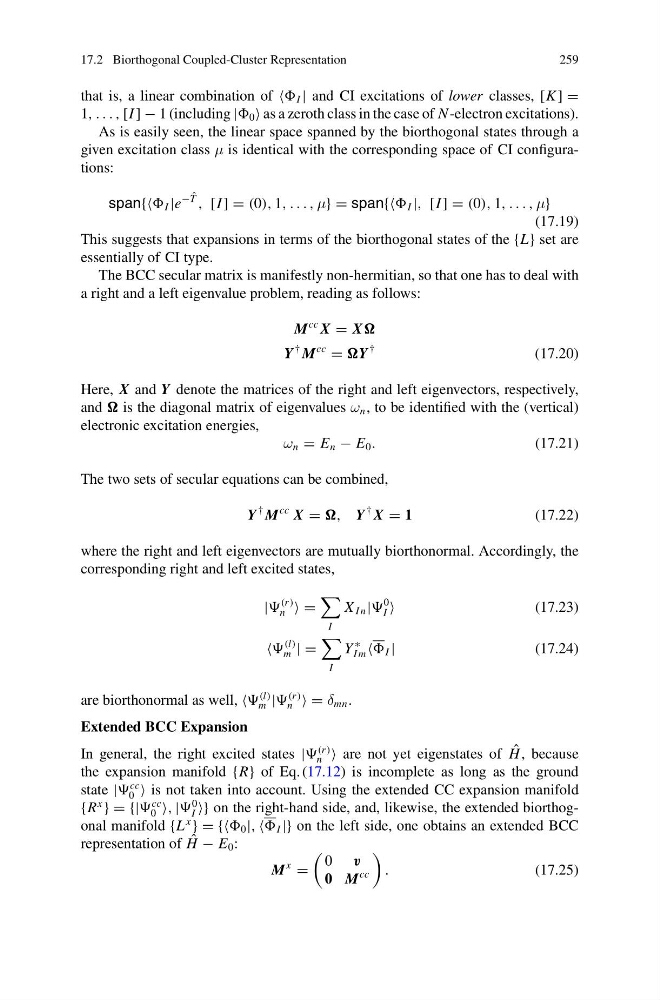
As is easily seen, the linear space spanned by the biorthogonal states through a
given excitation class μ is identical with the corresponding space of CI configurations:
span{{ I |e
− ˆ
T
, [I ] = (0), 1, . . . , μ} = span{{ I |, [I ] = (0), 1, . . . , μ}
(17.19)
This suggests that expansions in terms of the biorthogonal states of the {L} set are
essentially of CI type.
The BCC secular matrix is manifestly non-hermitian, so that one has to deal with
a right and a left eigenvalue problem, reading as follows:
M
cc X = X
Y
† M
cc
= Y
†
(17.20)
Here, X and Y denote the matrices of the right and left eigenvectors, respectively,
and is the diagonal matrix of eigenvalues ω n , to be identified with the (vertical)
electronic excitation energies,
ω n = E n − E 0 .
(17.21)
The two sets of secular equations can be combined,
Y
† M
cc X = , Y
† X = 1
(17.22)
where the right and left eigenvectors are mutually biorthonormal. Accordingly, the
corresponding right and left excited states,
|
(r )
n =
I
X I n |
0
I
(17.23)
(l)
m | =
I
Y
∗
I m I |
(17.24)
are biorthonormal as well,
(l)
m |
(r )
n = δ mn .
Extended BCC Expansion
In general, the right excited states |
(r )
n are not yet eigenstates of ˆ
H , because
the expansion manifold {R} of Eq. (17.12) is incomplete as long as the ground
state |
cc
0 is not taken into account. Using the extended CC expansion manifold
{R
x
} = {|
cc
0 , |
0
I } on the right-hand side, and, likewise, the extended biorthogonal manifold {L
x
} = {{ 0 |, I |} on the left side, one obtains an extended BCC
representation of ˆ
H − E 0 :
M
x
=
0 v
0 M
cc
.
(17.25)
259
that is, a linear combination of I | and CI excitations of lower classes, [K ] =
1, . . . , [I ] − 1 (including | 0 as a zeroth class in the case of N -electron excitations).
As is easily seen, the linear space spanned by the biorthogonal states through a
given excitation class μ is identical with the corresponding space of CI configurations:
span{{ I |e
− ˆ
T
, [I ] = (0), 1, . . . , μ} = span{{ I |, [I ] = (0), 1, . . . , μ}
(17.19)
This suggests that expansions in terms of the biorthogonal states of the {L} set are
essentially of CI type.
The BCC secular matrix is manifestly non-hermitian, so that one has to deal with
a right and a left eigenvalue problem, reading as follows:
M
cc X = X
Y
† M
cc
= Y
†
(17.20)
Here, X and Y denote the matrices of the right and left eigenvectors, respectively,
and is the diagonal matrix of eigenvalues ω n , to be identified with the (vertical)
electronic excitation energies,
ω n = E n − E 0 .
(17.21)
The two sets of secular equations can be combined,
Y
† M
cc X = , Y
† X = 1
(17.22)
where the right and left eigenvectors are mutually biorthonormal. Accordingly, the
corresponding right and left excited states,
|
(r )
n =
I
X I n |
0
I
(17.23)
(l)
m | =
I
Y
∗
I m I |
(17.24)
are biorthonormal as well,
(l)
m |
(r )
n = δ mn .
Extended BCC Expansion
In general, the right excited states |
(r )
n are not yet eigenstates of ˆ
H , because
the expansion manifold {R} of Eq. (17.12) is incomplete as long as the ground
state |
cc
0 is not taken into account. Using the extended CC expansion manifold
{R
x
} = {|
cc
0 , |
0
I } on the right-hand side, and, likewise, the extended biorthogonal manifold {L
x
} = {{ 0 |, I |} on the left side, one obtains an extended BCC
representation of ˆ
H − E 0 :
M
x
=
0 v
0 M
cc
.
(17.25)