

258
17 Coupled-Cluster Methods for Generalized Excitations
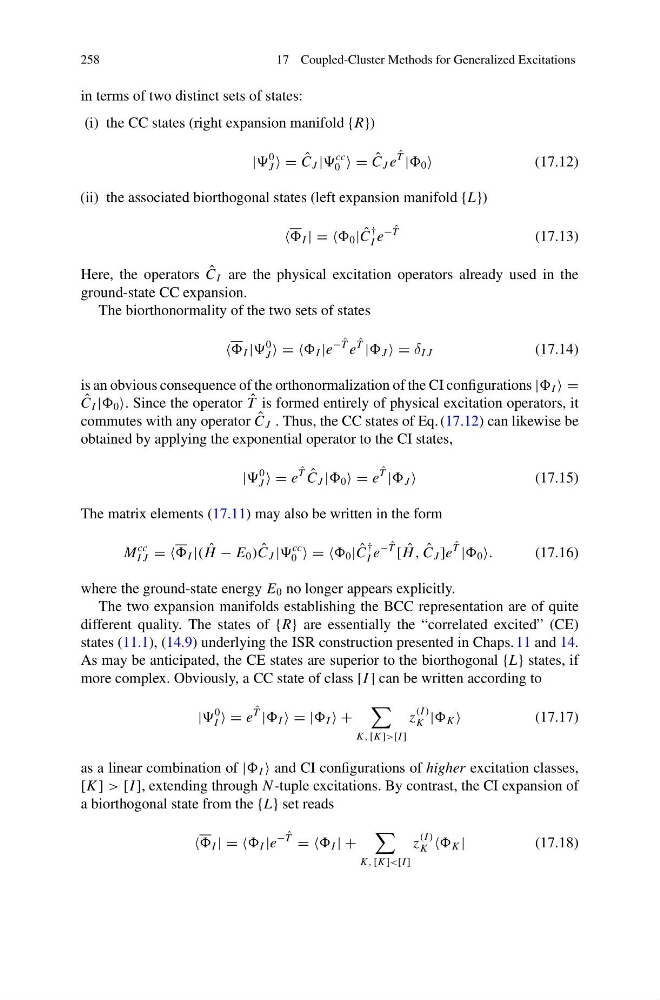
in terms of two distinct sets of states:
(i) the CC states (right expansion manifold {R})
|
0
J = ˆ
C J |
cc
0 = ˆ
C J e
ˆ
T
| 0
(17.12)
(ii) the associated biorthogonal states (left expansion manifold {L})
I | = = 0 | ˆ
C
†
I e
− ˆ
T
(17.13)
Here, the operators ˆ
C I are the physical excitation operators already used in the
ground-state CC expansion.
The biorthonormality of the two sets of states
I |
0
J = = I |e
− ˆ
T e
ˆ
T
| J = δ I J
(17.14)
is an obvious consequence of the orthonormalization of the CI configurations | I =
ˆ
C I | 0 . Since the operator ˆ
T is formed entirely of physical excitation operators, it
commutes with any operator ˆ
C J . Thus, the CC states of Eq. (17.12) can likewise be
obtained by applying the exponential operator to the CI states,
|
0
J = e
ˆ
T ˆ
C J | 0 = e
ˆ
T
| J
(17.15)
The matrix elements (17.11) may also be written in the form
M
cc
I J = = I |( ˆ
H − E 0 ) ˆ
C J |
cc
0 = = 0 | ˆ
C
†
I e
− ˆ
T
[ ˆ
H , ˆ
C J ]e
ˆ
T
| 0 .
(17.16)
where the ground-state energy E 0 no longer appears explicitly.
The two expansion manifolds establishing the BCC representation are of quite
different quality. The states of {R} are essentially the “correlated excited” (CE)
states (11.1), (14.9) underlying the ISR construction presented in Chaps. 11 and 14.
As may be anticipated, the CE states are superior to the biorthogonal {L} states, if
more complex. Obviously, a CC state of class [I ] can be written according to
|
0
I = e
ˆ
T
| I = | I +
K , [K ]>[I ]
z
(I )
K | K
(17.17)
as a linear combination of | I and CI configurations of higher excitation classes,
[K ] > [I ], extending through N -tuple excitations. By contrast, the CI expansion of
a biorthogonal state from the {L} set reads
I | = = I |e
− ˆ
T
= = I | +
K , [K ]<[I ]
z
(I )
K K |
(17.18)
17 Coupled-Cluster Methods for Generalized Excitations
in terms of two distinct sets of states:
(i) the CC states (right expansion manifold {R})
|
0
J = ˆ
C J |
cc
0 = ˆ
C J e
ˆ
T
| 0
(17.12)
(ii) the associated biorthogonal states (left expansion manifold {L})
I | = = 0 | ˆ
C
†
I e
− ˆ
T
(17.13)
Here, the operators ˆ
C I are the physical excitation operators already used in the
ground-state CC expansion.
The biorthonormality of the two sets of states
I |
0
J = = I |e
− ˆ
T e
ˆ
T
| J = δ I J
(17.14)
is an obvious consequence of the orthonormalization of the CI configurations | I =
ˆ
C I | 0 . Since the operator ˆ
T is formed entirely of physical excitation operators, it
commutes with any operator ˆ
C J . Thus, the CC states of Eq. (17.12) can likewise be
obtained by applying the exponential operator to the CI states,
|
0
J = e
ˆ
T ˆ
C J | 0 = e
ˆ
T
| J
(17.15)
The matrix elements (17.11) may also be written in the form
M
cc
I J = = I |( ˆ
H − E 0 ) ˆ
C J |
cc
0 = = 0 | ˆ
C
†
I e
− ˆ
T
[ ˆ
H , ˆ
C J ]e
ˆ
T
| 0 .
(17.16)
where the ground-state energy E 0 no longer appears explicitly.
The two expansion manifolds establishing the BCC representation are of quite
different quality. The states of {R} are essentially the “correlated excited” (CE)
states (11.1), (14.9) underlying the ISR construction presented in Chaps. 11 and 14.
As may be anticipated, the CE states are superior to the biorthogonal {L} states, if
more complex. Obviously, a CC state of class [I ] can be written according to
|
0
I = e
ˆ
T
| I = | I +
K , [K ]>[I ]
z
(I )
K | K
(17.17)
as a linear combination of | I and CI configurations of higher excitation classes,
[K ] > [I ], extending through N -tuple excitations. By contrast, the CI expansion of
a biorthogonal state from the {L} set reads
I | = = I |e
− ˆ
T
= = I | +
K , [K ]<[I ]
z
(I )
K K |
(17.18)