

1.2 Matrix Elements for Many-Electron States
13
V pq[rs] = V pqrs − V pqsr
(1.53)
Equation (1.52) constitutes the first SC rule (c1) for the two-particle matrix elements.
(ii) Slater determinants differing at one position:
The matrix element
| ˆ
V | for the two Slater determinants (1.39) and (1.43),
differing at the kth position, can be evaluated as above, yielding
| ˆ
V | =
P
(−1)
P
q 1 | . . . q
| . . . q N |
i< j
ˆ
v(i, j)|q P(1) . . . |q P(N )
where q
is at the kth position of the Slater determinant on the left. If q
does not
enter the two-particle integral, that is, if i, j = k, there will be a vanishing overlap
factor, q
|q P(k) = 0, irrespective of the permutation P. This means that the double summation running over the orbital indices i < j becomes a single summation
according to
i< j
→
i
+
j>k
i=k
This gives
| ˆ
V | =
i
(−1)
P
q i q
| ˆ
v|q P(i) q P(k)
l =i,k
q l |q P(l)
+
j>k
P
(−1)
P
q
q j | ˆ
v|q P(k) q P( j)
l = j,k
q l |q P(l)
(1.54)
Let us consider the first term (A) on the right-hand side. The overlap product restricts
the permutations to the identical permutation and the transposition
P(i) = k,
P(k) = i
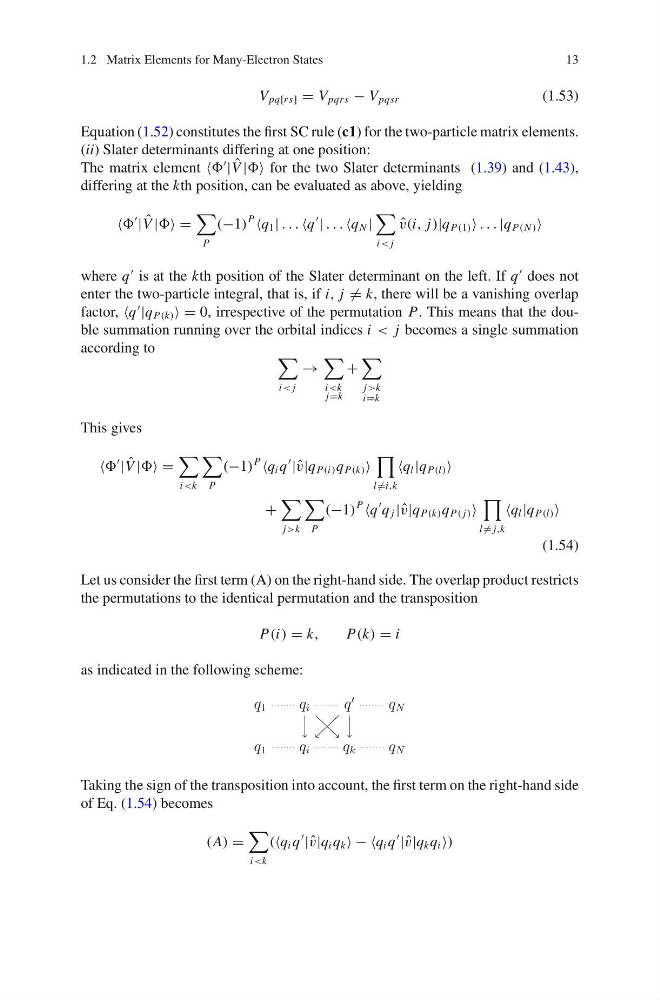
as indicated in the following scheme:
Taking the sign of the transposition into account, the first term on the right-hand side
of Eq. (1.54) becomes
(A) =
i
| ˆ
v|q i q k − −q i q
| ˆ
v|q k q i )
13
V pq[rs] = V pqrs − V pqsr
(1.53)
Equation (1.52) constitutes the first SC rule (c1) for the two-particle matrix elements.
(ii) Slater determinants differing at one position:
The matrix element
| ˆ
V | for the two Slater determinants (1.39) and (1.43),
differing at the kth position, can be evaluated as above, yielding
| ˆ
V | =
P
(−1)
P
q 1 | . . . q
| . . . q N |
i< j
ˆ
v(i, j)|q P(1) . . . |q P(N )
where q
is at the kth position of the Slater determinant on the left. If q
does not
enter the two-particle integral, that is, if i, j = k, there will be a vanishing overlap
factor, q
|q P(k) = 0, irrespective of the permutation P. This means that the double summation running over the orbital indices i < j becomes a single summation
according to
i< j
→
i
+
j>k
i=k
This gives
| ˆ
V | =
i
(−1)
P
q i q
| ˆ
v|q P(i) q P(k)
l =i,k
q l |q P(l)
+
j>k
P
(−1)
P
q
q j | ˆ
v|q P(k) q P( j)
l = j,k
q l |q P(l)
(1.54)
Let us consider the first term (A) on the right-hand side. The overlap product restricts
the permutations to the identical permutation and the transposition
P(i) = k,
P(k) = i
as indicated in the following scheme:
Taking the sign of the transposition into account, the first term on the right-hand side
of Eq. (1.54) becomes
(A) =
i
| ˆ
v|q i q k − −q i q
| ˆ
v|q k q i )