

12
1 Systems of Identical Particles
(i) Expectation values:
Like in the case of the one-particle operator, we may use the operator identity ˆ
A
† ˆ
V ˆ
A =
ˆ
V ˆ
A, which allows us to write
| ˆ
V | = N !!q 1 | . . . q N | ˆ
V ˆ
A|q 1 . . . |q N
=
P
(−1)
P
q 1 | . . . q N |
i< j
ˆ
v(i, j) |q P(1) . . . |q P(N )
=
i< j
P
(−1)
P
q i q j | ˆ
v|q P(i) q P( j)
k =i, j
q k |q P(k)
(1.49)
where
pq| ˆ
v|rs =
dξ 1 dξ 2 ψ
∗
p (ξ 1 )ψ
∗
q (ξ 2 ) ˆ
v(ξ 1 , ξ 2 )ψ r (ξ 1 )ψ s (ξ 2 )
(1.50)
denotes the two-particle matrix element, involving the four spin-orbitals p, q, r, s;
we shall also use the familiar shorthand notation
V pqrs = =pq| ˆ
v|rs
(1.51)
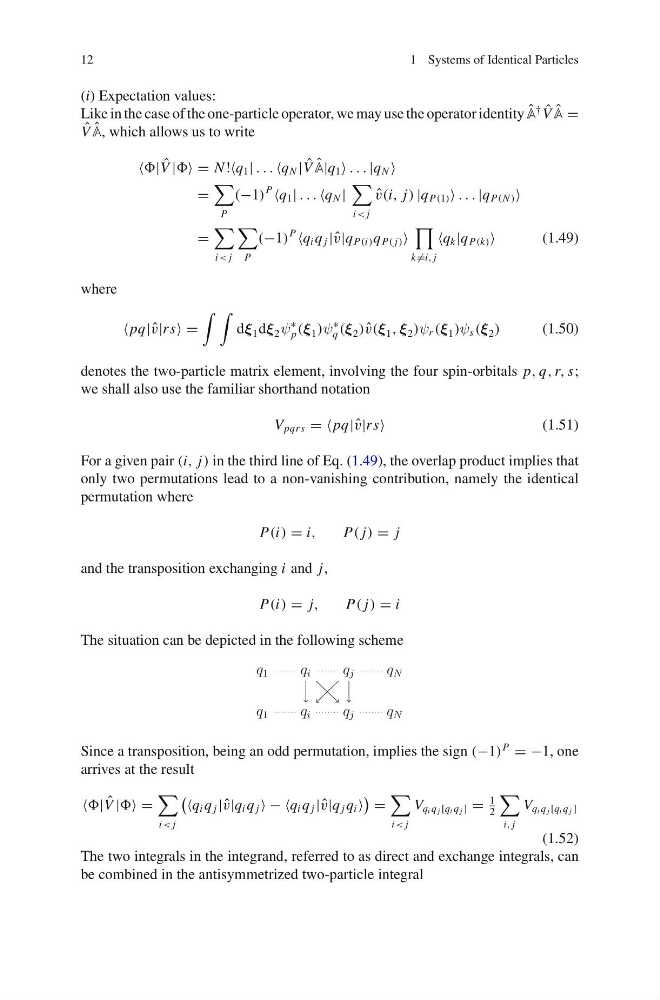
For a given pair (i, j) in the third line of Eq. (1.49), the overlap product implies that
only two permutations lead to a non-vanishing contribution, namely the identical
permutation where
P(i) = i,
P( j) = j
and the transposition exchanging i and j,
P(i) = j,
P( j) = i
The situation can be depicted in the following scheme
Since a transposition, being an odd permutation, implies the sign (−1)
P
= −1, one
arrives at the result
| ˆ
V | =
i< j
q i q j | ˆ
v|q i q j − −q i q j | ˆ
v|q j q i
=
i< j
V q i q j [q i q j ] =
1
2
i, j
V q i q j [q i q j ]
(1.52)
The two integrals in the integrand, referred to as direct and exchange integrals, can
be combined in the antisymmetrized two-particle integral
1 Systems of Identical Particles
(i) Expectation values:
Like in the case of the one-particle operator, we may use the operator identity ˆ
A
† ˆ
V ˆ
A =
ˆ
V ˆ
A, which allows us to write
| ˆ
V | = N !!q 1 | . . . q N | ˆ
V ˆ
A|q 1 . . . |q N
=
P
(−1)
P
q 1 | . . . q N |
i< j
ˆ
v(i, j) |q P(1) . . . |q P(N )
=
i< j
P
(−1)
P
q i q j | ˆ
v|q P(i) q P( j)
k =i, j
q k |q P(k)
(1.49)
where
pq| ˆ
v|rs =
dξ 1 dξ 2 ψ
∗
p (ξ 1 )ψ
∗
q (ξ 2 ) ˆ
v(ξ 1 , ξ 2 )ψ r (ξ 1 )ψ s (ξ 2 )
(1.50)
denotes the two-particle matrix element, involving the four spin-orbitals p, q, r, s;
we shall also use the familiar shorthand notation
V pqrs = =pq| ˆ
v|rs
(1.51)
For a given pair (i, j) in the third line of Eq. (1.49), the overlap product implies that
only two permutations lead to a non-vanishing contribution, namely the identical
permutation where
P(i) = i,
P( j) = j
and the transposition exchanging i and j,
P(i) = j,
P( j) = i
The situation can be depicted in the following scheme
Since a transposition, being an odd permutation, implies the sign (−1)
P
= −1, one
arrives at the result
| ˆ
V | =
i< j
q i q j | ˆ
v|q i q j − −q i q j | ˆ
v|q j q i
=
i< j
V q i q j [q i q j ] =
1
2
i, j
V q i q j [q i q j ]
(1.52)
The two integrals in the integrand, referred to as direct and exchange integrals, can
be combined in the antisymmetrized two-particle integral