

1.2 Matrix Elements for Many-Electron States
11
Here,
p| ˆ
w|q =
ψ
∗
p (ξ) ˆ
w ψ q (ξ)dξ
(1.46)
denotes the one-particle matrix element for the spin-orbitals p and q. As in the case
of the scalar products, the product of overlap factors vanishes for all permutations
except for the identical permutation, giving rise to the simple final result in the second line of Eq. (1.45). This constitutes the first SC rule (b1) for matrix elements of
a one-particle operator.
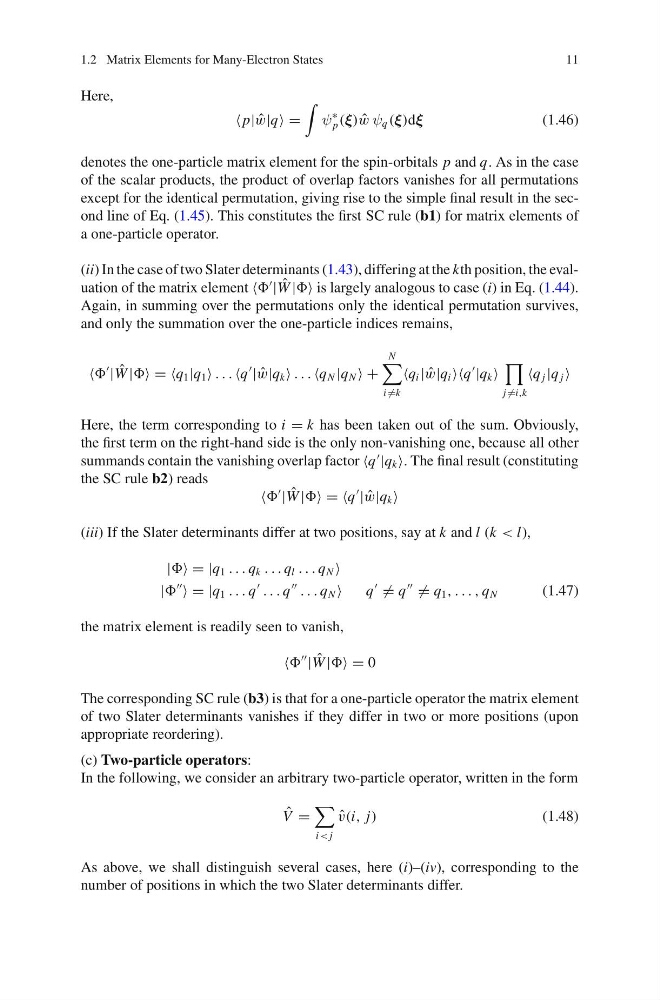
(ii) In the case of two Slater determinants (1.43), differing at the kth position, the evaluation of the matrix element
| ˆ
W | is largely analogous to case (i) in Eq. (1.44).
Again, in summing over the permutations only the identical permutation survives,
and only the summation over the one-particle indices remains,
| ˆ
W | = =q 1 |q 1 . . . q
| ˆ
w|q k . . . q N |q N +
N
i =k
q i | ˆ
w|q i q
|q k
j =i,k
q j |q j
Here, the term corresponding to i = k has been taken out of the sum. Obviously,
the first term on the right-hand side is the only non-vanishing one, because all other
summands contain the vanishing overlap factor q
|q k . The final result (constituting
the SC rule b2) reads
| ˆ
W | = =q
| ˆ
w|q k
(iii) If the Slater determinants differ at two positions, say at k and l (k < l),
| = |q 1 . . . q k . . . q l . . . q N
|
= |q 1 . . . q
. . . q
. . . q N
q
= q
= q 1 , . . . , q N
(1.47)
the matrix element is readily seen to vanish,
| ˆ
W | = 0
The corresponding SC rule (b3) is that for a one-particle operator the matrix element
of two Slater determinants vanishes if they differ in two or more positions (upon
appropriate reordering).
(c) Two-particle operators:
In the following, we consider an arbitrary two-particle operator, written in the form
ˆ
V =
i< j
ˆ
v(i, j)
(1.48)
As above, we shall distinguish several cases, here (i)–(iv), corresponding to the
number of positions in which the two Slater determinants differ.
11
Here,
p| ˆ
w|q =
ψ
∗
p (ξ) ˆ
w ψ q (ξ)dξ
(1.46)
denotes the one-particle matrix element for the spin-orbitals p and q. As in the case
of the scalar products, the product of overlap factors vanishes for all permutations
except for the identical permutation, giving rise to the simple final result in the second line of Eq. (1.45). This constitutes the first SC rule (b1) for matrix elements of
a one-particle operator.
(ii) In the case of two Slater determinants (1.43), differing at the kth position, the evaluation of the matrix element
| ˆ
W | is largely analogous to case (i) in Eq. (1.44).
Again, in summing over the permutations only the identical permutation survives,
and only the summation over the one-particle indices remains,
| ˆ
W | = =q 1 |q 1 . . . q
| ˆ
w|q k . . . q N |q N +
N
i =k
q i | ˆ
w|q i q
|q k
j =i,k
q j |q j
Here, the term corresponding to i = k has been taken out of the sum. Obviously,
the first term on the right-hand side is the only non-vanishing one, because all other
summands contain the vanishing overlap factor q
|q k . The final result (constituting
the SC rule b2) reads
| ˆ
W | = =q
| ˆ
w|q k
(iii) If the Slater determinants differ at two positions, say at k and l (k < l),
| = |q 1 . . . q k . . . q l . . . q N
|
= |q 1 . . . q
. . . q
. . . q N
q
= q
= q 1 , . . . , q N
(1.47)
the matrix element is readily seen to vanish,
| ˆ
W | = 0
The corresponding SC rule (b3) is that for a one-particle operator the matrix element
of two Slater determinants vanishes if they differ in two or more positions (upon
appropriate reordering).
(c) Two-particle operators:
In the following, we consider an arbitrary two-particle operator, written in the form
ˆ
V =
i< j
ˆ
v(i, j)
(1.48)
As above, we shall distinguish several cases, here (i)–(iv), corresponding to the
number of positions in which the two Slater determinants differ.