

10
1 Systems of Identical Particles
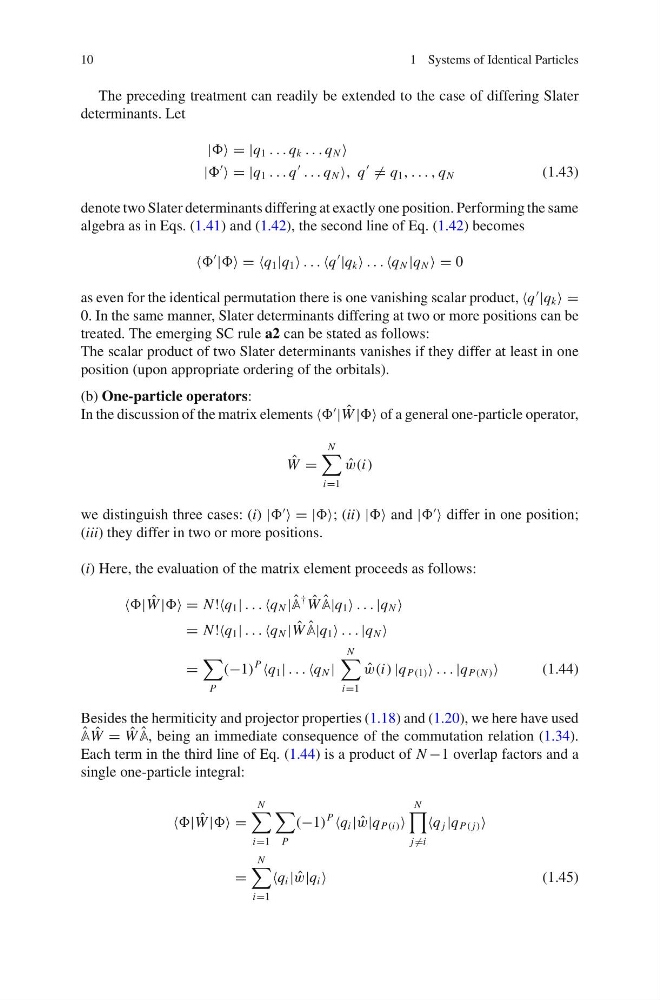
The preceding treatment can readily be extended to the case of differing Slater
determinants. Let
| = |q 1 . . . q k . . . q N
|
= |q 1 . . . q
. . . q N , q
= q 1 , . . . , q N
(1.43)
denote two Slater determinants differing at exactly one position. Performing the same
algebra as in Eqs. (1.41) and (1.42), the second line of Eq. (1.42) becomes
| = =q 1 |q 1 . . . q
|q k . . . q N |q N = 0
as even for the identical permutation there is one vanishing scalar product, q
|q k =
0. In the same manner, Slater determinants differing at two or more positions can be
treated. The emerging SC rule a2 can be stated as follows:
The scalar product of two Slater determinants vanishes if they differ at least in one
position (upon appropriate ordering of the orbitals).
(b) One-particle operators:
In the discussion of the matrix elements
| ˆ
W | of a general one-particle operator,
ˆ
W =
N
i=1
ˆ
w(i)
we distinguish three cases: (i) |
= |; (ii) | and |
differ in one position;
(iii) they differ in two or more positions.
(i) Here, the evaluation of the matrix element proceeds as follows:
| ˆ
W | = N !!q 1 | . . . q N | ˆ
A
† ˆ
W ˆ
A|q 1 . . . |q N
= N !!q 1 | . . . q N | ˆ
W ˆ
A|q 1 . . . |q N
=
P
(−1)
P
q 1 | . . . q N |
N
i=1
ˆ
w(i) |q P(1) . . . |q P(N )
(1.44)
Besides the hermiticity and projector properties (1.18) and (1.20), we here have used
ˆ
A ˆ
W = ˆ
W ˆ
A, being an immediate consequence of the commutation relation (1.34).
Each term in the third line of Eq. (1.44) is a product of N −1 overlap factors and a
single one-particle integral:
| ˆ
W | =
N
i=1
P
(−1)
P
q i | ˆ
w|q P(i)
N
j =i
q j |q P( j)
=
N
i=1
q i | ˆ
w|q i
(1.45)
1 Systems of Identical Particles
The preceding treatment can readily be extended to the case of differing Slater
determinants. Let
| = |q 1 . . . q k . . . q N
|
= |q 1 . . . q
. . . q N , q
= q 1 , . . . , q N
(1.43)
denote two Slater determinants differing at exactly one position. Performing the same
algebra as in Eqs. (1.41) and (1.42), the second line of Eq. (1.42) becomes
| = =q 1 |q 1 . . . q
|q k . . . q N |q N = 0
as even for the identical permutation there is one vanishing scalar product, q
|q k =
0. In the same manner, Slater determinants differing at two or more positions can be
treated. The emerging SC rule a2 can be stated as follows:
The scalar product of two Slater determinants vanishes if they differ at least in one
position (upon appropriate ordering of the orbitals).
(b) One-particle operators:
In the discussion of the matrix elements
| ˆ
W | of a general one-particle operator,
ˆ
W =
N
i=1
ˆ
w(i)
we distinguish three cases: (i) |
= |; (ii) | and |
differ in one position;
(iii) they differ in two or more positions.
(i) Here, the evaluation of the matrix element proceeds as follows:
| ˆ
W | = N !!q 1 | . . . q N | ˆ
A
† ˆ
W ˆ
A|q 1 . . . |q N
= N !!q 1 | . . . q N | ˆ
W ˆ
A|q 1 . . . |q N
=
P
(−1)
P
q 1 | . . . q N |
N
i=1
ˆ
w(i) |q P(1) . . . |q P(N )
(1.44)
Besides the hermiticity and projector properties (1.18) and (1.20), we here have used
ˆ
A ˆ
W = ˆ
W ˆ
A, being an immediate consequence of the commutation relation (1.34).
Each term in the third line of Eq. (1.44) is a product of N −1 overlap factors and a
single one-particle integral:
| ˆ
W | =
N
i=1
P
(−1)
P
q i | ˆ
w|q P(i)
N
j =i
q j |q P( j)
=
N
i=1
q i | ˆ
w|q i
(1.45)