

1.1 Many-Electron Wave Functions
9
ˆ
V =
1
2
i = j
ˆ
v(i, j)
(1.38)
being a two-particle operator. It should be noted that ˆ
H is spin-independent; that
is, its constituents act exclusively on the spatial coordinates of the electrons. Spindependent terms come into play when relativistic effects are taken into consideration.
1.2 Matrix Elements for Many-Electron States
In dealing with many-particle systems, the handling of matrix elements involving
Slater determinants is required. The basic tool here is a set of simple rules, referred
to as Slater–Condon rules, which we consider in the following.
Let us consider a general Slater determinant
| = |q 1 . . . q N
(1.39)
corresponding to a specific choice of one-particle states of a given orthonormal basis
set {|q}. We shall specifically address three cases, namely (a) scalar products, (b)
matrix elements of one-particle operators, and (c) matrix elements of two-particle
operators.
(a) Scalar products:
Let us first consider the scalar product |:
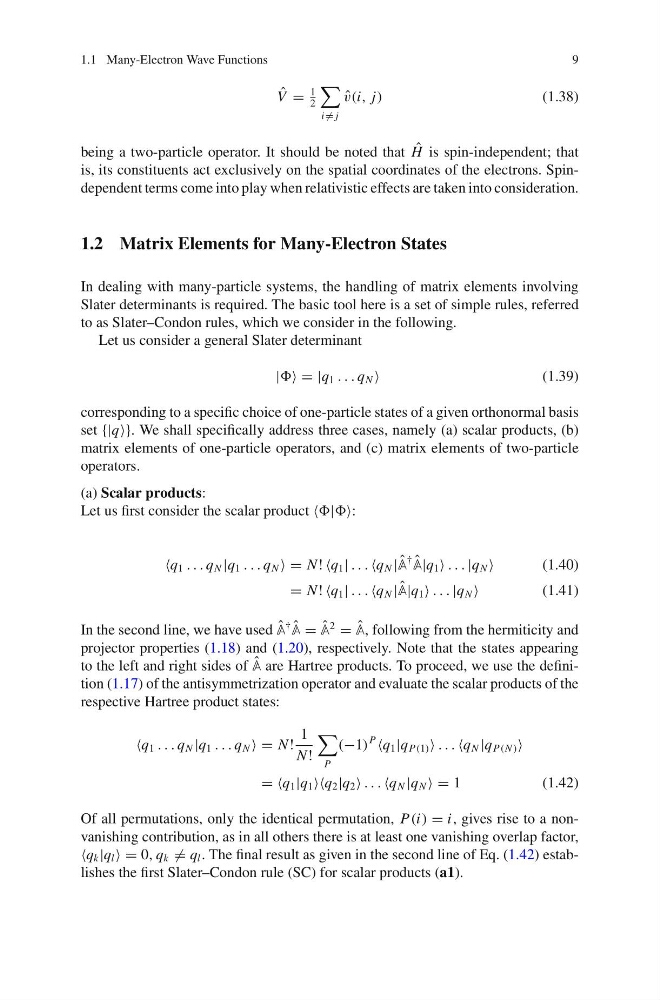
q 1 . . . q N |q 1 . . . q N = N ! !q 1 | . . . q N | ˆ
A
† ˆ
A|q 1 . . . |q N
(1.40)
= N ! !q 1 | . . . q N | ˆ
A|q 1 . . . |q N
(1.41)
In the second line, we have used ˆ
A
† ˆ
A = ˆ
A
2
= ˆ
A, following from the hermiticity and
projector properties (1.18) and (1.20), respectively. Note that the states appearing
to the left and right sides of ˆ
A are Hartree products. To proceed, we use the definition (1.17) of the antisymmetrization operator and evaluate the scalar products of the
respective Hartree product states:
q 1 . . . q N |q 1 . . . q N = N !
1
N !
P
(−1)
P
q 1 |q P(1) . . . q N |q P(N )
= =q 1 |q 1 q 2 |q 2 . . . q N |q N = 1
(1.42)
Of all permutations, only the identical permutation, P(i) = i, gives rise to a nonvanishing contribution, as in all others there is at least one vanishing overlap factor,
q k |q l = 0, q k = q l . The final result as given in the second line of Eq. (1.42) establishes the first Slater–Condon rule (SC) for scalar products (a1).
9
ˆ
V =
1
2
i = j
ˆ
v(i, j)
(1.38)
being a two-particle operator. It should be noted that ˆ
H is spin-independent; that
is, its constituents act exclusively on the spatial coordinates of the electrons. Spindependent terms come into play when relativistic effects are taken into consideration.
1.2 Matrix Elements for Many-Electron States
In dealing with many-particle systems, the handling of matrix elements involving
Slater determinants is required. The basic tool here is a set of simple rules, referred
to as Slater–Condon rules, which we consider in the following.
Let us consider a general Slater determinant
| = |q 1 . . . q N
(1.39)
corresponding to a specific choice of one-particle states of a given orthonormal basis
set {|q}. We shall specifically address three cases, namely (a) scalar products, (b)
matrix elements of one-particle operators, and (c) matrix elements of two-particle
operators.
(a) Scalar products:
Let us first consider the scalar product |:
q 1 . . . q N |q 1 . . . q N = N ! !q 1 | . . . q N | ˆ
A
† ˆ
A|q 1 . . . |q N
(1.40)
= N ! !q 1 | . . . q N | ˆ
A|q 1 . . . |q N
(1.41)
In the second line, we have used ˆ
A
† ˆ
A = ˆ
A
2
= ˆ
A, following from the hermiticity and
projector properties (1.18) and (1.20), respectively. Note that the states appearing
to the left and right sides of ˆ
A are Hartree products. To proceed, we use the definition (1.17) of the antisymmetrization operator and evaluate the scalar products of the
respective Hartree product states:
q 1 . . . q N |q 1 . . . q N = N !
1
N !
P
(−1)
P
q 1 |q P(1) . . . q N |q P(N )
= =q 1 |q 1 q 2 |q 2 . . . q N |q N = 1
(1.42)
Of all permutations, only the identical permutation, P(i) = i, gives rise to a nonvanishing contribution, as in all others there is at least one vanishing overlap factor,
q k |q l = 0, q k = q l . The final result as given in the second line of Eq. (1.42) establishes the first Slater–Condon rule (SC) for scalar products (a1).