

8
1 Systems of Identical Particles
For a complete basis set of one-particle states, the manifold of product states
|q 1 . . . q N , q 1 < q 2 < · · · < q N forms a basis of the Hilbert space of antisymmetric
N -electron states.
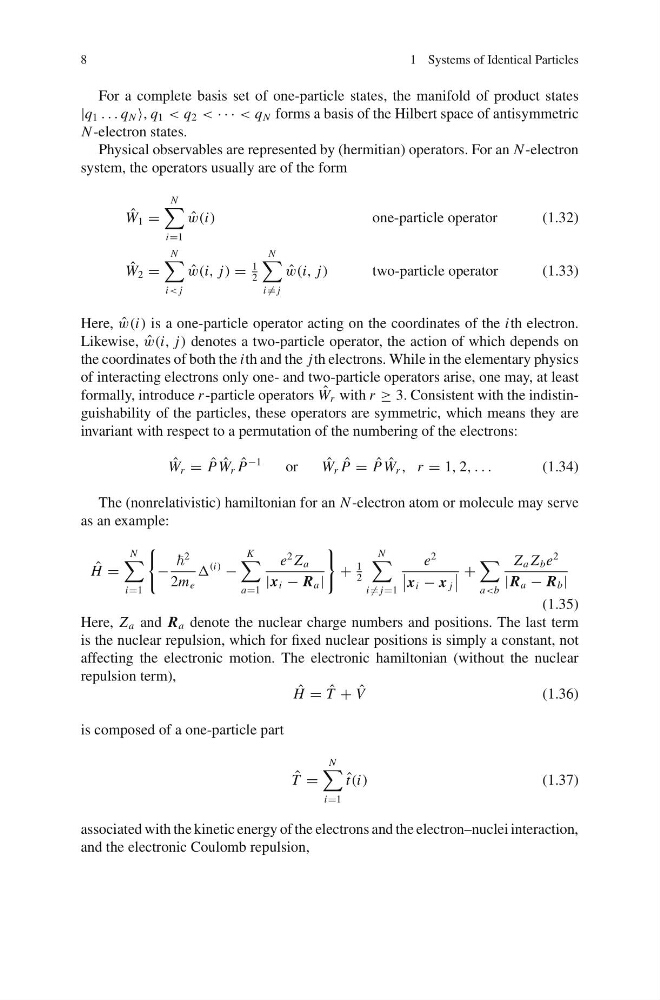
Physical observables are represented by (hermitian) operators. For an N -electron
system, the operators usually are of the form
ˆ
W 1 =
N
i=1
ˆ
w(i)
one-particle operator
(1.32)
ˆ
W 2 =
N
i< j
ˆ
w(i, j) =
1
2
N
i = j
ˆ
w(i, j)
two-particle operator
(1.33)
Here, ˆ
w(i) is a one-particle operator acting on the coordinates of the ith electron.
Likewise, ˆ
w(i, j) denotes a two-particle operator, the action of which depends on
the coordinates of both the ith and the jth electrons. While in the elementary physics
of interacting electrons only one- and two-particle operators arise, one may, at least
formally, introduce r -particle operators ˆ
W r with r ≥ 3. Consistent with the indistinguishability of the particles, these operators are symmetric, which means they are
invariant with respect to a permutation of the numbering of the electrons:
ˆ
W r = ˆ
P ˆ
W r ˆ
P
−1
or
ˆ
W r ˆ
P = ˆ
P ˆ
W r , r = 1, 2, . . .
(1.34)
The (nonrelativistic) hamiltonian for an N -electron atom or molecule may serve
as an example:
ˆ
H =
N
i=1
−
2
2m e
(i)
−
K
a=1
e
2 Z a
|x i − R a |
+
1
2
N
i = j=1
e
2
x i − x j
+
a
2
|R a − R b |
(1.35)
Here, Z a and R a denote the nuclear charge numbers and positions. The last term
is the nuclear repulsion, which for fixed nuclear positions is simply a constant, not
affecting the electronic motion. The electronic hamiltonian (without the nuclear
repulsion term),
ˆ
H = ˆ
T + ˆ
V
(1.36)
is composed of a one-particle part
ˆ
T =
N
i=1
ˆ
t(i)
(1.37)
associated with the kinetic energy of the electrons and the electron–nuclei interaction,
and the electronic Coulomb repulsion,
1 Systems of Identical Particles
For a complete basis set of one-particle states, the manifold of product states
|q 1 . . . q N , q 1 < q 2 < · · · < q N forms a basis of the Hilbert space of antisymmetric
N -electron states.
Physical observables are represented by (hermitian) operators. For an N -electron
system, the operators usually are of the form
ˆ
W 1 =
N
i=1
ˆ
w(i)
one-particle operator
(1.32)
ˆ
W 2 =
N
i< j
ˆ
w(i, j) =
1
2
N
i = j
ˆ
w(i, j)
two-particle operator
(1.33)
Here, ˆ
w(i) is a one-particle operator acting on the coordinates of the ith electron.
Likewise, ˆ
w(i, j) denotes a two-particle operator, the action of which depends on
the coordinates of both the ith and the jth electrons. While in the elementary physics
of interacting electrons only one- and two-particle operators arise, one may, at least
formally, introduce r -particle operators ˆ
W r with r ≥ 3. Consistent with the indistinguishability of the particles, these operators are symmetric, which means they are
invariant with respect to a permutation of the numbering of the electrons:
ˆ
W r = ˆ
P ˆ
W r ˆ
P
−1
or
ˆ
W r ˆ
P = ˆ
P ˆ
W r , r = 1, 2, . . .
(1.34)
The (nonrelativistic) hamiltonian for an N -electron atom or molecule may serve
as an example:
ˆ
H =
N
i=1
−
2
2m e
(i)
−
K
a=1
e
2 Z a
|x i − R a |
+
1
2
N
i = j=1
e
2
x i − x j
+
a
2
|R a − R b |
(1.35)
Here, Z a and R a denote the nuclear charge numbers and positions. The last term
is the nuclear repulsion, which for fixed nuclear positions is simply a constant, not
affecting the electronic motion. The electronic hamiltonian (without the nuclear
repulsion term),
ˆ
H = ˆ
T + ˆ
V
(1.36)
is composed of a one-particle part
ˆ
T =
N
i=1
ˆ
t(i)
(1.37)
associated with the kinetic energy of the electrons and the electron–nuclei interaction,
and the electronic Coulomb repulsion,