

14
1 Systems of Identical Particles
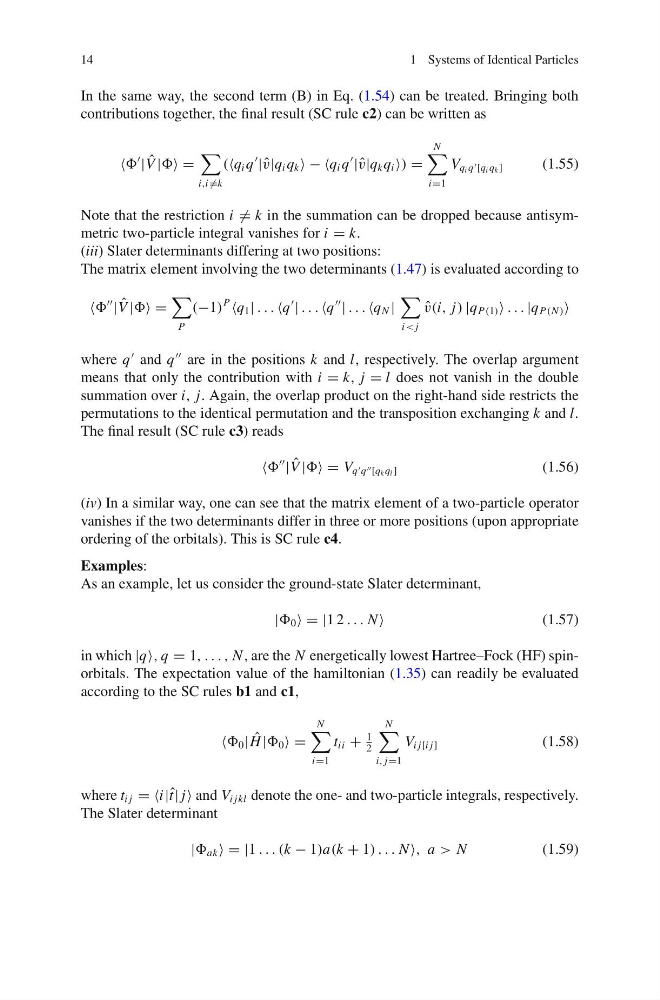
In the same way, the second term (B) in Eq. (1.54) can be treated. Bringing both
contributions together, the final result (SC rule c2) can be written as
| ˆ
V | =
i,i =k
(q i q
| ˆ
v|q i q k − −q i q
| ˆ
v|q k q i ) =
N
i=1
V q i q [q i q k ]
(1.55)
Note that the restriction i = k in the summation can be dropped because antisymmetric two-particle integral vanishes for i = k.
(iii) Slater determinants differing at two positions:
The matrix element involving the two determinants (1.47) is evaluated according to
| ˆ
V | =
P
(−1)
P
q 1 | . . . q
| . . . q
| . . . q N |
i< j
ˆ
v(i, j) |q P(1) . . . |q P(N )
where q
and q
are in the positions k and l, respectively. The overlap argument
means that only the contribution with i = k, j = l does not vanish in the double
summation over i, j. Again, the overlap product on the right-hand side restricts the
permutations to the identical permutation and the transposition exchanging k and l.
The final result (SC rule c3) reads
| ˆ
V | = V q q [q k q l ]
(1.56)
(iv) In a similar way, one can see that the matrix element of a two-particle operator
vanishes if the two determinants differ in three or more positions (upon appropriate
ordering of the orbitals). This is SC rule c4.
Examples:
As an example, let us consider the ground-state Slater determinant,
| 0 = |1 2 . . . N
(1.57)
in which |q, q = 1, . . . , N , are the N energetically lowest Hartree–Fock (HF) spinorbitals. The expectation value of the hamiltonian (1.35) can readily be evaluated
according to the SC rules b1 and c1,
0 | ˆ
H | 0 =
N
i=1
t ii +
1
2
N
i, j=1
V i j[i j]
(1.58)
where t i j = =i|ˆ t| j and V i jkl denote the one- and two-particle integrals, respectively.
The Slater determinant
| ak = |1 . . . (k − 1)a(k + 1) . . . N , a > N
(1.59)
1 Systems of Identical Particles
In the same way, the second term (B) in Eq. (1.54) can be treated. Bringing both
contributions together, the final result (SC rule c2) can be written as
| ˆ
V | =
i,i =k
(q i q
| ˆ
v|q i q k − −q i q
| ˆ
v|q k q i ) =
N
i=1
V q i q [q i q k ]
(1.55)
Note that the restriction i = k in the summation can be dropped because antisymmetric two-particle integral vanishes for i = k.
(iii) Slater determinants differing at two positions:
The matrix element involving the two determinants (1.47) is evaluated according to
| ˆ
V | =
P
(−1)
P
q 1 | . . . q
| . . . q
| . . . q N |
i< j
ˆ
v(i, j) |q P(1) . . . |q P(N )
where q
and q
are in the positions k and l, respectively. The overlap argument
means that only the contribution with i = k, j = l does not vanish in the double
summation over i, j. Again, the overlap product on the right-hand side restricts the
permutations to the identical permutation and the transposition exchanging k and l.
The final result (SC rule c3) reads
| ˆ
V | = V q q [q k q l ]
(1.56)
(iv) In a similar way, one can see that the matrix element of a two-particle operator
vanishes if the two determinants differ in three or more positions (upon appropriate
ordering of the orbitals). This is SC rule c4.
Examples:
As an example, let us consider the ground-state Slater determinant,
| 0 = |1 2 . . . N
(1.57)
in which |q, q = 1, . . . , N , are the N energetically lowest Hartree–Fock (HF) spinorbitals. The expectation value of the hamiltonian (1.35) can readily be evaluated
according to the SC rules b1 and c1,
0 | ˆ
H | 0 =
N
i=1
t ii +
1
2
N
i, j=1
V i j[i j]
(1.58)
where t i j = =i|ˆ t| j and V i jkl denote the one- and two-particle integrals, respectively.
The Slater determinant
| ak = |1 . . . (k − 1)a(k + 1) . . . N , a > N
(1.59)