

16.2 A State Representation of the EOM Secular Equations
247
(and complete) in the (N −1)-electron Hilbert space (see Sect. 11.1). Consequently,
the subset of -states, | I , I ∈ {N − 1}, is linear independent in the Fock space
too. The linear independence of the full set of -states, I ∈ {N + 1, N − 1}, follows
from the orthogonality of the two subsets according to Eq. (16.20).
We now may expand an arbitrary (N −1)-electron state, |
N −1
u
, in terms of the
| I -states as follows:
|
N −1
u
=
I,J
| I (S
−1
) I J J |
N −1
u
=
I
X I u | I
(16.30)
The expansion coefficients used in the second equation are given by
X I u =
J
(S
−1
) I J 0 | ˆ
O
†
J |
N −1
u
(16.31)
Since |
N −1
u
is an (N −1)-electron state, Eq. (16.30) decomposes into two separate
equations,
|
N −1
u
=
I
X I u ˆ
O I | 0
(16.32)
0 =
I
X I u ˆ
O
†
I | 0
(16.33)
This can be seen as a direct proof for the existence of a unique solution of Eqs. (16.1),
(16.2) based on the operator manifold (16.6).
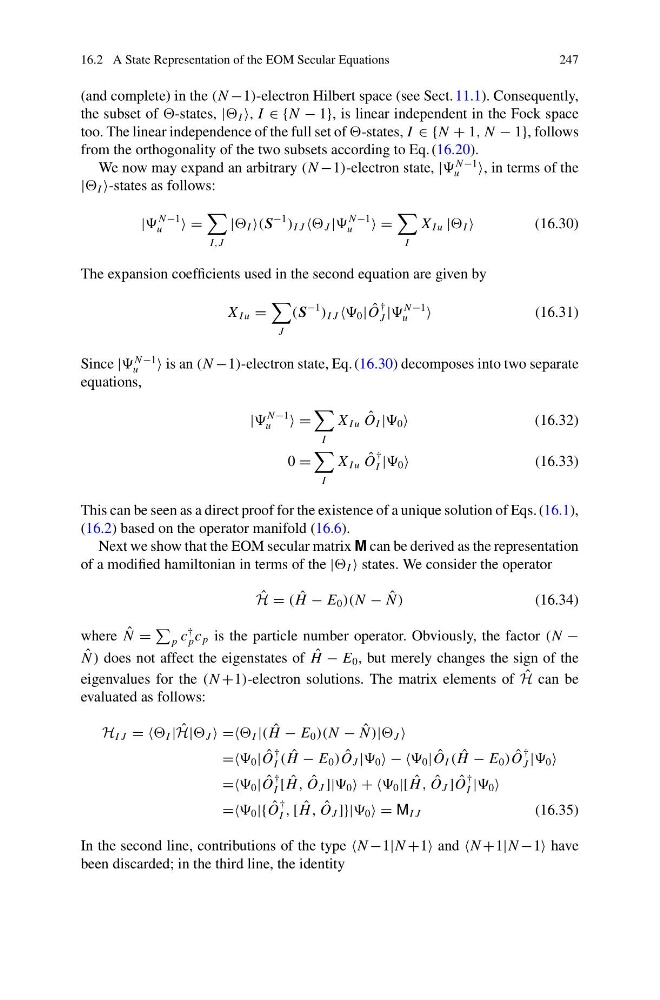
Next we show that the EOM secular matrix M can be derived as the representation
of a modified hamiltonian in terms of the | I states. We consider the operator
ˆ
H = ( ˆ
H − E 0 )(N − ˆ
N )
(16.34)
where ˆ
N =
p c
†
p c p is the particle number operator. Obviously, the factor (N −
ˆ
N ) does not affect the eigenstates of ˆ
H − E 0 , but merely changes the sign of the
eigenvalues for the (N +1)-electron solutions. The matrix elements of ˆ
H can be
evaluated as follows:
H I J = = I | ˆ
H| J == I |( ˆ
H − E 0 )(N − ˆ
N )| J
== 0 | ˆ
O
†
I ( ˆ
H − E 0 ) ˆ
O J | 0 − − 0 | ˆ
O I ( ˆ
H − E 0 ) ˆ
O
†
J | 0
== 0 | ˆ
O
†
I [ ˆ
H , ˆ
O J ]| 0 + + 0 |[ ˆ
H , ˆ
O J ] ˆ
O
†
I | 0
== 0 |{ ˆ
O
†
I , [ ˆ
H , ˆ
O J ]}| 0 = M I J
(16.35)
In the second line, contributions of the type N −1|N +1 and N +1|N −1 have
been discarded; in the third line, the identity
247
(and complete) in the (N −1)-electron Hilbert space (see Sect. 11.1). Consequently,
the subset of -states, | I , I ∈ {N − 1}, is linear independent in the Fock space
too. The linear independence of the full set of -states, I ∈ {N + 1, N − 1}, follows
from the orthogonality of the two subsets according to Eq. (16.20).
We now may expand an arbitrary (N −1)-electron state, |
N −1
u
, in terms of the
| I -states as follows:
|
N −1
u
=
I,J
| I (S
−1
) I J J |
N −1
u
=
I
X I u | I
(16.30)
The expansion coefficients used in the second equation are given by
X I u =
J
(S
−1
) I J 0 | ˆ
O
†
J |
N −1
u
(16.31)
Since |
N −1
u
is an (N −1)-electron state, Eq. (16.30) decomposes into two separate
equations,
|
N −1
u
=
I
X I u ˆ
O I | 0
(16.32)
0 =
I
X I u ˆ
O
†
I | 0
(16.33)
This can be seen as a direct proof for the existence of a unique solution of Eqs. (16.1),
(16.2) based on the operator manifold (16.6).
Next we show that the EOM secular matrix M can be derived as the representation
of a modified hamiltonian in terms of the | I states. We consider the operator
ˆ
H = ( ˆ
H − E 0 )(N − ˆ
N )
(16.34)
where ˆ
N =
p c
†
p c p is the particle number operator. Obviously, the factor (N −
ˆ
N ) does not affect the eigenstates of ˆ
H − E 0 , but merely changes the sign of the
eigenvalues for the (N +1)-electron solutions. The matrix elements of ˆ
H can be
evaluated as follows:
H I J = = I | ˆ
H| J == I |( ˆ
H − E 0 )(N − ˆ
N )| J
== 0 | ˆ
O
†
I ( ˆ
H − E 0 ) ˆ
O J | 0 − − 0 | ˆ
O I ( ˆ
H − E 0 ) ˆ
O
†
J | 0
== 0 | ˆ
O
†
I [ ˆ
H , ˆ
O J ]| 0 + + 0 |[ ˆ
H , ˆ
O J ] ˆ
O
†
I | 0
== 0 |{ ˆ
O
†
I , [ ˆ
H , ˆ
O J ]}| 0 = M I J
(16.35)
In the second line, contributions of the type N −1|N +1 and N +1|N −1 have
been discarded; in the third line, the identity