

220
14 ADC and ISR Approaches to the Polarization Propagator
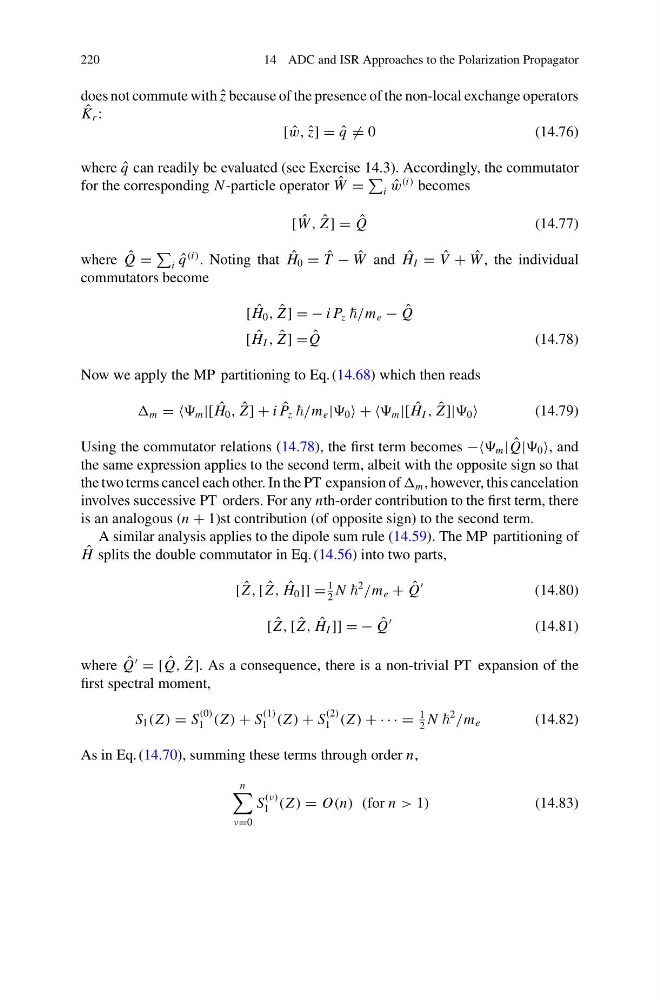
does not commute with ˆ
z because of the presence of the non-local exchange operators
ˆ
K r :
[ ˆ
w, ˆ
z] = ˆ
q = 0
(14.76)
where ˆ
q can readily be evaluated (see Exercise 14.3). Accordingly, the commutator
for the corresponding N -particle operator ˆ
W =
i ˆ
w
(i) becomes
[ ˆ
W , ˆ
Z ] = ˆ
Q
(14.77)
where ˆ
Q =
i ˆ
q
(i) . Noting that ˆ
H 0 = ˆ
T − ˆ
W and ˆ
H I = ˆ
V + ˆ
W , the individual
commutators become
[ ˆ
H 0 , ˆ
Z ] = − i P z /m e − ˆ
Q
[ ˆ
H I , ˆ
Z ] = ˆ
Q
(14.78)
Now we apply the MP partitioning to Eq. (14.68) which then reads
m = = m |[ ˆ
H 0 , ˆ
Z ] + i ˆ
P z /m e | 0 + + m |[ ˆ
H I , ˆ
Z ]| 0
(14.79)
Using the commutator relations (14.78), the first term becomes −− m | ˆ
Q| 0 , and
the same expression applies to the second term, albeit with the opposite sign so that
the two terms cancel each other. In the PT expansion of m , however, this cancelation
involves successive PT orders. For any nth-order contribution to the first term, there
is an analogous (n + 1)st contribution (of opposite sign) to the second term.
A similar analysis applies to the dipole sum rule (14.59). The MP partitioning of
ˆ
H splits the double commutator in Eq. (14.56) into two parts,
[ ˆ
Z , [ ˆ
Z , ˆ
H 0 ]] =
1
2
N
2
/m e + ˆ
Q
(14.80)
[ ˆ
Z , [ ˆ
Z , ˆ
H I ]] = − ˆ
Q
(14.81)
where ˆ
Q
= [ ˆ
Q, ˆ
Z ]. As a consequence, there is a non-trivial PT expansion of the
first spectral moment,
S 1 (Z ) = S
(0)
1 (Z ) + S
(1)
1 (Z ) + S
(2)
1 (Z ) + · · · =
1
2
N
2
/m e
(14.82)
As in Eq. (14.70), summing these terms through order n,
n
ν=0
S
(ν)
1 (Z ) = O(n) (for n > 1)
(14.83)
14 ADC and ISR Approaches to the Polarization Propagator
does not commute with ˆ
z because of the presence of the non-local exchange operators
ˆ
K r :
[ ˆ
w, ˆ
z] = ˆ
q = 0
(14.76)
where ˆ
q can readily be evaluated (see Exercise 14.3). Accordingly, the commutator
for the corresponding N -particle operator ˆ
W =
i ˆ
w
(i) becomes
[ ˆ
W , ˆ
Z ] = ˆ
Q
(14.77)
where ˆ
Q =
i ˆ
q
(i) . Noting that ˆ
H 0 = ˆ
T − ˆ
W and ˆ
H I = ˆ
V + ˆ
W , the individual
commutators become
[ ˆ
H 0 , ˆ
Z ] = − i P z /m e − ˆ
Q
[ ˆ
H I , ˆ
Z ] = ˆ
Q
(14.78)
Now we apply the MP partitioning to Eq. (14.68) which then reads
m = = m |[ ˆ
H 0 , ˆ
Z ] + i ˆ
P z /m e | 0 + + m |[ ˆ
H I , ˆ
Z ]| 0
(14.79)
Using the commutator relations (14.78), the first term becomes −− m | ˆ
Q| 0 , and
the same expression applies to the second term, albeit with the opposite sign so that
the two terms cancel each other. In the PT expansion of m , however, this cancelation
involves successive PT orders. For any nth-order contribution to the first term, there
is an analogous (n + 1)st contribution (of opposite sign) to the second term.
A similar analysis applies to the dipole sum rule (14.59). The MP partitioning of
ˆ
H splits the double commutator in Eq. (14.56) into two parts,
[ ˆ
Z , [ ˆ
Z , ˆ
H 0 ]] =
1
2
N
2
/m e + ˆ
Q
(14.80)
[ ˆ
Z , [ ˆ
Z , ˆ
H I ]] = − ˆ
Q
(14.81)
where ˆ
Q
= [ ˆ
Q, ˆ
Z ]. As a consequence, there is a non-trivial PT expansion of the
first spectral moment,
S 1 (Z ) = S
(0)
1 (Z ) + S
(1)
1 (Z ) + S
(2)
1 (Z ) + · · · =
1
2
N
2
/m e
(14.82)
As in Eq. (14.70), summing these terms through order n,
n
ν=0
S
(ν)
1 (Z ) = O(n) (for n > 1)
(14.83)