

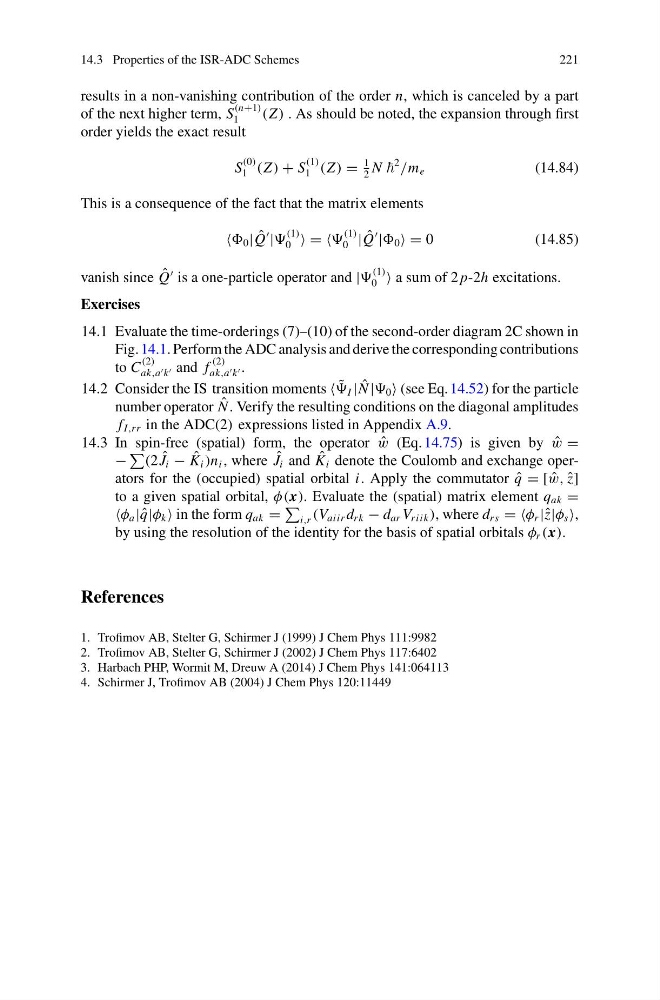
14.3 Properties of the ISR-ADC Schemes
221
results in a non-vanishing contribution of the order n, which is canceled by a part
of the next higher term, S
(n+1)
1
(Z ) . As should be noted, the expansion through first
order yields the exact result
S
(0)
1 (Z ) + S
(1)
1 (Z ) =
1
2
N
2
/m e
(14.84)
This is a consequence of the fact that the matrix elements
0 | ˆ
Q
|
(1)
0 = =
(1)
0 | ˆ
Q
| 0 = 0
(14.85)
vanish since ˆ
Q
is a one-particle operator and |
(1)
0 a sum of 2 p-2h excitations.
Exercises
14.1 Evaluate the time-orderings (7)–(10) of the second-order diagram 2C shown in
Fig. 14.1. Perform the ADC analysis and derive the corresponding contributions
to C
(2)
ak,a k and f
(2)
ak,a k .
14.2 Consider the IS transition moments ˜
I | ˆ
N | 0 (see Eq. 14.52) for the particle
number operator ˆ
N . Verify the resulting conditions on the diagonal amplitudes
f I,rr in the ADC(2) expressions listed in Appendix A.9.
14.3 In spin-free (spatial) form, the operator ˆ
w (Eq. 14.75) is given by ˆ
w =
−
(2 ˆ
J i − ˆ
K i )n i , where ˆ
J i and ˆ
K i denote the Coulomb and exchange operators for the (occupied) spatial orbital i. Apply the commutator ˆ
q = [ ˆ
w, ˆ
z]
to a given spatial orbital, φ(x). Evaluate the (spatial) matrix element q ak =
φ a | ˆ
q|φ k in the form q ak =
i,r (V aiir d rk − d ar V riik ), where d rs = =φ r |ˆ z|φ s ,
by using the resolution of the identity for the basis of spatial orbitals φ r (x).
References
1. Trofimov AB, Stelter G, Schirmer J (1999) J Chem Phys 111:9982
2. Trofimov AB, Stelter G, Schirmer J (2002) J Chem Phys 117:6402
3. Harbach PHP, Wormit M, Dreuw A (2014) J Chem Phys 141:064113
4. Schirmer J, Trofimov AB (2004) J Chem Phys 120:11449
221
results in a non-vanishing contribution of the order n, which is canceled by a part
of the next higher term, S
(n+1)
1
(Z ) . As should be noted, the expansion through first
order yields the exact result
S
(0)
1 (Z ) + S
(1)
1 (Z ) =
1
2
N
2
/m e
(14.84)
This is a consequence of the fact that the matrix elements
0 | ˆ
Q
|
(1)
0 = =
(1)
0 | ˆ
Q
| 0 = 0
(14.85)
vanish since ˆ
Q
is a one-particle operator and |
(1)
0 a sum of 2 p-2h excitations.
Exercises
14.1 Evaluate the time-orderings (7)–(10) of the second-order diagram 2C shown in
Fig. 14.1. Perform the ADC analysis and derive the corresponding contributions
to C
(2)
ak,a k and f
(2)
ak,a k .
14.2 Consider the IS transition moments ˜
I | ˆ
N | 0 (see Eq. 14.52) for the particle
number operator ˆ
N . Verify the resulting conditions on the diagonal amplitudes
f I,rr in the ADC(2) expressions listed in Appendix A.9.
14.3 In spin-free (spatial) form, the operator ˆ
w (Eq. 14.75) is given by ˆ
w =
−
(2 ˆ
J i − ˆ
K i )n i , where ˆ
J i and ˆ
K i denote the Coulomb and exchange operators for the (occupied) spatial orbital i. Apply the commutator ˆ
q = [ ˆ
w, ˆ
z]
to a given spatial orbital, φ(x). Evaluate the (spatial) matrix element q ak =
φ a | ˆ
q|φ k in the form q ak =
i,r (V aiir d rk − d ar V riik ), where d rs = =φ r |ˆ z|φ s ,
by using the resolution of the identity for the basis of spatial orbitals φ r (x).
References
1. Trofimov AB, Stelter G, Schirmer J (1999) J Chem Phys 111:9982
2. Trofimov AB, Stelter G, Schirmer J (2002) J Chem Phys 117:6402
3. Harbach PHP, Wormit M, Dreuw A (2014) J Chem Phys 141:064113
4. Schirmer J, Trofimov AB (2004) J Chem Phys 120:11449