

14.3 Properties of the ISR-ADC Schemes
219
accuracy afforded at the respective level of approximation and the quality of the oneparticle basis set used. Interestingly, for a consistent nth-order treatment, obtained,
for example, at the ADC (n) level, the deviation error is of order n, rather than n + 1
as one might expect. For an explanation, we have to take a closer look at how the PT
expansions conform to the exact spectral identities.
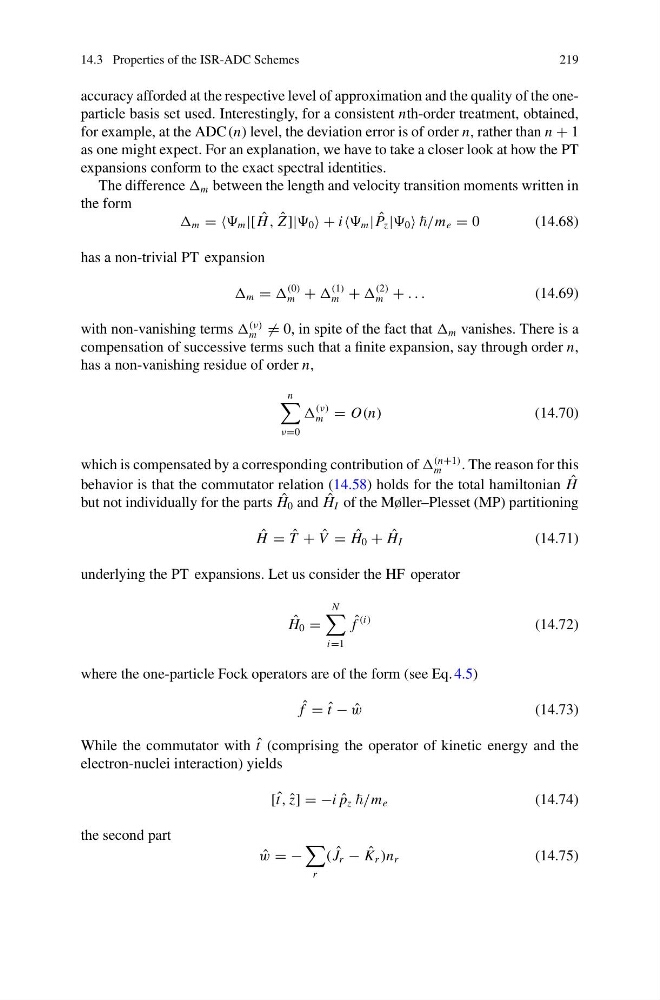
The difference m between the length and velocity transition moments written in
the form
m = = m |[ ˆ
H , ˆ
Z ]| 0 + i m | ˆ
P z | 0 /m e = 0
(14.68)
has a non-trivial PT expansion
m =
(0)
m +
(1)
m +
(2)
m + . . .
(14.69)
with non-vanishing terms
(ν)
m = 0, in spite of the fact that m vanishes. There is a
compensation of successive terms such that a finite expansion, say through order n,
has a non-vanishing residue of order n,
n
ν=0
(ν)
m = O(n)
(14.70)
which is compensated by a corresponding contribution of
(n+1)
m
. The reason for this
behavior is that the commutator relation (14.58) holds for the total hamiltonian ˆ
H
but not individually for the parts ˆ
H 0 and ˆ
H I of the Møller–Plesset (MP) partitioning
ˆ
H = ˆ
T + ˆ
V = ˆ
H 0 + ˆ
H I
(14.71)
underlying the PT expansions. Let us consider the HF operator
ˆ
H 0 =
N
i=1
ˆ
f
(i)
(14.72)
where the one-particle Fock operators are of the form (see Eq. 4.5)
ˆ
f = ˆ
t − ˆ
w
(14.73)
While the commutator with ˆ
t (comprising the operator of kinetic energy and the
electron-nuclei interaction) yields
[ˆ t, ˆ
z] = −i ˆ
p z /m e
(14.74)
the second part
ˆ
w = −
r
( ˆ
J r − ˆ
K r )n r
(14.75)
219
accuracy afforded at the respective level of approximation and the quality of the oneparticle basis set used. Interestingly, for a consistent nth-order treatment, obtained,
for example, at the ADC (n) level, the deviation error is of order n, rather than n + 1
as one might expect. For an explanation, we have to take a closer look at how the PT
expansions conform to the exact spectral identities.
The difference m between the length and velocity transition moments written in
the form
m = = m |[ ˆ
H , ˆ
Z ]| 0 + i m | ˆ
P z | 0 /m e = 0
(14.68)
has a non-trivial PT expansion
m =
(0)
m +
(1)
m +
(2)
m + . . .
(14.69)
with non-vanishing terms
(ν)
m = 0, in spite of the fact that m vanishes. There is a
compensation of successive terms such that a finite expansion, say through order n,
has a non-vanishing residue of order n,
n
ν=0
(ν)
m = O(n)
(14.70)
which is compensated by a corresponding contribution of
(n+1)
m
. The reason for this
behavior is that the commutator relation (14.58) holds for the total hamiltonian ˆ
H
but not individually for the parts ˆ
H 0 and ˆ
H I of the Møller–Plesset (MP) partitioning
ˆ
H = ˆ
T + ˆ
V = ˆ
H 0 + ˆ
H I
(14.71)
underlying the PT expansions. Let us consider the HF operator
ˆ
H 0 =
N
i=1
ˆ
f
(i)
(14.72)
where the one-particle Fock operators are of the form (see Eq. 4.5)
ˆ
f = ˆ
t − ˆ
w
(14.73)
While the commutator with ˆ
t (comprising the operator of kinetic energy and the
electron-nuclei interaction) yields
[ˆ t, ˆ
z] = −i ˆ
p z /m e
(14.74)
the second part
ˆ
w = −
r
( ˆ
J r − ˆ
K r )n r
(14.75)