

218
14 ADC and ISR Approaches to the Polarization Propagator
F J (Z ) =
r,s
f J,rs z rs
(14.61)
The equivalence of the ADC form (14.60) and Eq. (14.55) can be seen by writing
the secular equation (14.5) as
M = XX
†
(14.62)
and using Eq. (14.7) with the transition operator ˆ
Z . Let us note that the ADC form
can readily be extended to other spectral moments, S k (D), k = 0, 1, 2, . . . :
S k (D) = F(D)
† M
k F(D)
(14.63)
Here D refers to a given one-particle operator ˆ
D.
The dipole sum rule (14.59) may serve as a test of the accuracy of the computational scheme. Deviations from the exact value can reflect shortcomings of the
method as well as an incompleteness of the molecular basis set used to compute the
excitation spectrum. Interestingly, in the random-phase approximation (RPA), to be
considered in Chap. 15, the dipole sum rule is fulfilled exactly (apart from the basis
set error) although the RPA excitation energies and transition moments (of singly
excited states) are consistent only through first order. We will come back to this point
in Sect. 15.1.
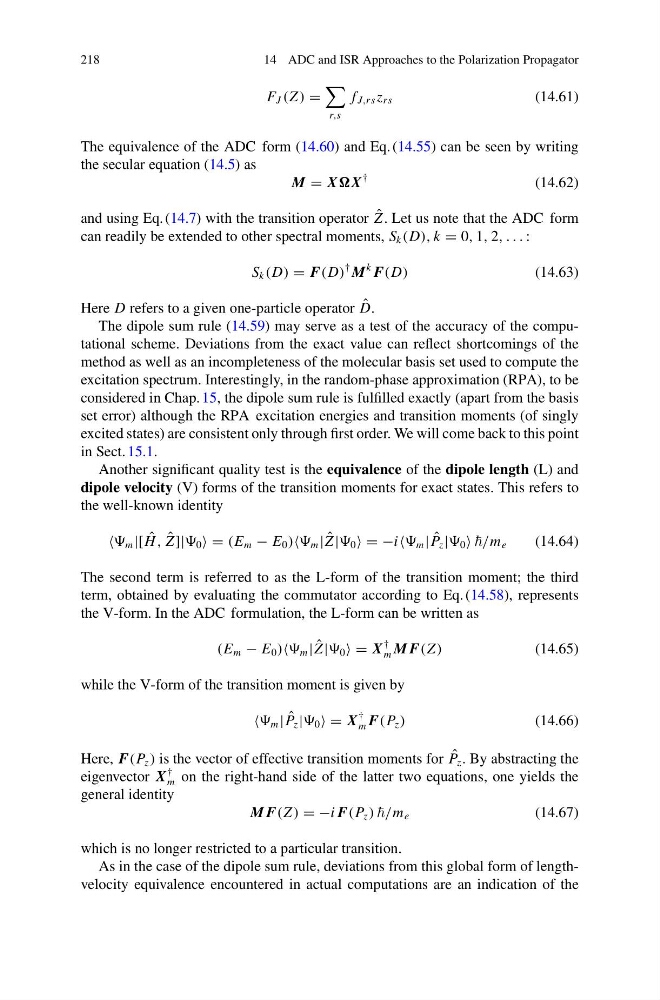
Another significant quality test is the equivalence of the dipole length (L) and
dipole velocity (V) forms of the transition moments for exact states. This refers to
the well-known identity
m |[ ˆ
H , ˆ
Z ]| 0 = (E m − E 0 ) m | ˆ
Z | 0 = −i m | ˆ
P z | 0 /m e
(14.64)
The second term is referred to as the L-form of the transition moment; the third
term, obtained by evaluating the commutator according to Eq. (14.58), represents
the V-form. In the ADC formulation, the L-form can be written as
(E m − E 0 ) m | ˆ
Z | 0 = X
†
m M F(Z )
(14.65)
while the V-form of the transition moment is given by
m | ˆ
P z | 0 = X
†
m F(P z )
(14.66)
Here, F(P z ) is the vector of effective transition moments for ˆ
P z . By abstracting the
eigenvector X
†
m on the right-hand side of the latter two equations, one yields the
general identity
M F(Z ) = −i F(P z ) /m e
(14.67)
which is no longer restricted to a particular transition.
As in the case of the dipole sum rule, deviations from this global form of lengthvelocity equivalence encountered in actual computations are an indication of the
14 ADC and ISR Approaches to the Polarization Propagator
F J (Z ) =
r,s
f J,rs z rs
(14.61)
The equivalence of the ADC form (14.60) and Eq. (14.55) can be seen by writing
the secular equation (14.5) as
M = XX
†
(14.62)
and using Eq. (14.7) with the transition operator ˆ
Z . Let us note that the ADC form
can readily be extended to other spectral moments, S k (D), k = 0, 1, 2, . . . :
S k (D) = F(D)
† M
k F(D)
(14.63)
Here D refers to a given one-particle operator ˆ
D.
The dipole sum rule (14.59) may serve as a test of the accuracy of the computational scheme. Deviations from the exact value can reflect shortcomings of the
method as well as an incompleteness of the molecular basis set used to compute the
excitation spectrum. Interestingly, in the random-phase approximation (RPA), to be
considered in Chap. 15, the dipole sum rule is fulfilled exactly (apart from the basis
set error) although the RPA excitation energies and transition moments (of singly
excited states) are consistent only through first order. We will come back to this point
in Sect. 15.1.
Another significant quality test is the equivalence of the dipole length (L) and
dipole velocity (V) forms of the transition moments for exact states. This refers to
the well-known identity
m |[ ˆ
H , ˆ
Z ]| 0 = (E m − E 0 ) m | ˆ
Z | 0 = −i m | ˆ
P z | 0 /m e
(14.64)
The second term is referred to as the L-form of the transition moment; the third
term, obtained by evaluating the commutator according to Eq. (14.58), represents
the V-form. In the ADC formulation, the L-form can be written as
(E m − E 0 ) m | ˆ
Z | 0 = X
†
m M F(Z )
(14.65)
while the V-form of the transition moment is given by
m | ˆ
P z | 0 = X
†
m F(P z )
(14.66)
Here, F(P z ) is the vector of effective transition moments for ˆ
P z . By abstracting the
eigenvector X
†
m on the right-hand side of the latter two equations, one yields the
general identity
M F(Z ) = −i F(P z ) /m e
(14.67)
which is no longer restricted to a particular transition.
As in the case of the dipole sum rule, deviations from this global form of lengthvelocity equivalence encountered in actual computations are an indication of the