

214
14 ADC and ISR Approaches to the Polarization Propagator
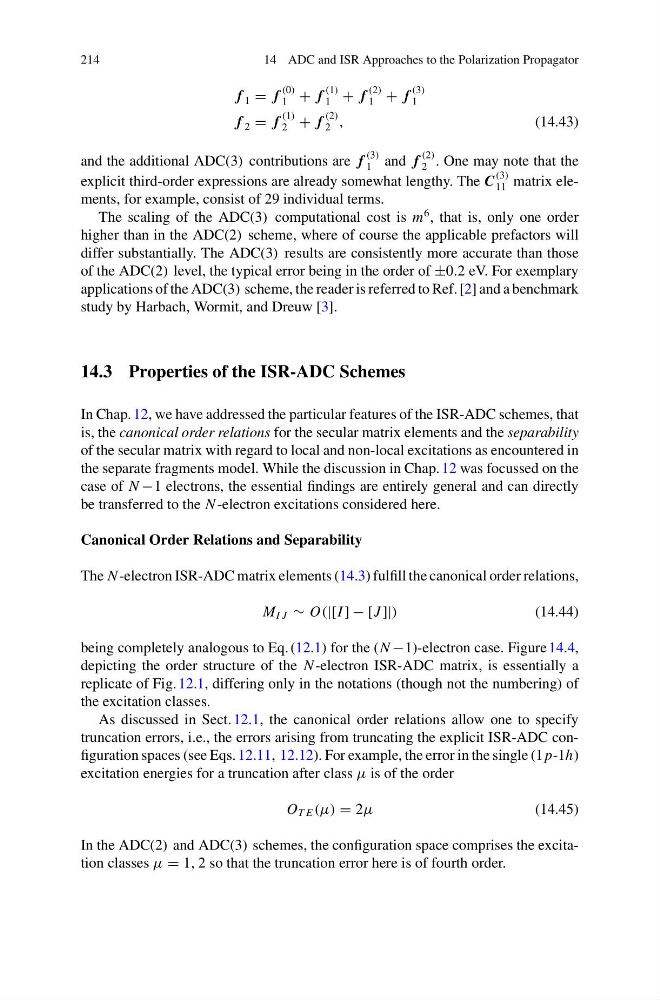
f 1 = f
(0)
1 + f
(1)
1 + f
(2)
1 + f
(3)
1
f 2 = f
(1)
2 + f
(2)
2 ,
(14.43)
and the additional ADC(3) contributions are f
(3)
1 and f
(2)
2 . One may note that the
explicit third-order expressions are already somewhat lengthy. The C
(3)
11 matrix elements, for example, consist of 29 individual terms.
The scaling of the ADC(3) computational cost is m
6 , that is, only one order
higher than in the ADC(2) scheme, where of course the applicable prefactors will
differ substantially. The ADC(3) results are consistently more accurate than those
of the ADC(2) level, the typical error being in the order of ±0.2 eV. For exemplary
applications of the ADC(3) scheme, the reader is referred to Ref. [2] and a benchmark
study by Harbach, Wormit, and Dreuw [3].
14.3 Properties of the ISR-ADC Schemes
In Chap. 12, we have addressed the particular features of the ISR-ADC schemes, that
is, the canonical order relations for the secular matrix elements and the separability
of the secular matrix with regard to local and non-local excitations as encountered in
the separate fragments model. While the discussion in Chap. 12 was focussed on the
case of N −1 electrons, the essential findings are entirely general and can directly
be transferred to the N -electron excitations considered here.
Canonical Order Relations and Separability
The N -electron ISR-ADC matrix elements (14.3) fulfill the canonical order relations,
M I J ∼ O(|[I ] − [J ]|)
(14.44)
being completely analogous to Eq. (12.1) for the (N −1)-electron case. Figure 14.4,
depicting the order structure of the N -electron ISR-ADC matrix, is essentially a
replicate of Fig. 12.1, differing only in the notations (though not the numbering) of
the excitation classes.
As discussed in Sect. 12.1, the canonical order relations allow one to specify
truncation errors, i.e., the errors arising from truncating the explicit ISR-ADC configuration spaces (see Eqs. 12.11, 12.12). For example, the error in the single (1 p-1h)
excitation energies for a truncation after class μ is of the order
O T E (μ) = 2μ
(14.45)
In the ADC(2) and ADC(3) schemes, the configuration space comprises the excitation classes μ = 1, 2 so that the truncation error here is of fourth order.
14 ADC and ISR Approaches to the Polarization Propagator
f 1 = f
(0)
1 + f
(1)
1 + f
(2)
1 + f
(3)
1
f 2 = f
(1)
2 + f
(2)
2 ,
(14.43)
and the additional ADC(3) contributions are f
(3)
1 and f
(2)
2 . One may note that the
explicit third-order expressions are already somewhat lengthy. The C
(3)
11 matrix elements, for example, consist of 29 individual terms.
The scaling of the ADC(3) computational cost is m
6 , that is, only one order
higher than in the ADC(2) scheme, where of course the applicable prefactors will
differ substantially. The ADC(3) results are consistently more accurate than those
of the ADC(2) level, the typical error being in the order of ±0.2 eV. For exemplary
applications of the ADC(3) scheme, the reader is referred to Ref. [2] and a benchmark
study by Harbach, Wormit, and Dreuw [3].
14.3 Properties of the ISR-ADC Schemes
In Chap. 12, we have addressed the particular features of the ISR-ADC schemes, that
is, the canonical order relations for the secular matrix elements and the separability
of the secular matrix with regard to local and non-local excitations as encountered in
the separate fragments model. While the discussion in Chap. 12 was focussed on the
case of N −1 electrons, the essential findings are entirely general and can directly
be transferred to the N -electron excitations considered here.
Canonical Order Relations and Separability
The N -electron ISR-ADC matrix elements (14.3) fulfill the canonical order relations,
M I J ∼ O(|[I ] − [J ]|)
(14.44)
being completely analogous to Eq. (12.1) for the (N −1)-electron case. Figure 14.4,
depicting the order structure of the N -electron ISR-ADC matrix, is essentially a
replicate of Fig. 12.1, differing only in the notations (though not the numbering) of
the excitation classes.
As discussed in Sect. 12.1, the canonical order relations allow one to specify
truncation errors, i.e., the errors arising from truncating the explicit ISR-ADC configuration spaces (see Eqs. 12.11, 12.12). For example, the error in the single (1 p-1h)
excitation energies for a truncation after class μ is of the order
O T E (μ) = 2μ
(14.45)
In the ADC(2) and ADC(3) schemes, the configuration space comprises the excitation classes μ = 1, 2 so that the truncation error here is of fourth order.