

14.2 Explicit ADC Schemes for the Polarization Propagator
213
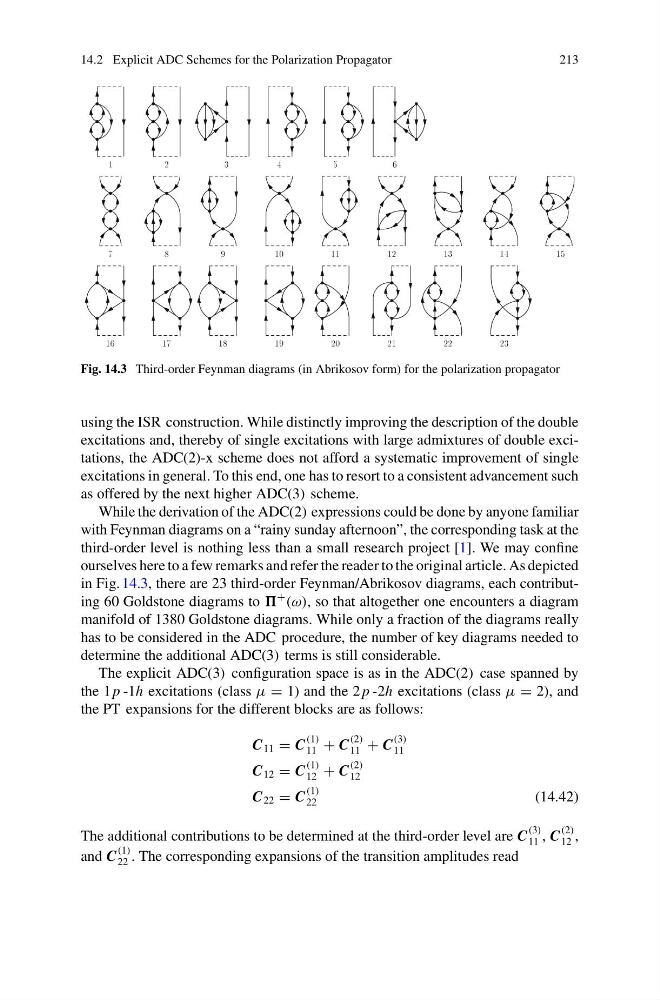
Fig. 14.3 Third-order Feynman diagrams (in Abrikosov form) for the polarization propagator
using the ISR construction. While distinctly improving the description of the double
excitations and, thereby of single excitations with large admixtures of double excitations, the ADC(2)-x scheme does not afford a systematic improvement of single
excitations in general. To this end, one has to resort to a consistent advancement such
as offered by the next higher ADC(3) scheme.
While the derivation of the ADC(2) expressions could be done by anyone familiar
with Feynman diagrams on a “rainy sunday afternoon”, the corresponding task at the
third-order level is nothing less than a small research project [1]. We may confine
ourselves here to a few remarks and refer the reader to the original article. As depicted
in Fig. 14.3, there are 23 third-order Feynman/Abrikosov diagrams, each contributing 60 Goldstone diagrams to
+
(ω), so that altogether one encounters a diagram
manifold of 1380 Goldstone diagrams. While only a fraction of the diagrams really
has to be considered in the ADC procedure, the number of key diagrams needed to
determine the additional ADC(3) terms is still considerable.
The explicit ADC(3) configuration space is as in the ADC(2) case spanned by
the 1 p -1h excitations (class μ = 1) and the 2 p -2h excitations (class μ = 2), and
the PT expansions for the different blocks are as follows:
C 11 = C
(1)
11 + C
(2)
11 + C
(3)
11
C 12 = C
(1)
12 + C
(2)
12
C 22 = C
(1)
22
(14.42)
The additional contributions to be determined at the third-order level are C
(3)
11 , C
(2)
12 ,
and C
(1)
22 . The corresponding expansions of the transition amplitudes read
213
Fig. 14.3 Third-order Feynman diagrams (in Abrikosov form) for the polarization propagator
using the ISR construction. While distinctly improving the description of the double
excitations and, thereby of single excitations with large admixtures of double excitations, the ADC(2)-x scheme does not afford a systematic improvement of single
excitations in general. To this end, one has to resort to a consistent advancement such
as offered by the next higher ADC(3) scheme.
While the derivation of the ADC(2) expressions could be done by anyone familiar
with Feynman diagrams on a “rainy sunday afternoon”, the corresponding task at the
third-order level is nothing less than a small research project [1]. We may confine
ourselves here to a few remarks and refer the reader to the original article. As depicted
in Fig. 14.3, there are 23 third-order Feynman/Abrikosov diagrams, each contributing 60 Goldstone diagrams to
+
(ω), so that altogether one encounters a diagram
manifold of 1380 Goldstone diagrams. While only a fraction of the diagrams really
has to be considered in the ADC procedure, the number of key diagrams needed to
determine the additional ADC(3) terms is still considerable.
The explicit ADC(3) configuration space is as in the ADC(2) case spanned by
the 1 p -1h excitations (class μ = 1) and the 2 p -2h excitations (class μ = 2), and
the PT expansions for the different blocks are as follows:
C 11 = C
(1)
11 + C
(2)
11 + C
(3)
11
C 12 = C
(1)
12 + C
(2)
12
C 22 = C
(1)
22
(14.42)
The additional contributions to be determined at the third-order level are C
(3)
11 , C
(2)
12 ,
and C
(1)
22 . The corresponding expansions of the transition amplitudes read