

14.1 General Framework
207
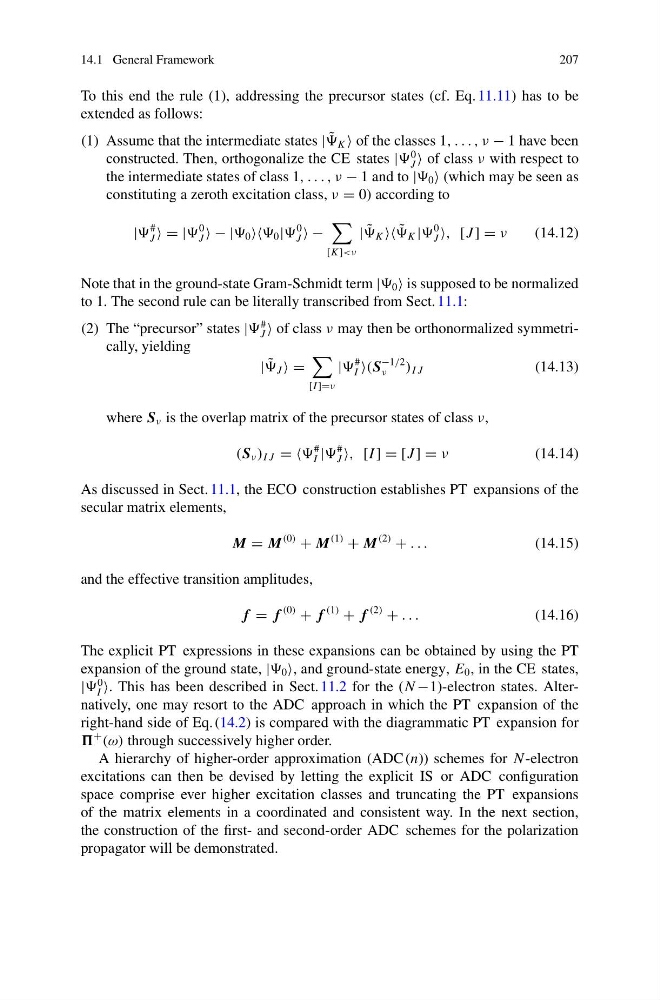
To this end the rule (1), addressing the precursor states (cf. Eq. 11.11) has to be
extended as follows:
(1) Assume that the intermediate states | ˜
K of the classes 1, . . . , ν − 1 have been
constructed. Then, orthogonalize the CE states |
0
J of class ν with respect to
the intermediate states of class 1, . . . , ν − 1 and to | 0 (which may be seen as
constituting a zeroth excitation class, ν = 0) according to
|
#
J = |
0
J − | 0 0 |
0
J −
[K ]<ν
| ˜
K ˜
K |
0
J , [J ] = ν
(14.12)
Note that in the ground-state Gram-Schmidt term | 0 is supposed to be normalized
to 1. The second rule can be literally transcribed from Sect. 11.1:
(2) The “precursor” states |
#
J of class ν may then be orthonormalized symmetrically, yielding
| ˜
J =
[I ]=ν
|
#
I (S
−1/2
ν
) I J
(14.13)
where S ν is the overlap matrix of the precursor states of class ν,
(S ν ) I J = =
#
I |
#
J , [I ] = [J ] = ν
(14.14)
As discussed in Sect. 11.1, the ECO construction establishes PT expansions of the
secular matrix elements,
M = M
(0)
+ M
(1)
+ M
(2)
+ . . .
(14.15)
and the effective transition amplitudes,
f = f
(0)
+ f
(1)
+ f
(2)
+ . . .
(14.16)
The explicit PT expressions in these expansions can be obtained by using the PT
expansion of the ground state, | 0 , and ground-state energy, E 0 , in the CE states,
|
0
I . This has been described in Sect. 11.2 for the (N −1)-electron states. Alternatively, one may resort to the ADC approach in which the PT expansion of the
right-hand side of Eq. (14.2) is compared with the diagrammatic PT expansion for
+
(ω) through successively higher order.
A hierarchy of higher-order approximation (ADC (n)) schemes for N -electron
excitations can then be devised by letting the explicit IS or ADC configuration
space comprise ever higher excitation classes and truncating the PT expansions
of the matrix elements in a coordinated and consistent way. In the next section,
the construction of the first- and second-order ADC schemes for the polarization
propagator will be demonstrated.
207
To this end the rule (1), addressing the precursor states (cf. Eq. 11.11) has to be
extended as follows:
(1) Assume that the intermediate states | ˜
K of the classes 1, . . . , ν − 1 have been
constructed. Then, orthogonalize the CE states |
0
J of class ν with respect to
the intermediate states of class 1, . . . , ν − 1 and to | 0 (which may be seen as
constituting a zeroth excitation class, ν = 0) according to
|
#
J = |
0
J − | 0 0 |
0
J −
[K ]<ν
| ˜
K ˜
K |
0
J , [J ] = ν
(14.12)
Note that in the ground-state Gram-Schmidt term | 0 is supposed to be normalized
to 1. The second rule can be literally transcribed from Sect. 11.1:
(2) The “precursor” states |
#
J of class ν may then be orthonormalized symmetrically, yielding
| ˜
J =
[I ]=ν
|
#
I (S
−1/2
ν
) I J
(14.13)
where S ν is the overlap matrix of the precursor states of class ν,
(S ν ) I J = =
#
I |
#
J , [I ] = [J ] = ν
(14.14)
As discussed in Sect. 11.1, the ECO construction establishes PT expansions of the
secular matrix elements,
M = M
(0)
+ M
(1)
+ M
(2)
+ . . .
(14.15)
and the effective transition amplitudes,
f = f
(0)
+ f
(1)
+ f
(2)
+ . . .
(14.16)
The explicit PT expressions in these expansions can be obtained by using the PT
expansion of the ground state, | 0 , and ground-state energy, E 0 , in the CE states,
|
0
I . This has been described in Sect. 11.2 for the (N −1)-electron states. Alternatively, one may resort to the ADC approach in which the PT expansion of the
right-hand side of Eq. (14.2) is compared with the diagrammatic PT expansion for
+
(ω) through successively higher order.
A hierarchy of higher-order approximation (ADC (n)) schemes for N -electron
excitations can then be devised by letting the explicit IS or ADC configuration
space comprise ever higher excitation classes and truncating the PT expansions
of the matrix elements in a coordinated and consistent way. In the next section,
the construction of the first- and second-order ADC schemes for the polarization
propagator will be demonstrated.