

180
12 Order Relations and Separability
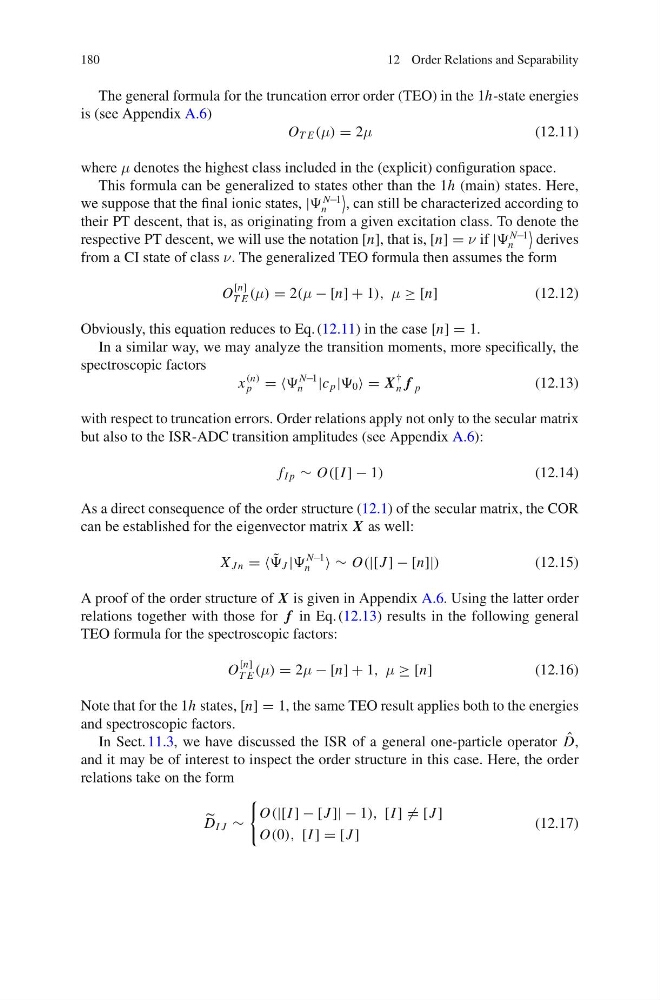
The general formula for the truncation error order (TEO) in the 1h-state energies
is (see Appendix A.6)
O T E (μ) = 2μ
(12.11)
where μ denotes the highest class included in the (explicit) configuration space.
This formula can be generalized to states other than the 1h (main) states. Here,
we suppose that the final ionic states, |
N−1
n
, can still be characterized according to
their PT descent, that is, as originating from a given excitation class. To denote the
respective PT descent, we will use the notation [n], that is, [n] = ν if |
N−1
n
derives
from a CI state of class ν. The generalized TEO formula then assumes the form
O
[n]
T E (μ) = 2(μ − [n] + 1), μ ≥ [n]
(12.12)
Obviously, this equation reduces to Eq. (12.11) in the case [n] = 1.
In a similar way, we may analyze the transition moments, more specifically, the
spectroscopic factors
x
(n)
p = =
N−1
n |c p | 0 = X
†
n f p
(12.13)
with respect to truncation errors. Order relations apply not only to the secular matrix
but also to the ISR-ADC transition amplitudes (see Appendix A.6):
f I p ∼ O([I ] − 1)
(12.14)
As a direct consequence of the order structure (12.1) of the secular matrix, the COR
can be established for the eigenvector matrix X as well:
X J n = = ˜
J |
N−1
n ∼ O(|[J ] − [n]|)
(12.15)
A proof of the order structure of X is given in Appendix A.6. Using the latter order
relations together with those for f in Eq. (12.13) results in the following general
TEO formula for the spectroscopic factors:
O
[n]
T E (μ) = 2μ − [n] + 1, μ ≥ [n]
(12.16)
Note that for the 1h states, [n] = 1, the same TEO result applies both to the energies
and spectroscopic factors.
In Sect. 11.3, we have discussed the ISR of a general one-particle operator ˆ
D,
and it may be of interest to inspect the order structure in this case. Here, the order
relations take on the form
D I J ∼
O(|[I ] − [J ]| − 1), [I ] = [J ]
O(0), [I ] = [J ]
(12.17)
12 Order Relations and Separability
The general formula for the truncation error order (TEO) in the 1h-state energies
is (see Appendix A.6)
O T E (μ) = 2μ
(12.11)
where μ denotes the highest class included in the (explicit) configuration space.
This formula can be generalized to states other than the 1h (main) states. Here,
we suppose that the final ionic states, |
N−1
n
, can still be characterized according to
their PT descent, that is, as originating from a given excitation class. To denote the
respective PT descent, we will use the notation [n], that is, [n] = ν if |
N−1
n
derives
from a CI state of class ν. The generalized TEO formula then assumes the form
O
[n]
T E (μ) = 2(μ − [n] + 1), μ ≥ [n]
(12.12)
Obviously, this equation reduces to Eq. (12.11) in the case [n] = 1.
In a similar way, we may analyze the transition moments, more specifically, the
spectroscopic factors
x
(n)
p = =
N−1
n |c p | 0 = X
†
n f p
(12.13)
with respect to truncation errors. Order relations apply not only to the secular matrix
but also to the ISR-ADC transition amplitudes (see Appendix A.6):
f I p ∼ O([I ] − 1)
(12.14)
As a direct consequence of the order structure (12.1) of the secular matrix, the COR
can be established for the eigenvector matrix X as well:
X J n = = ˜
J |
N−1
n ∼ O(|[J ] − [n]|)
(12.15)
A proof of the order structure of X is given in Appendix A.6. Using the latter order
relations together with those for f in Eq. (12.13) results in the following general
TEO formula for the spectroscopic factors:
O
[n]
T E (μ) = 2μ − [n] + 1, μ ≥ [n]
(12.16)
Note that for the 1h states, [n] = 1, the same TEO result applies both to the energies
and spectroscopic factors.
In Sect. 11.3, we have discussed the ISR of a general one-particle operator ˆ
D,
and it may be of interest to inspect the order structure in this case. Here, the order
relations take on the form
D I J ∼
O(|[I ] − [J ]| − 1), [I ] = [J ]
O(0), [I ] = [J ]
(12.17)