

12.1 Canonical Order Relations
181
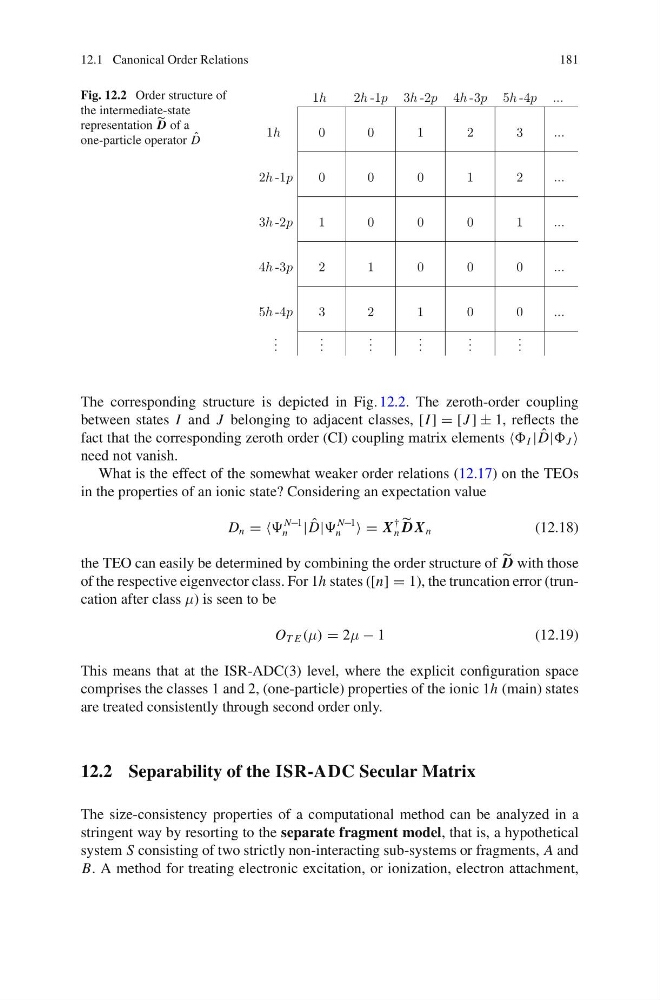
Fig. 12.2 Order structure of
the intermediate-state
representation D of a
one-particle operator ˆ
D
1h
2h -1p 3h -2p 4h -3p 5h -4p ...
1h
0
0
1
2
3
...
2h -1p
0
0
0
1
2
...
3h -2p
1
0
0
0
1
...
4h -3p
2
1
0
0
0
...
5h -4p
3
2
1
0
0
...
. . .
. . .
. . .
. . .
. . .
. . .
The corresponding structure is depicted in Fig. 12.2. The zeroth-order coupling
between states I and J belonging to adjacent classes, [I ] = [J ] ± 1, reflects the
fact that the corresponding zeroth order (CI) coupling matrix elements I | ˆ
D| J
need not vanish.
What is the effect of the somewhat weaker order relations (12.17) on the TEOs
in the properties of an ionic state? Considering an expectation value
D n = =
N−1
n | ˆ
D|
N−1
n = X
†
n
DX n
(12.18)
the TEO can easily be determined by combining the order structure of D with those
of the respective eigenvector class. For 1h states ([n] = 1), the truncation error (truncation after class μ) is seen to be
O T E (μ) = 2μ − 1
(12.19)
This means that at the ISR-ADC(3) level, where the explicit configuration space
comprises the classes 1 and 2, (one-particle) properties of the ionic 1h (main) states
are treated consistently through second order only.
12.2 Separability of the ISR-ADC Secular Matrix
The size-consistency properties of a computational method can be analyzed in a
stringent way by resorting to the separate fragment model, that is, a hypothetical
system S consisting of two strictly non-interacting sub-systems or fragments, A and
B. A method for treating electronic excitation, or ionization, electron attachment,
181
Fig. 12.2 Order structure of
the intermediate-state
representation D of a
one-particle operator ˆ
D
1h
2h -1p 3h -2p 4h -3p 5h -4p ...
1h
0
0
1
2
3
...
2h -1p
0
0
0
1
2
...
3h -2p
1
0
0
0
1
...
4h -3p
2
1
0
0
0
...
5h -4p
3
2
1
0
0
...
. . .
. . .
. . .
. . .
. . .
. . .
The corresponding structure is depicted in Fig. 12.2. The zeroth-order coupling
between states I and J belonging to adjacent classes, [I ] = [J ] ± 1, reflects the
fact that the corresponding zeroth order (CI) coupling matrix elements I | ˆ
D| J
need not vanish.
What is the effect of the somewhat weaker order relations (12.17) on the TEOs
in the properties of an ionic state? Considering an expectation value
D n = =
N−1
n | ˆ
D|
N−1
n = X
†
n
DX n
(12.18)
the TEO can easily be determined by combining the order structure of D with those
of the respective eigenvector class. For 1h states ([n] = 1), the truncation error (truncation after class μ) is seen to be
O T E (μ) = 2μ − 1
(12.19)
This means that at the ISR-ADC(3) level, where the explicit configuration space
comprises the classes 1 and 2, (one-particle) properties of the ionic 1h (main) states
are treated consistently through second order only.
12.2 Separability of the ISR-ADC Secular Matrix
The size-consistency properties of a computational method can be analyzed in a
stringent way by resorting to the separate fragment model, that is, a hypothetical
system S consisting of two strictly non-interacting sub-systems or fragments, A and
B. A method for treating electronic excitation, or ionization, electron attachment,