

12.1 Canonical Order Relations
179
| ˜
(1)
i
= c i |
(1)
0
(12.5)
where the first-order ground state, |
(1)
0
, is given by Eq. (11.32). In first order, the
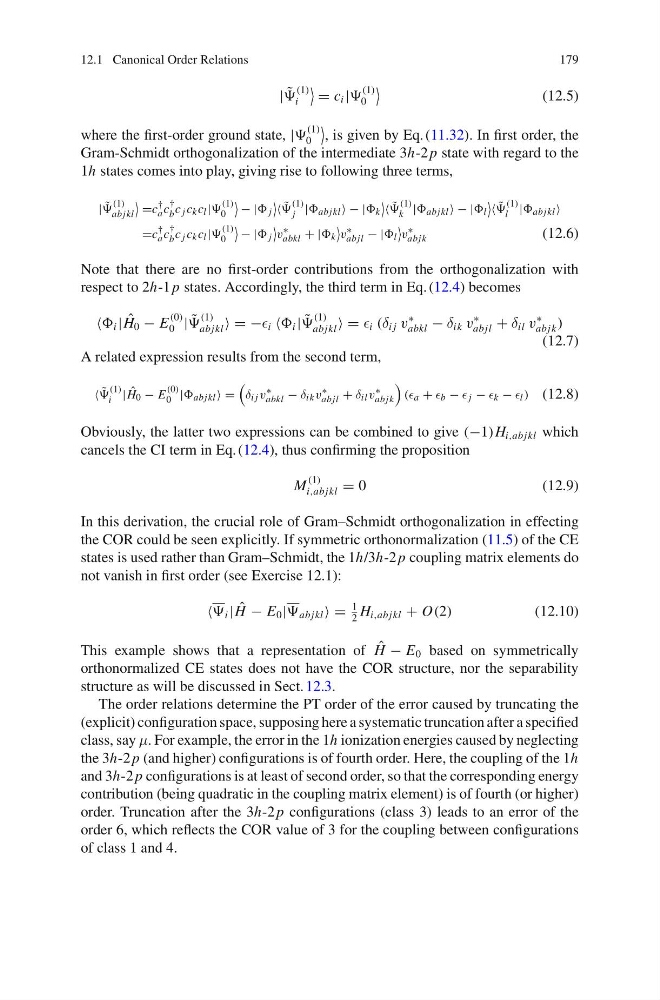
Gram-Schmidt orthogonalization of the intermediate 3h-2 p state with regard to the
1h states comes into play, giving rise to following three terms,
| ˜
(1)
abjkl
=c
†
a c
†
b c j c k c l |
(1)
0
− | j
˜
(1)
j | abjkl − | k
˜
(1)
k | abjkl − | l
˜
(1)
l | abjkl
=c
†
a c
†
b c j c k c l |
(1)
0
− | j
v
∗
abkl + | k
v
∗
abjl − | l
v
∗
abjk
(12.6)
Note that there are no first-order contributions from the orthogonalization with
respect to 2h-1 p states. Accordingly, the third term in Eq. (12.4) becomes
i | ˆ
H 0 − E
(0)
0 | ˜
(1)
abjkl = − i i | ˜
(1)
abjkl = i (δ i j v
∗
abkl − δ ik v
∗
abjl + δ il v
∗
abjk )
(12.7)
A related expression results from the second term,
˜
(1)
i | ˆ
H 0 − E
(0)
0 | abjkl =
δ i j v
∗
abkl − δ ik v
∗
abjl + δ il v
∗
abjk
( a + b − j − k − l ) (12.8)
Obviously, the latter two expressions can be combined to give (−1)H i,abjkl which
cancels the CI term in Eq. (12.4), thus confirming the proposition
M
(1)
i,abjkl = 0
(12.9)
In this derivation, the crucial role of Gram–Schmidt orthogonalization in effecting
the COR could be seen explicitly. If symmetric orthonormalization (11.5) of the CE
states is used rather than Gram–Schmidt, the 1h/3h-2 p coupling matrix elements do
not vanish in first order (see Exercise 12.1):
i | ˆ
H − E 0 | abjkl =
1
2
H i,abjkl + O(2)
(12.10)
This example shows that a representation of ˆ
H − E 0 based on symmetrically
orthonormalized CE states does not have the COR structure, nor the separability
structure as will be discussed in Sect. 12.3.
The order relations determine the PT order of the error caused by truncating the
(explicit) configuration space, supposing here a systematic truncation after a specified
class, say μ. For example, the error in the 1h ionization energies caused by neglecting
the 3h-2 p (and higher) configurations is of fourth order. Here, the coupling of the 1h
and 3h-2 p configurations is at least of second order, so that the corresponding energy
contribution (being quadratic in the coupling matrix element) is of fourth (or higher)
order. Truncation after the 3h-2 p configurations (class 3) leads to an error of the
order 6, which reflects the COR value of 3 for the coupling between configurations
of class 1 and 4.
179
| ˜
(1)
i
= c i |
(1)
0
(12.5)
where the first-order ground state, |
(1)
0
, is given by Eq. (11.32). In first order, the
Gram-Schmidt orthogonalization of the intermediate 3h-2 p state with regard to the
1h states comes into play, giving rise to following three terms,
| ˜
(1)
abjkl
=c
†
a c
†
b c j c k c l |
(1)
0
− | j
˜
(1)
j | abjkl − | k
˜
(1)
k | abjkl − | l
˜
(1)
l | abjkl
=c
†
a c
†
b c j c k c l |
(1)
0
− | j
v
∗
abkl + | k
v
∗
abjl − | l
v
∗
abjk
(12.6)
Note that there are no first-order contributions from the orthogonalization with
respect to 2h-1 p states. Accordingly, the third term in Eq. (12.4) becomes
i | ˆ
H 0 − E
(0)
0 | ˜
(1)
abjkl = − i i | ˜
(1)
abjkl = i (δ i j v
∗
abkl − δ ik v
∗
abjl + δ il v
∗
abjk )
(12.7)
A related expression results from the second term,
˜
(1)
i | ˆ
H 0 − E
(0)
0 | abjkl =
δ i j v
∗
abkl − δ ik v
∗
abjl + δ il v
∗
abjk
( a + b − j − k − l ) (12.8)
Obviously, the latter two expressions can be combined to give (−1)H i,abjkl which
cancels the CI term in Eq. (12.4), thus confirming the proposition
M
(1)
i,abjkl = 0
(12.9)
In this derivation, the crucial role of Gram–Schmidt orthogonalization in effecting
the COR could be seen explicitly. If symmetric orthonormalization (11.5) of the CE
states is used rather than Gram–Schmidt, the 1h/3h-2 p coupling matrix elements do
not vanish in first order (see Exercise 12.1):
i | ˆ
H − E 0 | abjkl =
1
2
H i,abjkl + O(2)
(12.10)
This example shows that a representation of ˆ
H − E 0 based on symmetrically
orthonormalized CE states does not have the COR structure, nor the separability
structure as will be discussed in Sect. 12.3.
The order relations determine the PT order of the error caused by truncating the
(explicit) configuration space, supposing here a systematic truncation after a specified
class, say μ. For example, the error in the 1h ionization energies caused by neglecting
the 3h-2 p (and higher) configurations is of fourth order. Here, the coupling of the 1h
and 3h-2 p configurations is at least of second order, so that the corresponding energy
contribution (being quadratic in the coupling matrix element) is of fourth (or higher)
order. Truncation after the 3h-2 p configurations (class 3) leads to an error of the
order 6, which reflects the COR value of 3 for the coupling between configurations
of class 1 and 4.