

178
12 Order Relations and Separability
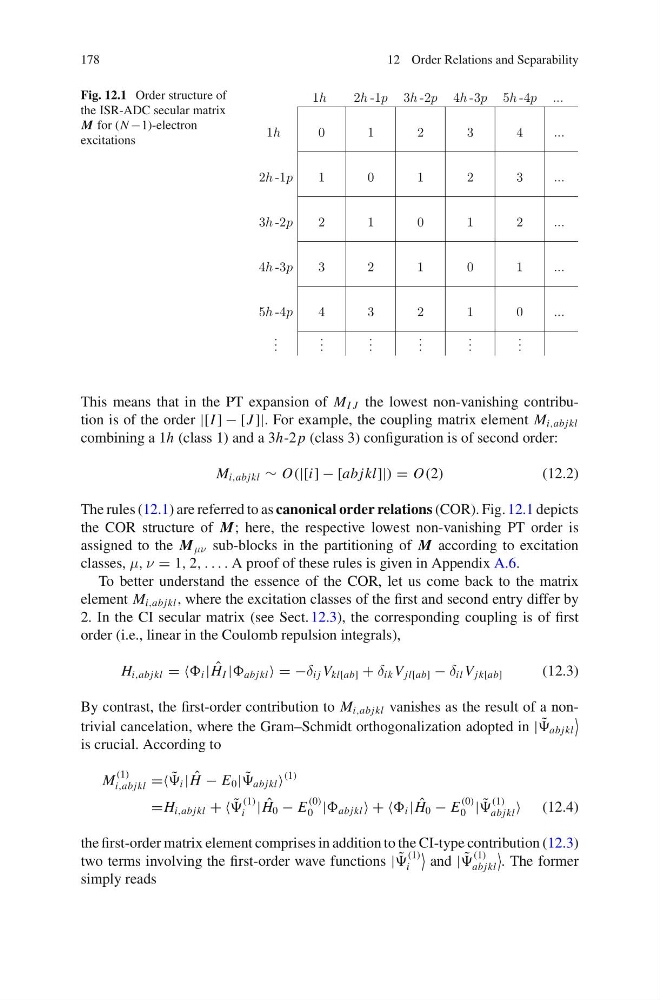
Fig. 12.1 Order structure of
the ISR-ADC secular matrix
M for (N −1)-electron
excitations
1h
2h -1p 3h -2p 4h -3p 5h -4p ...
1h
0
1
2
3
4
...
2h -1p
1
0
1
2
3
...
3h -2p
2
1
0
1
2
...
4h -3p
3
2
1
0
1
...
5h -4p
4
3
2
1
0
...
. . .
. . .
. . .
. . .
. . .
. . .
This means that in the PT expansion of M I J the lowest non-vanishing contribution is of the order |[I ] − [J ]|. For example, the coupling matrix element M i,abjkl
combining a 1h (class 1) and a 3h-2 p (class 3) configuration is of second order:
M i,abjkl ∼ O(|[i] − [abjkl]|) = O(2)
(12.2)
The rules (12.1) are referred to as canonical order relations (COR). Fig. 12.1 depicts
the COR structure of M; here, the respective lowest non-vanishing PT order is
assigned to the M μν sub-blocks in the partitioning of M according to excitation
classes, μ, ν = 1, 2, . . . . A proof of these rules is given in Appendix A.6.
To better understand the essence of the COR, let us come back to the matrix
element M i,abjkl , where the excitation classes of the first and second entry differ by
2. In the CI secular matrix (see Sect. 12.3), the corresponding coupling is of first
order (i.e., linear in the Coulomb repulsion integrals),
H i,abjkl = = i | ˆ
H I | abjkl = −δ i j V kl[ab] + δ ik V jl[ab] − δ il V jk[ab]
(12.3)
By contrast, the first-order contribution to M i,abjkl vanishes as the result of a nontrivial cancelation, where the Gram–Schmidt orthogonalization adopted in | ˜
abjkl
is crucial. According to
M
(1)
i,abjkl == ˜
i | ˆ
H − E 0 | ˜
abjkl
(1)
=H i,abjkl + + ˜
(1)
i | ˆ
H 0 − E
(0)
0 | abjkl + + i | ˆ
H 0 − E
(0)
0 | ˜
(1)
abjkl (12.4)
the first-order matrix element comprises in addition to the CI-type contribution (12.3)
two terms involving the first-order wave functions | ˜
(1)
i
and | ˜
(1)
abjkl
. The former
simply reads
12 Order Relations and Separability
Fig. 12.1 Order structure of
the ISR-ADC secular matrix
M for (N −1)-electron
excitations
1h
2h -1p 3h -2p 4h -3p 5h -4p ...
1h
0
1
2
3
4
...
2h -1p
1
0
1
2
3
...
3h -2p
2
1
0
1
2
...
4h -3p
3
2
1
0
1
...
5h -4p
4
3
2
1
0
...
. . .
. . .
. . .
. . .
. . .
. . .
This means that in the PT expansion of M I J the lowest non-vanishing contribution is of the order |[I ] − [J ]|. For example, the coupling matrix element M i,abjkl
combining a 1h (class 1) and a 3h-2 p (class 3) configuration is of second order:
M i,abjkl ∼ O(|[i] − [abjkl]|) = O(2)
(12.2)
The rules (12.1) are referred to as canonical order relations (COR). Fig. 12.1 depicts
the COR structure of M; here, the respective lowest non-vanishing PT order is
assigned to the M μν sub-blocks in the partitioning of M according to excitation
classes, μ, ν = 1, 2, . . . . A proof of these rules is given in Appendix A.6.
To better understand the essence of the COR, let us come back to the matrix
element M i,abjkl , where the excitation classes of the first and second entry differ by
2. In the CI secular matrix (see Sect. 12.3), the corresponding coupling is of first
order (i.e., linear in the Coulomb repulsion integrals),
H i,abjkl = = i | ˆ
H I | abjkl = −δ i j V kl[ab] + δ ik V jl[ab] − δ il V jk[ab]
(12.3)
By contrast, the first-order contribution to M i,abjkl vanishes as the result of a nontrivial cancelation, where the Gram–Schmidt orthogonalization adopted in | ˜
abjkl
is crucial. According to
M
(1)
i,abjkl == ˜
i | ˆ
H − E 0 | ˜
abjkl
(1)
=H i,abjkl + + ˜
(1)
i | ˆ
H 0 − E
(0)
0 | abjkl + + i | ˆ
H 0 − E
(0)
0 | ˜
(1)
abjkl (12.4)
the first-order matrix element comprises in addition to the CI-type contribution (12.3)
two terms involving the first-order wave functions | ˜
(1)
i
and | ˜
(1)
abjkl
. The former
simply reads