

140
9 Algebraic–Diagrammatic Construction (ADC)
are altogether 240 Goldstone diagrams, of which one half (120 diagrams) contributes
to M
(4)+ , the other half to M
(4)− . For the ADC procedure, many of these diagrams
are redundant as they only recover ingredients already determined at the second- and
third-order level. To determine those ADC(4) contributions which arise for the first
time, it suffices to inspect a subset of certain key diagrams.
While the ADC(2) and ADC(3) configuration space for M
+
(ω) was spanned by
the 2 p-1h excitations, the next higher excitation class, 3 p-2h, comes explicitly into
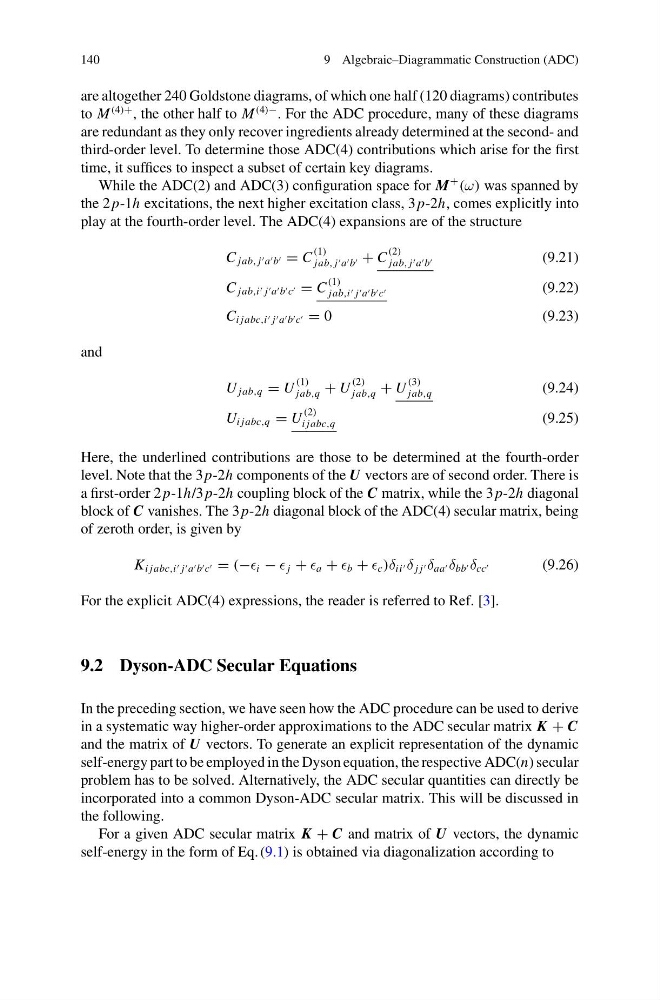
play at the fourth-order level. The ADC(4) expansions are of the structure
C jab, j a b = C
(1)
jab, j a b + C
(2)
jab, j a b
(9.21)
C jab,i j a b c = C
(1)
jab,i j a b c
(9.22)
C i jabc,i j a b c = 0
(9.23)
and
U jab,q = U
(1)
jab,q + U
(2)
jab,q + U
(3)
jab,q
(9.24)
U i jabc,q = U
(2)
i jabc,q
(9.25)
Here, the underlined contributions are those to be determined at the fourth-order
level. Note that the 3 p-2h components of the U vectors are of second order. There is
a first-order 2 p-1h/3 p-2h coupling block of the C matrix, while the 3 p-2h diagonal
block of C vanishes. The 3 p-2h diagonal block of the ADC(4) secular matrix, being
of zeroth order, is given by
K i jabc,i j a b c = (− i − j + a + b + c )δ ii δ j j δ aa δ bb δ cc
(9.26)
For the explicit ADC(4) expressions, the reader is referred to Ref. [3].
9.2 Dyson-ADC Secular Equations
In the preceding section, we have seen how the ADC procedure can be used to derive
in a systematic way higher-order approximations to the ADC secular matrix K + C
and the matrix of U vectors. To generate an explicit representation of the dynamic
self-energy part to be employed in the Dyson equation, the respective ADC(n) secular
problem has to be solved. Alternatively, the ADC secular quantities can directly be
incorporated into a common Dyson-ADC secular matrix. This will be discussed in
the following.
For a given ADC secular matrix K + C and matrix of U vectors, the dynamic
self-energy in the form of Eq. (9.1) is obtained via diagonalization according to
9 Algebraic–Diagrammatic Construction (ADC)
are altogether 240 Goldstone diagrams, of which one half (120 diagrams) contributes
to M
(4)+ , the other half to M
(4)− . For the ADC procedure, many of these diagrams
are redundant as they only recover ingredients already determined at the second- and
third-order level. To determine those ADC(4) contributions which arise for the first
time, it suffices to inspect a subset of certain key diagrams.
While the ADC(2) and ADC(3) configuration space for M
+
(ω) was spanned by
the 2 p-1h excitations, the next higher excitation class, 3 p-2h, comes explicitly into
play at the fourth-order level. The ADC(4) expansions are of the structure
C jab, j a b = C
(1)
jab, j a b + C
(2)
jab, j a b
(9.21)
C jab,i j a b c = C
(1)
jab,i j a b c
(9.22)
C i jabc,i j a b c = 0
(9.23)
and
U jab,q = U
(1)
jab,q + U
(2)
jab,q + U
(3)
jab,q
(9.24)
U i jabc,q = U
(2)
i jabc,q
(9.25)
Here, the underlined contributions are those to be determined at the fourth-order
level. Note that the 3 p-2h components of the U vectors are of second order. There is
a first-order 2 p-1h/3 p-2h coupling block of the C matrix, while the 3 p-2h diagonal
block of C vanishes. The 3 p-2h diagonal block of the ADC(4) secular matrix, being
of zeroth order, is given by
K i jabc,i j a b c = (− i − j + a + b + c )δ ii δ j j δ aa δ bb δ cc
(9.26)
For the explicit ADC(4) expressions, the reader is referred to Ref. [3].
9.2 Dyson-ADC Secular Equations
In the preceding section, we have seen how the ADC procedure can be used to derive
in a systematic way higher-order approximations to the ADC secular matrix K + C
and the matrix of U vectors. To generate an explicit representation of the dynamic
self-energy part to be employed in the Dyson equation, the respective ADC(n) secular
problem has to be solved. Alternatively, the ADC secular quantities can directly be
incorporated into a common Dyson-ADC secular matrix. This will be discussed in
the following.
For a given ADC secular matrix K + C and matrix of U vectors, the dynamic
self-energy in the form of Eq. (9.1) is obtained via diagonalization according to