

8.3 Solving the Dyson Equation
129
Here, the matrix elements of the 2h-1 p diagonal block are specified only through
zeroth order. Obviously, the secular matrix given by Eq. (8.67) is (up to a sign) part
of the second-order Dyson matrix. In a similar way, the analogous CI secular matrix
for N +1 particles is retrieved within A(2). What makes A(2) peculiar is the fact
that there is a coupling of the (N −1)- and (N +1)-particle parts. How can such a
coupling, which is not feasible within a wave-function approach, be rationalized?
An analysis of the results through second order of perturbation theory can give some
clue.
5. Analysis of the Dyson Equation Using Second-Order Perturbation Theory
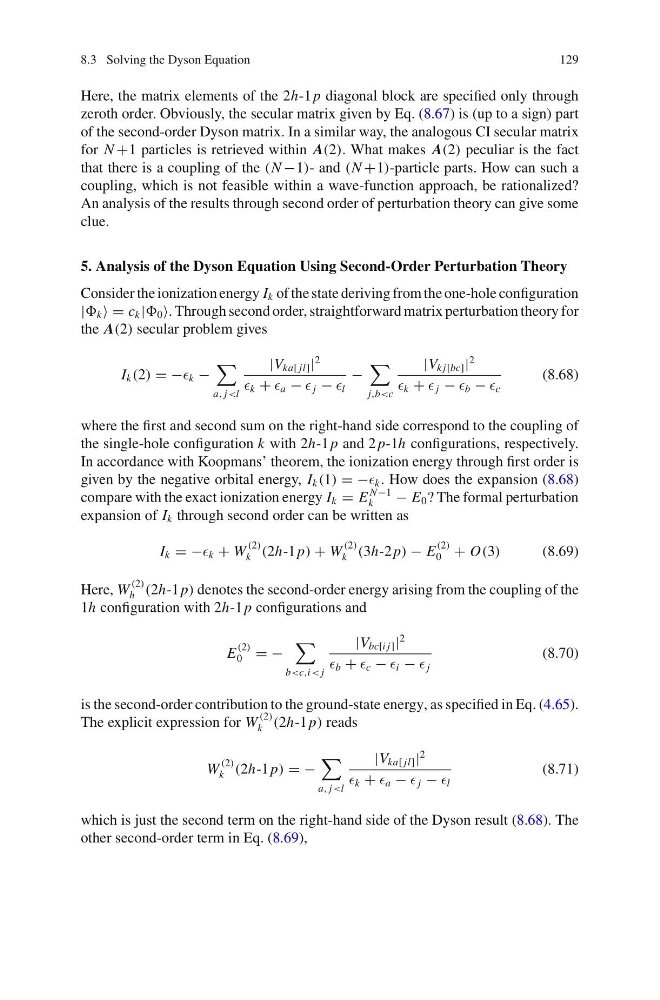
Consider the ionization energy I k of the state deriving from the one-hole configuration
| k = c k | 0 . Through second order, straightforward matrix perturbation theory for
the A(2) secular problem gives
I k (2) = − k −
a, j
2
k + a − j − l
−
j,b
2
k + j − b − c
(8.68)
where the first and second sum on the right-hand side correspond to the coupling of
the single-hole configuration k with 2h-1 p and 2 p-1h configurations, respectively.
In accordance with Koopmans’ theorem, the ionization energy through first order is
given by the negative orbital energy, I k (1) = − k . How does the expansion (8.68)
compare with the exact ionization energy I k = E
N −1
k
− E 0 ? The formal perturbation
expansion of I k through second order can be written as
I k = − k + W
(2)
k (2h-1 p) + W
(2)
k (3h-2 p) − E
(2)
0 + O(3)
(8.69)
Here, W
(2)
h (2h-1 p) denotes the second-order energy arising from the coupling of the
1h configuration with 2h-1 p configurations and
E
(2)
0 = −
b
2
b + c − i − j
(8.70)
is the second-order contribution to the ground-state energy, as specified in Eq. (4.65).
The explicit expression for W
(2)
k (2h-1 p) reads
W
(2)
k (2h-1 p) = −
a, j
2
k + a − j − l
(8.71)
which is just the second term on the right-hand side of the Dyson result (8.68). The
other second-order term in Eq. (8.69),
129
Here, the matrix elements of the 2h-1 p diagonal block are specified only through
zeroth order. Obviously, the secular matrix given by Eq. (8.67) is (up to a sign) part
of the second-order Dyson matrix. In a similar way, the analogous CI secular matrix
for N +1 particles is retrieved within A(2). What makes A(2) peculiar is the fact
that there is a coupling of the (N −1)- and (N +1)-particle parts. How can such a
coupling, which is not feasible within a wave-function approach, be rationalized?
An analysis of the results through second order of perturbation theory can give some
clue.
5. Analysis of the Dyson Equation Using Second-Order Perturbation Theory
Consider the ionization energy I k of the state deriving from the one-hole configuration
| k = c k | 0 . Through second order, straightforward matrix perturbation theory for
the A(2) secular problem gives
I k (2) = − k −
a, j
2
k + a − j − l
−
j,b
2
k + j − b − c
(8.68)
where the first and second sum on the right-hand side correspond to the coupling of
the single-hole configuration k with 2h-1 p and 2 p-1h configurations, respectively.
In accordance with Koopmans’ theorem, the ionization energy through first order is
given by the negative orbital energy, I k (1) = − k . How does the expansion (8.68)
compare with the exact ionization energy I k = E
N −1
k
− E 0 ? The formal perturbation
expansion of I k through second order can be written as
I k = − k + W
(2)
k (2h-1 p) + W
(2)
k (3h-2 p) − E
(2)
0 + O(3)
(8.69)
Here, W
(2)
h (2h-1 p) denotes the second-order energy arising from the coupling of the
1h configuration with 2h-1 p configurations and
E
(2)
0 = −
b
2
b + c − i − j
(8.70)
is the second-order contribution to the ground-state energy, as specified in Eq. (4.65).
The explicit expression for W
(2)
k (2h-1 p) reads
W
(2)
k (2h-1 p) = −
a, j
2
k + a − j − l
(8.71)
which is just the second term on the right-hand side of the Dyson result (8.68). The
other second-order term in Eq. (8.69),