

130
8 Self-Energy and the Dyson Equation
W
(2)
k (3h-2 p) = −
b
|V bc[i j] |
2
b + c − i − j
(8.72)
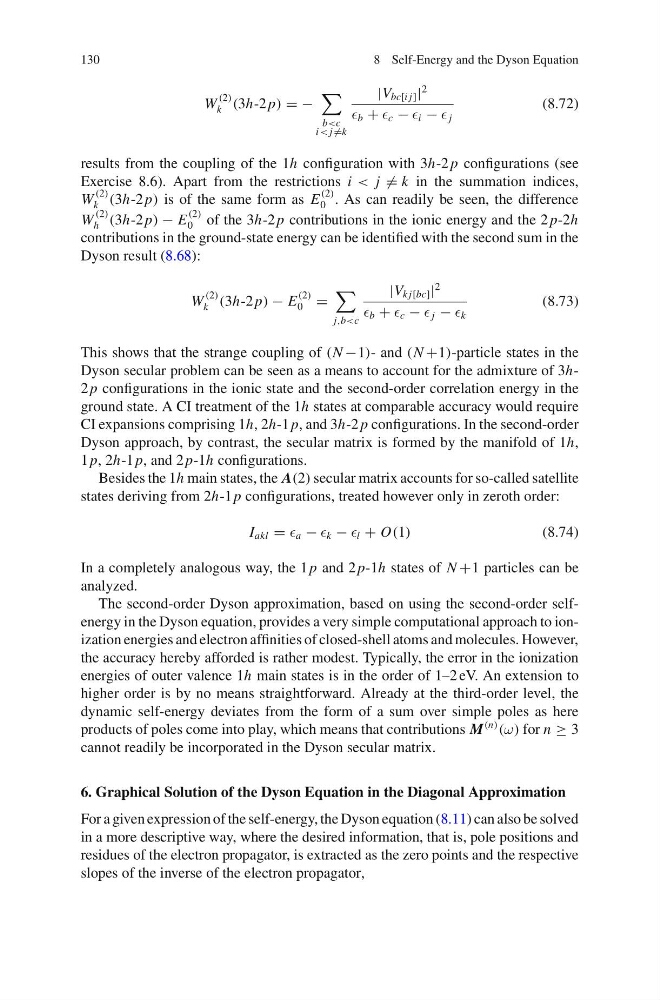
results from the coupling of the 1h configuration with 3h-2 p configurations (see
Exercise 8.6). Apart from the restrictions i < j = k in the summation indices,
W
(2)
k (3h-2 p) is of the same form as E
(2)
0 . As can readily be seen, the difference
W
(2)
h (3h-2 p) − E
(2)
0 of the 3h-2 p contributions in the ionic energy and the 2 p-2h
contributions in the ground-state energy can be identified with the second sum in the
Dyson result (8.68):
W
(2)
k (3h-2 p) − E
(2)
0 =
j,b
2
b + c − j − k
(8.73)
This shows that the strange coupling of (N −1)- and (N +1)-particle states in the
Dyson secular problem can be seen as a means to account for the admixture of 3h2 p configurations in the ionic state and the second-order correlation energy in the
ground state. A CI treatment of the 1h states at comparable accuracy would require
CI expansions comprising 1h, 2h-1 p, and 3h-2 p configurations. In the second-order
Dyson approach, by contrast, the secular matrix is formed by the manifold of 1h,
1 p, 2h-1 p, and 2 p-1h configurations.
Besides the 1h main states, the A(2) secular matrix accounts for so-called satellite
states deriving from 2h-1 p configurations, treated however only in zeroth order:
I akl = a − k − l + O(1)
(8.74)
In a completely analogous way, the 1 p and 2 p-1h states of N +1 particles can be
analyzed.
The second-order Dyson approximation, based on using the second-order selfenergy in the Dyson equation, provides a very simple computational approach to ionization energies and electron affinities of closed-shell atoms and molecules. However,
the accuracy hereby afforded is rather modest. Typically, the error in the ionization
energies of outer valence 1h main states is in the order of 1–2 eV. An extension to
higher order is by no means straightforward. Already at the third-order level, the
dynamic self-energy deviates from the form of a sum over simple poles as here
products of poles come into play, which means that contributions M
(n)
(ω) for n ≥ 3
cannot readily be incorporated in the Dyson secular matrix.
6. Graphical Solution of the Dyson Equation in the Diagonal Approximation
For a given expression of the self-energy, the Dyson equation (8.11) can also be solved
in a more descriptive way, where the desired information, that is, pole positions and
residues of the electron propagator, is extracted as the zero points and the respective
slopes of the inverse of the electron propagator,
8 Self-Energy and the Dyson Equation
W
(2)
k (3h-2 p) = −
b
|V bc[i j] |
2
b + c − i − j
(8.72)
results from the coupling of the 1h configuration with 3h-2 p configurations (see
Exercise 8.6). Apart from the restrictions i < j = k in the summation indices,
W
(2)
k (3h-2 p) is of the same form as E
(2)
0 . As can readily be seen, the difference
W
(2)
h (3h-2 p) − E
(2)
0 of the 3h-2 p contributions in the ionic energy and the 2 p-2h
contributions in the ground-state energy can be identified with the second sum in the
Dyson result (8.68):
W
(2)
k (3h-2 p) − E
(2)
0 =
j,b
2
b + c − j − k
(8.73)
This shows that the strange coupling of (N −1)- and (N +1)-particle states in the
Dyson secular problem can be seen as a means to account for the admixture of 3h2 p configurations in the ionic state and the second-order correlation energy in the
ground state. A CI treatment of the 1h states at comparable accuracy would require
CI expansions comprising 1h, 2h-1 p, and 3h-2 p configurations. In the second-order
Dyson approach, by contrast, the secular matrix is formed by the manifold of 1h,
1 p, 2h-1 p, and 2 p-1h configurations.
Besides the 1h main states, the A(2) secular matrix accounts for so-called satellite
states deriving from 2h-1 p configurations, treated however only in zeroth order:
I akl = a − k − l + O(1)
(8.74)
In a completely analogous way, the 1 p and 2 p-1h states of N +1 particles can be
analyzed.
The second-order Dyson approximation, based on using the second-order selfenergy in the Dyson equation, provides a very simple computational approach to ionization energies and electron affinities of closed-shell atoms and molecules. However,
the accuracy hereby afforded is rather modest. Typically, the error in the ionization
energies of outer valence 1h main states is in the order of 1–2 eV. An extension to
higher order is by no means straightforward. Already at the third-order level, the
dynamic self-energy deviates from the form of a sum over simple poles as here
products of poles come into play, which means that contributions M
(n)
(ω) for n ≥ 3
cannot readily be incorporated in the Dyson secular matrix.
6. Graphical Solution of the Dyson Equation in the Diagonal Approximation
For a given expression of the self-energy, the Dyson equation (8.11) can also be solved
in a more descriptive way, where the desired information, that is, pole positions and
residues of the electron propagator, is extracted as the zero points and the respective
slopes of the inverse of the electron propagator,