

122
8 Self-Energy and the Dyson Equation
pq (∞) =
u,v
V pu[qv] (−i)
G vu (t, t
+
) − G
0
vu (t, t
+
)
(8.36)
or
pq (∞) =
u,v
V pu[qv]
1
2πi
2
G vu (ω) − G
0
vu (ω)
dω
(8.37)
This result, establishing a relationship between the static self-energy and the electron
propagator, can further be expanded by inserting the formal solution (8.11) of the
Dyson equation for G(ω) on the right-hand side:
pq (∞) =
u,v
V pu[qv]
1
2πi
2
G
0
(ω)
−1
−(∞)− M(ω)
−1
vu
dω −δ uv n u
(8.38)
Here, the partitioning (8.18) of the self-energy has been used. As Eq. (8.38) shows,
the static self-energy part is determined by the dynamical part: For a given M(ω), it
constitutes an implicit equation for (∞). This means that in devising approximation
schemes for the self-energy one can focus on the dynamical part. Once a suitable
approximation for M(ω) has been devised, a consistent approximation for (∞)
can be obtained via Eq. (8.38). A practical procedure for the evaluation of (∞) is
described in Appendix A.5.
The closed-form expressions (8.36) and (8.37) can be obtained in a more intuitive
way using diagrammatic analysis. The diagrams contributing to (∞) are of the
form of the third-order diagram T 3 in Fig. 8.9. Any nth-order diagram, n > 0, in
the electron propagator expansion can be transformed into a corresponding (∞)
diagram of order n + 1 by joining the two outer free fermion lines in an interaction
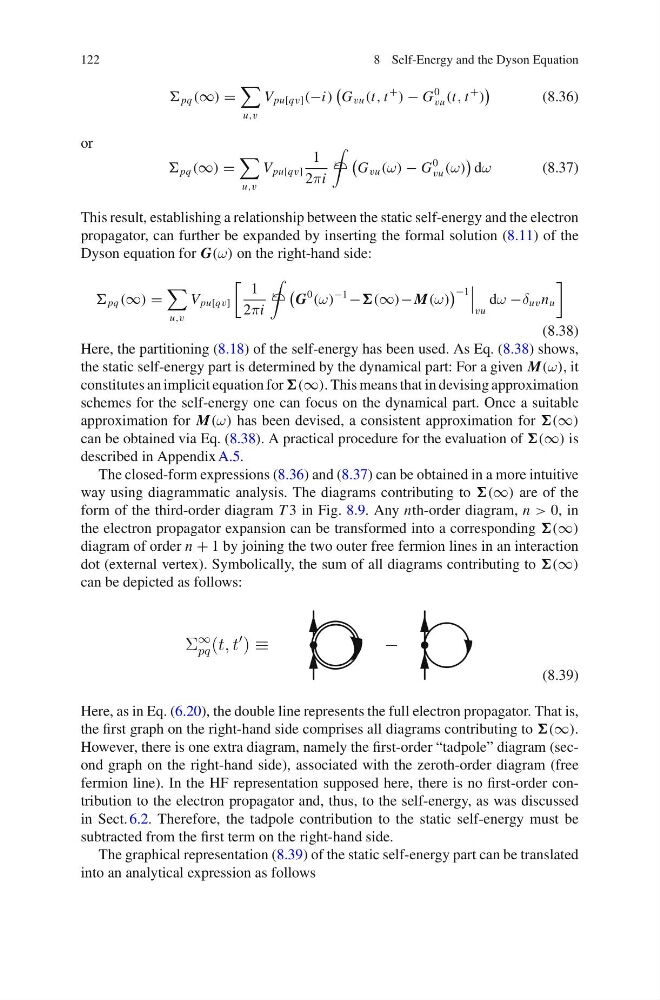
dot (external vertex). Symbolically, the sum of all diagrams contributing to (∞)
can be depicted as follows:
(8.39)
Here, as in Eq. (6.20), the double line represents the full electron propagator. That is,
the first graph on the right-hand side comprises all diagrams contributing to (∞).
However, there is one extra diagram, namely the first-order “tadpole” diagram (second graph on the right-hand side), associated with the zeroth-order diagram (free
fermion line). In the HF representation supposed here, there is no first-order contribution to the electron propagator and, thus, to the self-energy, as was discussed
in Sect. 6.2. Therefore, the tadpole contribution to the static self-energy must be
subtracted from the first term on the right-hand side.
The graphical representation (8.39) of the static self-energy part can be translated
into an analytical expression as follows
8 Self-Energy and the Dyson Equation
pq (∞) =
u,v
V pu[qv] (−i)
G vu (t, t
+
) − G
0
vu (t, t
+
)
(8.36)
or
pq (∞) =
u,v
V pu[qv]
1
2πi
2
G vu (ω) − G
0
vu (ω)
dω
(8.37)
This result, establishing a relationship between the static self-energy and the electron
propagator, can further be expanded by inserting the formal solution (8.11) of the
Dyson equation for G(ω) on the right-hand side:
pq (∞) =
u,v
V pu[qv]
1
2πi
2
G
0
(ω)
−1
−(∞)− M(ω)
−1
vu
dω −δ uv n u
(8.38)
Here, the partitioning (8.18) of the self-energy has been used. As Eq. (8.38) shows,
the static self-energy part is determined by the dynamical part: For a given M(ω), it
constitutes an implicit equation for (∞). This means that in devising approximation
schemes for the self-energy one can focus on the dynamical part. Once a suitable
approximation for M(ω) has been devised, a consistent approximation for (∞)
can be obtained via Eq. (8.38). A practical procedure for the evaluation of (∞) is
described in Appendix A.5.
The closed-form expressions (8.36) and (8.37) can be obtained in a more intuitive
way using diagrammatic analysis. The diagrams contributing to (∞) are of the
form of the third-order diagram T 3 in Fig. 8.9. Any nth-order diagram, n > 0, in
the electron propagator expansion can be transformed into a corresponding (∞)
diagram of order n + 1 by joining the two outer free fermion lines in an interaction
dot (external vertex). Symbolically, the sum of all diagrams contributing to (∞)
can be depicted as follows:
(8.39)
Here, as in Eq. (6.20), the double line represents the full electron propagator. That is,
the first graph on the right-hand side comprises all diagrams contributing to (∞).
However, there is one extra diagram, namely the first-order “tadpole” diagram (second graph on the right-hand side), associated with the zeroth-order diagram (free
fermion line). In the HF representation supposed here, there is no first-order contribution to the electron propagator and, thus, to the self-energy, as was discussed
in Sect. 6.2. Therefore, the tadpole contribution to the static self-energy must be
subtracted from the first term on the right-hand side.
The graphical representation (8.39) of the static self-energy part can be translated
into an analytical expression as follows