

8.2 Analytical Properties of the Self-Energy
123
∞
pq (t, t
) = δ(t − t
)) pq (∞)
pq (∞) = lim
t
1 →t 1
r,s
V pr[qs] (−i)
G sr (t 1 , t
1 ) − G
0
sr (t 1 , t
1 )
(8.40)
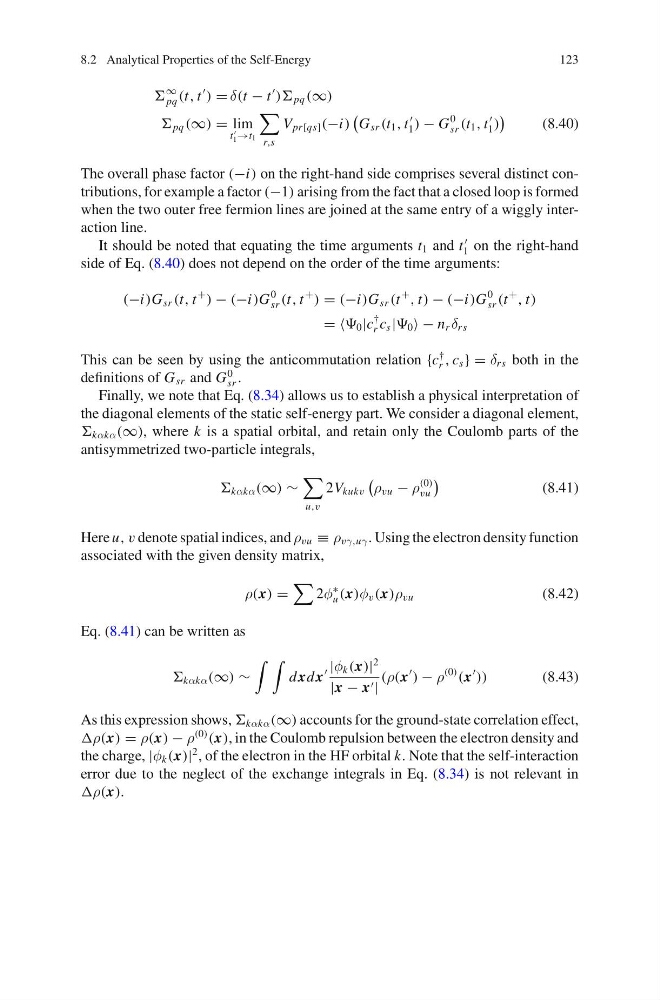
The overall phase factor (−i) on the right-hand side comprises several distinct contributions, for example a factor (−1) arising from the fact that a closed loop is formed
when the two outer free fermion lines are joined at the same entry of a wiggly interaction line.
It should be noted that equating the time arguments t 1 and t
1 on the right-hand
side of Eq. (8.40) does not depend on the order of the time arguments:
(−i)G sr (t, t
+
) − (−i)G
0
sr (t, t
+
) = (−i)G sr (t
+
, t) − (−i)G
0
sr (t
+
, t)
= = 0 |c
†
r c s | 0 − n r δ rs
This can be seen by using the anticommutation relation {c
†
r , c s } = δ rs both in the
definitions of G sr and G
0
sr .
Finally, we note that Eq. (8.34) allows us to establish a physical interpretation of
the diagonal elements of the static self-energy part. We consider a diagonal element,
kαkα (∞), where k is a spatial orbital, and retain only the Coulomb parts of the
antisymmetrized two-particle integrals,
kαkα (∞) ∼
u,v
2V kukv
ρ vu − ρ
(0)
vu
(8.41)
Here u, v denote spatial indices, and ρ vu ≡ ρ vγ,uγ . Using the electron density function
associated with the given density matrix,
ρ(x) =
2φ
∗
u (x)φ v (x)ρ vu
(8.42)
Eq. (8.41) can be written as
kαkα (∞) ∼
d xd x
|φ k (x)|
2
|x − x |
(ρ(x
) − ρ
(0)
(x
))
(8.43)
As this expression shows, kαkα (∞) accounts for the ground-state correlation effect,
ρ(x) = ρ(x) − ρ
(0)
(x), in the Coulomb repulsion between the electron density and
the charge, |φ k (x)|
2 , of the electron in the HF orbital k. Note that the self-interaction
error due to the neglect of the exchange integrals in Eq. (8.34) is not relevant in
ρ(x).
123
∞
pq (t, t
) = δ(t − t
)) pq (∞)
pq (∞) = lim
t
1 →t 1
r,s
V pr[qs] (−i)
G sr (t 1 , t
1 ) − G
0
sr (t 1 , t
1 )
(8.40)
The overall phase factor (−i) on the right-hand side comprises several distinct contributions, for example a factor (−1) arising from the fact that a closed loop is formed
when the two outer free fermion lines are joined at the same entry of a wiggly interaction line.
It should be noted that equating the time arguments t 1 and t
1 on the right-hand
side of Eq. (8.40) does not depend on the order of the time arguments:
(−i)G sr (t, t
+
) − (−i)G
0
sr (t, t
+
) = (−i)G sr (t
+
, t) − (−i)G
0
sr (t
+
, t)
= = 0 |c
†
r c s | 0 − n r δ rs
This can be seen by using the anticommutation relation {c
†
r , c s } = δ rs both in the
definitions of G sr and G
0
sr .
Finally, we note that Eq. (8.34) allows us to establish a physical interpretation of
the diagonal elements of the static self-energy part. We consider a diagonal element,
kαkα (∞), where k is a spatial orbital, and retain only the Coulomb parts of the
antisymmetrized two-particle integrals,
kαkα (∞) ∼
u,v
2V kukv
ρ vu − ρ
(0)
vu
(8.41)
Here u, v denote spatial indices, and ρ vu ≡ ρ vγ,uγ . Using the electron density function
associated with the given density matrix,
ρ(x) =
2φ
∗
u (x)φ v (x)ρ vu
(8.42)
Eq. (8.41) can be written as
kαkα (∞) ∼
d xd x
|φ k (x)|
2
|x − x |
(ρ(x
) − ρ
(0)
(x
))
(8.43)
As this expression shows, kαkα (∞) accounts for the ground-state correlation effect,
ρ(x) = ρ(x) − ρ
(0)
(x), in the Coulomb repulsion between the electron density and
the charge, |φ k (x)|
2 , of the electron in the HF orbital k. Note that the self-interaction
error due to the neglect of the exchange integrals in Eq. (8.34) is not relevant in
ρ(x).