

100
7 Time-Ordered or Goldstone Diagrams
7.2 Performing the Inner Time Integrations
As we have seen in the preceding section, the energy representation of the
Feynman diagrams has simplified the integration problem but not solved it: one still
has to deal with an n-fold ω-integration for each nth-order diagram. In the following, we will address a diagrammatic technique, by which the result of the inner time
or ω-integrations is derived directly from the so-called time-ordered or Goldstone
diagrams (named after Ref. [1]) associated with a given Feynman (or Abrikosov)
diagram. Somewhat surprisingly, the concept of time-ordered diagrams can hardly
be considered as widely known. While the rules for drawing and evaluating Goldstone
diagrams can be found in the literature (see Refs. [2, 3]), actual derivations seem
to be missing. For a demonstration of how time-ordered diagrams come into play,
we begin with the simple case of the first-order Feynman diagram for a one-particle
interaction. Then, the general rules for drawing and evaluating the time-ordered diagrams will be presented and applied to the second-order Abrikosov diagram for the
electron propagator. A stringent derivation of the Goldstone diagram rules is given
in Appendix A.4.
Fourier and Internal Time Integrations in a Simple Example
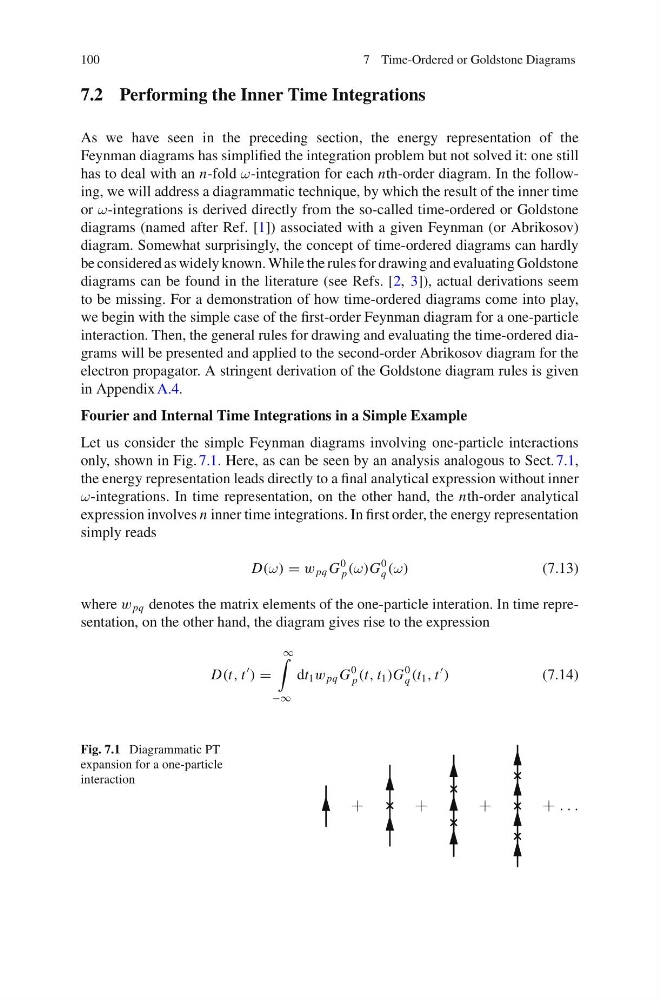
Let us consider the simple Feynman diagrams involving one-particle interactions
only, shown in Fig. 7.1. Here, as can be seen by an analysis analogous to Sect. 7.1,
the energy representation leads directly to a final analytical expression without inner
ω-integrations. In time representation, on the other hand, the nth-order analytical
expression involves n inner time integrations. In first order, the energy representation
simply reads
D(ω) = w pq G
0
p (ω)G
0
q (ω)
(7.13)
where w pq denotes the matrix elements of the one-particle interation. In time representation, on the other hand, the diagram gives rise to the expression
D(t, t
) =
∞
−∞
dt 1 w pq G
0
p (t, t 1 )G
0
q (t 1 , t
)
(7.14)
Fig. 7.1 Diagrammatic PT
expansion for a one-particle
interaction
7 Time-Ordered or Goldstone Diagrams
7.2 Performing the Inner Time Integrations
As we have seen in the preceding section, the energy representation of the
Feynman diagrams has simplified the integration problem but not solved it: one still
has to deal with an n-fold ω-integration for each nth-order diagram. In the following, we will address a diagrammatic technique, by which the result of the inner time
or ω-integrations is derived directly from the so-called time-ordered or Goldstone
diagrams (named after Ref. [1]) associated with a given Feynman (or Abrikosov)
diagram. Somewhat surprisingly, the concept of time-ordered diagrams can hardly
be considered as widely known. While the rules for drawing and evaluating Goldstone
diagrams can be found in the literature (see Refs. [2, 3]), actual derivations seem
to be missing. For a demonstration of how time-ordered diagrams come into play,
we begin with the simple case of the first-order Feynman diagram for a one-particle
interaction. Then, the general rules for drawing and evaluating the time-ordered diagrams will be presented and applied to the second-order Abrikosov diagram for the
electron propagator. A stringent derivation of the Goldstone diagram rules is given
in Appendix A.4.
Fourier and Internal Time Integrations in a Simple Example
Let us consider the simple Feynman diagrams involving one-particle interactions
only, shown in Fig. 7.1. Here, as can be seen by an analysis analogous to Sect. 7.1,
the energy representation leads directly to a final analytical expression without inner
ω-integrations. In time representation, on the other hand, the nth-order analytical
expression involves n inner time integrations. In first order, the energy representation
simply reads
D(ω) = w pq G
0
p (ω)G
0
q (ω)
(7.13)
where w pq denotes the matrix elements of the one-particle interation. In time representation, on the other hand, the diagram gives rise to the expression
D(t, t
) =
∞
−∞
dt 1 w pq G
0
p (t, t 1 )G
0
q (t 1 , t
)
(7.14)
Fig. 7.1 Diagrammatic PT
expansion for a one-particle
interaction