

photoisomerization of an azobenzene-based dicarboxylate linker 54 followed by
aggregation mediated crystal growth resulted in two distinct morphological forms
(flowers and stars). The two materials show subtle differences in their physical
properties. The maximum amounts of N 2 adsorbed at saturation pressure for 54 gel
and 54′ gel are 88 and 46 mL g
−1 , and Brunauer–Emmett–Teller (BET) surface
area 223 and 90 m
2 g
−1 , respectively.
Zhang and co-workers reported a gel with aggregation-induced emission
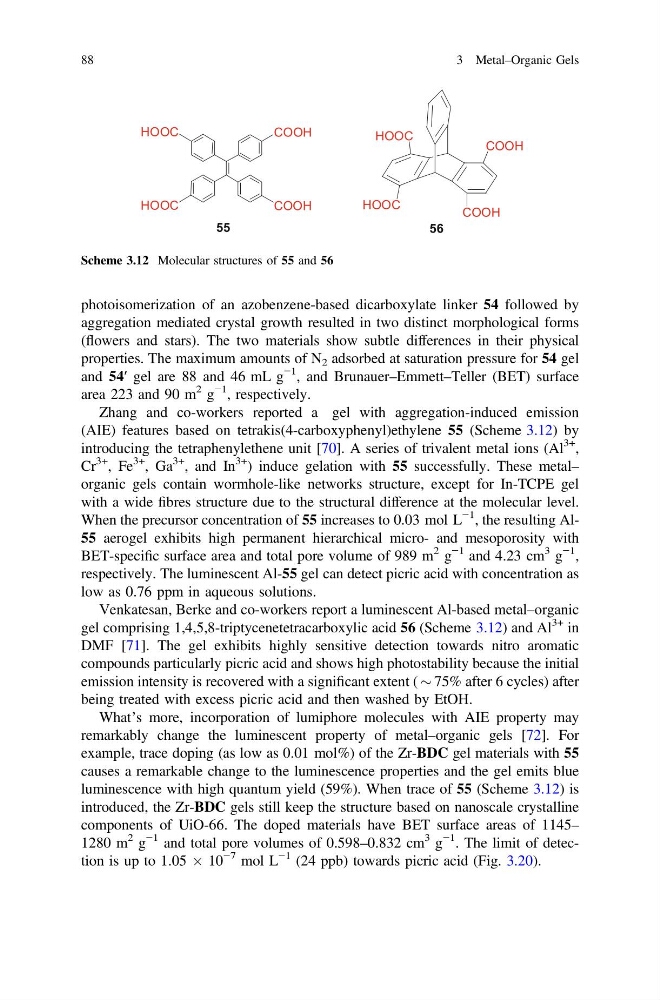
(AIE) features based on tetrakis(4-carboxyphenyl)ethylene 55 (Scheme 3.12) by
introducing the tetraphenylethene unit [70]. A series of trivalent metal ions (Al
3+ ,
Cr
3+ , Fe
3+ , Ga
3+ , and In
3+ ) induce gelation with 55 successfully. These metal–
organic gels contain wormhole-like networks structure, except for In-TCPE gel
with a wide fibres structure due to the structural difference at the molecular level.
When the precursor concentration of 55 increases to 0.03 mol L
−1 , the resulting Al55 aerogel exhibits high permanent hierarchical micro- and mesoporosity with
BET-specific surface area and total pore volume of 989 m
2 g
−1 and 4.23 cm
3 g
−1 ,
respectively. The luminescent Al-55 gel can detect picric acid with concentration as
low as 0.76 ppm in aqueous solutions.
Venkatesan, Berke and co-workers report a luminescent Al-based metal–organic
gel comprising 1,4,5,8-triptycenetetracarboxylic acid 56 (Scheme 3.12) and Al
3+ in
DMF [71]. The gel exhibits highly sensitive detection towards nitro aromatic
compounds particularly picric acid and shows high photostability because the initial
emission intensity is recovered with a significant extent ( $ 75% after 6 cycles) after
being treated with excess picric acid and then washed by EtOH.
What’s more, incorporation of lumiphore molecules with AIE property may
remarkably change the luminescent property of metal–organic gels [72]. For
example, trace doping (as low as 0.01 mol%) of the Zr-BDC gel materials with 55
causes a remarkable change to the luminescence properties and the gel emits blue
luminescence with high quantum yield (59%). When trace of 55 (Scheme 3.12) is
introduced, the Zr-BDC gels still keep the structure based on nanoscale crystalline
components of UiO-66. The doped materials have BET surface areas of 1145–
1280 m
2 g
−1 and total pore volumes of 0.598–0.832 cm
3 g
−1 . The limit of detection is up to 1.05 Â 10
−7 mol L
−1 (24 ppb) towards picric acid (Fig. 3.20).
56
HOOC
HOOC
COOH
COOH
COOH
HOOC
HOOC
COOH
55
Scheme 3.12 Molecular structures of 55 and 56
88
3 Metal–Organic Gels
aggregation mediated crystal growth resulted in two distinct morphological forms
(flowers and stars). The two materials show subtle differences in their physical
properties. The maximum amounts of N 2 adsorbed at saturation pressure for 54 gel
and 54′ gel are 88 and 46 mL g
−1 , and Brunauer–Emmett–Teller (BET) surface
area 223 and 90 m
2 g
−1 , respectively.
Zhang and co-workers reported a gel with aggregation-induced emission
(AIE) features based on tetrakis(4-carboxyphenyl)ethylene 55 (Scheme 3.12) by
introducing the tetraphenylethene unit [70]. A series of trivalent metal ions (Al
3+ ,
Cr
3+ , Fe
3+ , Ga
3+ , and In
3+ ) induce gelation with 55 successfully. These metal–
organic gels contain wormhole-like networks structure, except for In-TCPE gel
with a wide fibres structure due to the structural difference at the molecular level.
When the precursor concentration of 55 increases to 0.03 mol L
−1 , the resulting Al55 aerogel exhibits high permanent hierarchical micro- and mesoporosity with
BET-specific surface area and total pore volume of 989 m
2 g
−1 and 4.23 cm
3 g
−1 ,
respectively. The luminescent Al-55 gel can detect picric acid with concentration as
low as 0.76 ppm in aqueous solutions.
Venkatesan, Berke and co-workers report a luminescent Al-based metal–organic
gel comprising 1,4,5,8-triptycenetetracarboxylic acid 56 (Scheme 3.12) and Al
3+ in
DMF [71]. The gel exhibits highly sensitive detection towards nitro aromatic
compounds particularly picric acid and shows high photostability because the initial
emission intensity is recovered with a significant extent ( $ 75% after 6 cycles) after
being treated with excess picric acid and then washed by EtOH.
What’s more, incorporation of lumiphore molecules with AIE property may
remarkably change the luminescent property of metal–organic gels [72]. For
example, trace doping (as low as 0.01 mol%) of the Zr-BDC gel materials with 55
causes a remarkable change to the luminescence properties and the gel emits blue
luminescence with high quantum yield (59%). When trace of 55 (Scheme 3.12) is
introduced, the Zr-BDC gels still keep the structure based on nanoscale crystalline
components of UiO-66. The doped materials have BET surface areas of 1145–
1280 m
2 g
−1 and total pore volumes of 0.598–0.832 cm
3 g
−1 . The limit of detection is up to 1.05 Â 10
−7 mol L
−1 (24 ppb) towards picric acid (Fig. 3.20).
56
HOOC
HOOC
COOH
COOH
COOH
HOOC
HOOC
COOH
55
Scheme 3.12 Molecular structures of 55 and 56
88
3 Metal–Organic Gels