

C-gel changes into a red C-solution when kept at room temperature in the dark, and
finally reverts back into the original yellow O-solution when exposed to visible
light. The gelation process is affected by the addition of anions. Interestingly,
addition of non-coordinating anions like BF 4
− and PF 6
− causes gel–solution transition and preventing further gelation.
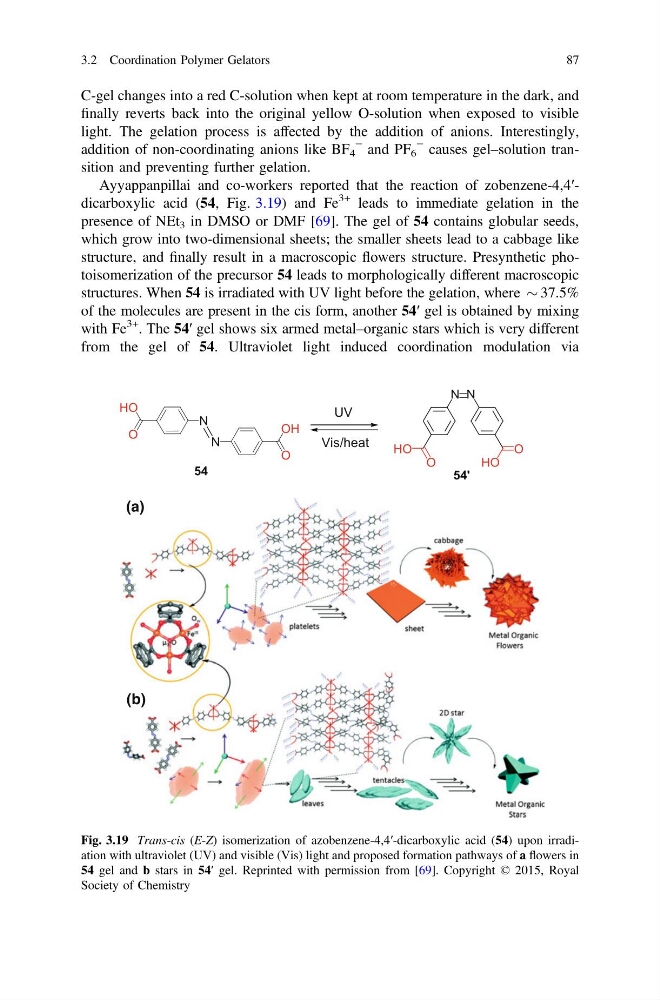
Ayyappanpillai and co-workers reported that the reaction of zobenzene-4,4′dicarboxylic acid (54, Fig. 3.19) and Fe
3+ leads to immediate gelation in the
presence of NEt 3 in DMSO or DMF [69]. The gel of 54 contains globular seeds,
which grow into two-dimensional sheets; the smaller sheets lead to a cabbage like
structure, and finally result in a macroscopic flowers structure. Presynthetic photoisomerization of the precursor 54 leads to morphologically different macroscopic
structures. When 54 is irradiated with UV light before the gelation, where $ 37.5%
of the molecules are present in the cis form, another 54′ gel is obtained by mixing
with Fe
3+ . The 54′ gel shows six armed metal–organic stars which is very different
from the gel of 54. Ultraviolet light induced coordination modulation via
N
N
OH
O
O
HO
54
Vis/heat
UV
N N
O
HO
HO
O
54'
(a)
(b)
Fig. 3.19 Trans-cis (E-Z) isomerization of azobenzene-4,4′-dicarboxylic acid (54) upon irradiation with ultraviolet (UV) and visible (Vis) light and proposed formation pathways of a flowers in
54 gel and b stars in 54′ gel. Reprinted with permission from [69]. Copyright © 2015, Royal
Society of Chemistry
3.2 Coordination Polymer Gelators
87
finally reverts back into the original yellow O-solution when exposed to visible
light. The gelation process is affected by the addition of anions. Interestingly,
addition of non-coordinating anions like BF 4
− and PF 6
− causes gel–solution transition and preventing further gelation.
Ayyappanpillai and co-workers reported that the reaction of zobenzene-4,4′dicarboxylic acid (54, Fig. 3.19) and Fe
3+ leads to immediate gelation in the
presence of NEt 3 in DMSO or DMF [69]. The gel of 54 contains globular seeds,
which grow into two-dimensional sheets; the smaller sheets lead to a cabbage like
structure, and finally result in a macroscopic flowers structure. Presynthetic photoisomerization of the precursor 54 leads to morphologically different macroscopic
structures. When 54 is irradiated with UV light before the gelation, where $ 37.5%
of the molecules are present in the cis form, another 54′ gel is obtained by mixing
with Fe
3+ . The 54′ gel shows six armed metal–organic stars which is very different
from the gel of 54. Ultraviolet light induced coordination modulation via
N
N
OH
O
O
HO
54
Vis/heat
UV
N N
O
HO
HO
O
54'
(a)
(b)
Fig. 3.19 Trans-cis (E-Z) isomerization of azobenzene-4,4′-dicarboxylic acid (54) upon irradiation with ultraviolet (UV) and visible (Vis) light and proposed formation pathways of a flowers in
54 gel and b stars in 54′ gel. Reprinted with permission from [69]. Copyright © 2015, Royal
Society of Chemistry
3.2 Coordination Polymer Gelators
87