

organic molecules like pyrrole, aniline and bithiophene are present in Fe-BDC gel,
highly photoluminescent hybrid materials are obtained while the gelation process is
unaffected. The morphology of the metal–organic gel transforms remarkably from
spindle-like structure to nanofibres. The photoluminescence turn-on response is
primarily attributed to the redox reaction between iron ions and the small organic
molecules generating oxidized oligomers in the porous gel matrix.
The carboxylate ligands are easy to be modified to enrich the functionalized of
metal-carboxylate gels. The photoresponsive chromophores have been introduced
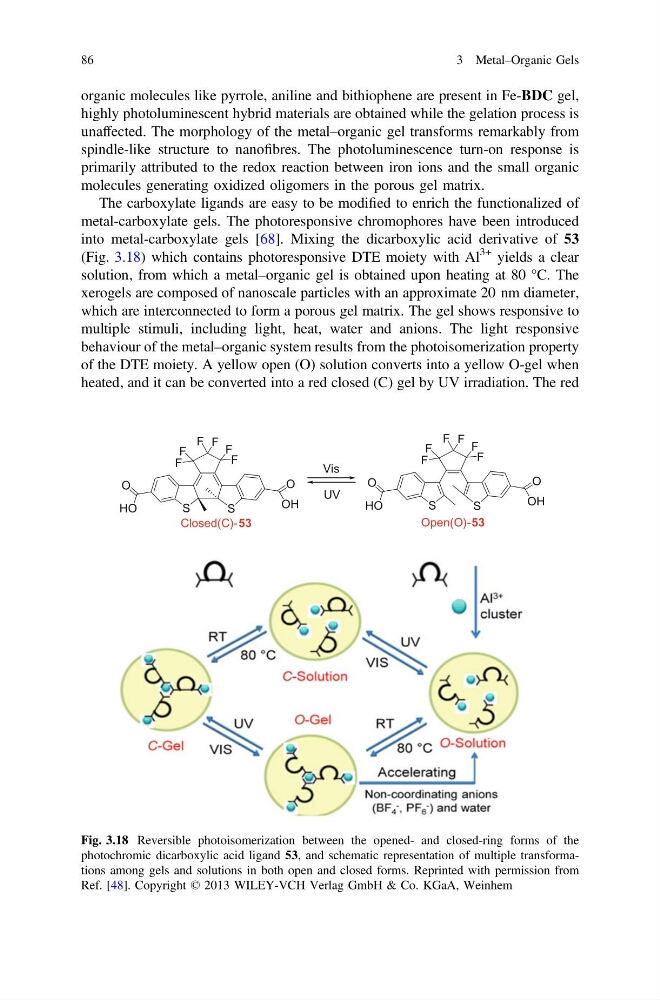
into metal-carboxylate gels [68]. Mixing the dicarboxylic acid derivative of 53
(Fig. 3.18) which contains photoresponsive DTE moiety with Al
3+ yields a clear
solution, from which a metal–organic gel is obtained upon heating at 80 °C. The
xerogels are composed of nanoscale particles with an approximate 20 nm diameter,
which are interconnected to form a porous gel matrix. The gel shows responsive to
multiple stimuli, including light, heat, water and anions. The light responsive
behaviour of the metal–organic system results from the photoisomerization property
of the DTE moiety. A yellow open (O) solution converts into a yellow O-gel when
heated, and it can be converted into a red closed (C) gel by UV irradiation. The red
S
S
F F F
F
F
F
OH
HO
O
O
S
S
F F F
F
F
F
OH
HO
O
O
Vis
UV
Open(O)-53
Closed(C)-53
Fig. 3.18 Reversible photoisomerization between the opened- and closed-ring forms of the
photochromic dicarboxylic acid ligand 53, and schematic representation of multiple transformations among gels and solutions in both open and closed forms. Reprinted with permission from
Ref. [48]. Copyright © 2013 WILEY-VCH Verlag GmbH & Co. KGaA, Weinhem
86
3 Metal–Organic Gels
highly photoluminescent hybrid materials are obtained while the gelation process is
unaffected. The morphology of the metal–organic gel transforms remarkably from
spindle-like structure to nanofibres. The photoluminescence turn-on response is
primarily attributed to the redox reaction between iron ions and the small organic
molecules generating oxidized oligomers in the porous gel matrix.
The carboxylate ligands are easy to be modified to enrich the functionalized of
metal-carboxylate gels. The photoresponsive chromophores have been introduced
into metal-carboxylate gels [68]. Mixing the dicarboxylic acid derivative of 53
(Fig. 3.18) which contains photoresponsive DTE moiety with Al
3+ yields a clear
solution, from which a metal–organic gel is obtained upon heating at 80 °C. The
xerogels are composed of nanoscale particles with an approximate 20 nm diameter,
which are interconnected to form a porous gel matrix. The gel shows responsive to
multiple stimuli, including light, heat, water and anions. The light responsive
behaviour of the metal–organic system results from the photoisomerization property
of the DTE moiety. A yellow open (O) solution converts into a yellow O-gel when
heated, and it can be converted into a red closed (C) gel by UV irradiation. The red
S
S
F F F
F
F
F
OH
HO
O
O
S
S
F F F
F
F
F
OH
HO
O
O
Vis
UV
Open(O)-53
Closed(C)-53
Fig. 3.18 Reversible photoisomerization between the opened- and closed-ring forms of the
photochromic dicarboxylic acid ligand 53, and schematic representation of multiple transformations among gels and solutions in both open and closed forms. Reprinted with permission from
Ref. [48]. Copyright © 2013 WILEY-VCH Verlag GmbH & Co. KGaA, Weinhem
86
3 Metal–Organic Gels