

role in the solvent-trapping process of the gelation in addition to coordinative
cross-linking, thus enabling the formation of gel networks. The gels show stable
shape persistence with any change in either the shape or size when kept in air over
time (up to 3 months). The gels also show high load-bearing capabilities, a weight
over 70 times than their own weight. What’s more, the gels exhibit self-healing
properties and the fractures disappeared completely within 2 h in the
fracture-recovery test. Furthermore, these gels can be engineered to exhibit optical
transparency, inject ability, mould ability, shape persistence and adhesiveness.
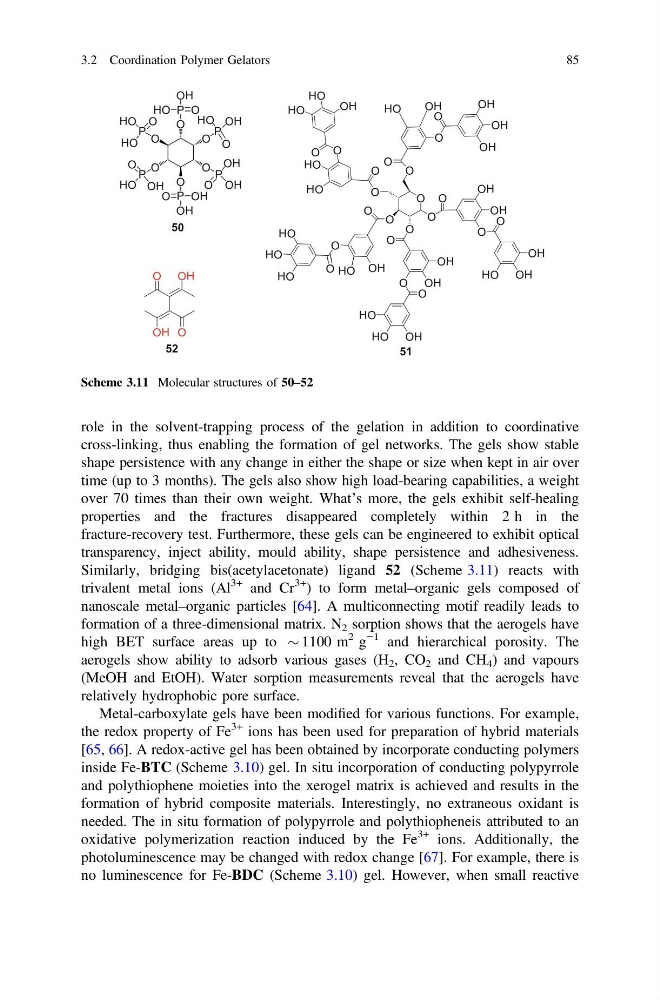
Similarly, bridging bis(acetylacetonate) ligand 52 (Scheme 3.11) reacts with
trivalent metal ions (Al
3+ and Cr
3+ ) to form metal–organic gels composed of
nanoscale metal–organic particles [64]. A multiconnecting motif readily leads to
formation of a three-dimensional matrix. N 2 sorption shows that the aerogels have
high BET surface areas up to $ 1100 m
2 g
−1 and hierarchical porosity. The
aerogels show ability to adsorb various gases (H 2 , CO 2 and CH 4 ) and vapours
(MeOH and EtOH). Water sorption measurements reveal that the aerogels have
relatively hydrophobic pore surface.
Metal-carboxylate gels have been modified for various functions. For example,
the redox property of Fe
3+ ions has been used for preparation of hybrid materials
[65, 66]. A redox-active gel has been obtained by incorporate conducting polymers
inside Fe-BTC (Scheme 3.10) gel. In situ incorporation of conducting polypyrrole
and polythiophene moieties into the xerogel matrix is achieved and results in the
formation of hybrid composite materials. Interestingly, no extraneous oxidant is
needed. The in situ formation of polypyrrole and polythiopheneis attributed to an
oxidative polymerization reaction induced by the Fe
3+ ions. Additionally, the
photoluminescence may be changed with redox change [67]. For example, there is
no luminescence for Fe-BDC (Scheme 3.10) gel. However, when small reactive
O
O
O
OH
OH
O
O
O
OH
HO
HO
OH
OH
O
O
OH
OH
HO
O
O
HO
OH
O
O
OH
OH
OH
O
O
O
OH
O
HO
HO
HO
O
HO
HO
O
O
HO
HO
OH
O
51
O HO
O
O
O
O
O
O
P
P
P
P
P
P
OH
O
HO
OH
O
HO
OH
O
OH
OH
O
OH
HO
O
OH
HO O
HO
50
OH
O
OH O
52
Scheme 3.11 Molecular structures of 50–52
3.2 Coordination Polymer Gelators
85
cross-linking, thus enabling the formation of gel networks. The gels show stable
shape persistence with any change in either the shape or size when kept in air over
time (up to 3 months). The gels also show high load-bearing capabilities, a weight
over 70 times than their own weight. What’s more, the gels exhibit self-healing
properties and the fractures disappeared completely within 2 h in the
fracture-recovery test. Furthermore, these gels can be engineered to exhibit optical
transparency, inject ability, mould ability, shape persistence and adhesiveness.
Similarly, bridging bis(acetylacetonate) ligand 52 (Scheme 3.11) reacts with
trivalent metal ions (Al
3+ and Cr
3+ ) to form metal–organic gels composed of
nanoscale metal–organic particles [64]. A multiconnecting motif readily leads to
formation of a three-dimensional matrix. N 2 sorption shows that the aerogels have
high BET surface areas up to $ 1100 m
2 g
−1 and hierarchical porosity. The
aerogels show ability to adsorb various gases (H 2 , CO 2 and CH 4 ) and vapours
(MeOH and EtOH). Water sorption measurements reveal that the aerogels have
relatively hydrophobic pore surface.
Metal-carboxylate gels have been modified for various functions. For example,
the redox property of Fe
3+ ions has been used for preparation of hybrid materials
[65, 66]. A redox-active gel has been obtained by incorporate conducting polymers
inside Fe-BTC (Scheme 3.10) gel. In situ incorporation of conducting polypyrrole
and polythiophene moieties into the xerogel matrix is achieved and results in the
formation of hybrid composite materials. Interestingly, no extraneous oxidant is
needed. The in situ formation of polypyrrole and polythiopheneis attributed to an
oxidative polymerization reaction induced by the Fe
3+ ions. Additionally, the
photoluminescence may be changed with redox change [67]. For example, there is
no luminescence for Fe-BDC (Scheme 3.10) gel. However, when small reactive
O
O
O
OH
OH
O
O
O
OH
HO
HO
OH
OH
O
O
OH
OH
HO
O
O
HO
OH
O
O
OH
OH
OH
O
O
O
OH
O
HO
HO
HO
O
HO
HO
O
O
HO
HO
OH
O
51
O HO
O
O
O
O
O
O
P
P
P
P
P
P
OH
O
HO
OH
O
HO
OH
O
OH
OH
O
OH
HO
O
OH
HO O
HO
50
OH
O
OH O
52
Scheme 3.11 Molecular structures of 50–52
3.2 Coordination Polymer Gelators
85