

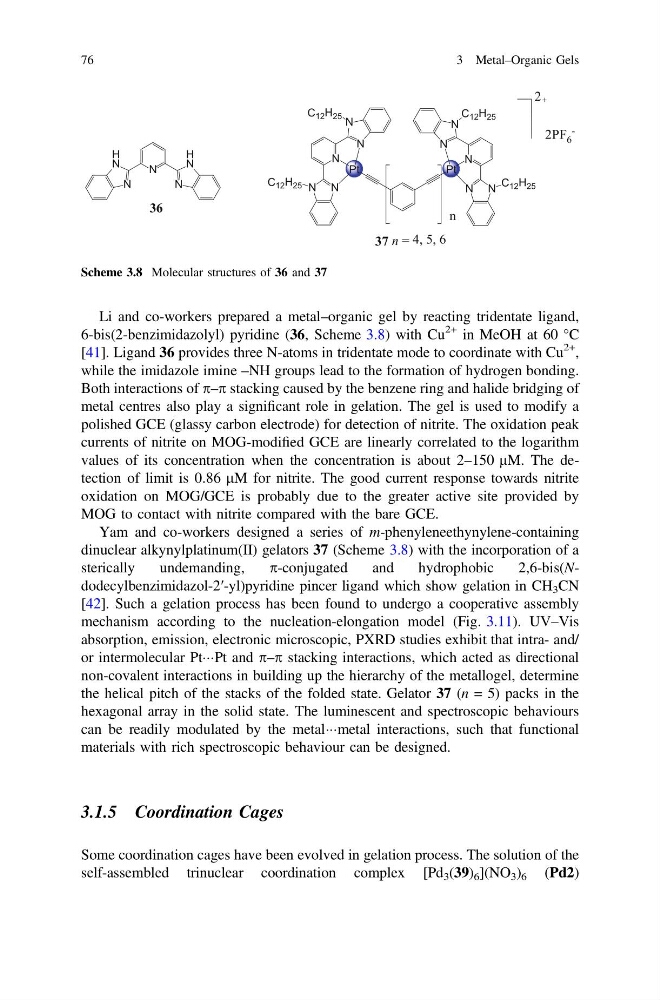
Li and co-workers prepared a metal–organic gel by reacting tridentate ligand,
6-bis(2-benzimidazolyl) pyridine (36, Scheme 3.8) with Cu
2+ in MeOH at 60 °C
[41]. Ligand 36 provides three N-atoms in tridentate mode to coordinate with Cu
2+ ,
while the imidazole imine –NH groups lead to the formation of hydrogen bonding.
Both interactions of p–p stacking caused by the benzene ring and halide bridging of
metal centres also play a significant role in gelation. The gel is used to modify a
polished GCE (glassy carbon electrode) for detection of nitrite. The oxidation peak
currents of nitrite on MOG-modified GCE are linearly correlated to the logarithm
values of its concentration when the concentration is about 2–150 lM. The detection of limit is 0.86 lM for nitrite. The good current response towards nitrite
oxidation on MOG/GCE is probably due to the greater active site provided by
MOG to contact with nitrite compared with the bare GCE.
Yam and co-workers designed a series of m-phenyleneethynylene-containing
dinuclear alkynylplatinum(II) gelators 37 (Scheme 3.8) with the incorporation of a
sterically
undemanding,
p-conjugated
and
hydrophobic
2,6-bis(Ndodecylbenzimidazol-2′-yl)pyridine pincer ligand which show gelation in CH 3 CN
[42]. Such a gelation process has been found to undergo a cooperative assembly
mechanism according to the nucleation-elongation model (Fig. 3.11). UV–Vis
absorption, emission, electronic microscopic, PXRD studies exhibit that intra- and/
or intermolecular PtÁÁÁPt and p–p stacking interactions, which acted as directional
non-covalent interactions in building up the hierarchy of the metallogel, determine
the helical pitch of the stacks of the folded state. Gelator 37 (n = 5) packs in the
hexagonal array in the solid state. The luminescent and spectroscopic behaviours
can be readily modulated by the metalÁÁÁmetal interactions, such that functional
materials with rich spectroscopic behaviour can be designed.
3.1.5 Coordination Cages
Some coordination cages have been evolved in gelation process. The solution of the
self-assembled trinuclear coordination complex [Pd 3 (39) 6 ](NO 3 ) 6 (Pd2)
Pt
Pt
N
N N
N
N
C 12 H 25
C 12 H 25
N
N N
N
N
C 12 H 25
C 12 H 25
n
37 n = 4, 5, 6
N
H
N
N
N
H
N
36
2
2PF 6
-
Scheme 3.8 Molecular structures of 36 and 37
76
3 Metal–Organic Gels
6-bis(2-benzimidazolyl) pyridine (36, Scheme 3.8) with Cu
2+ in MeOH at 60 °C
[41]. Ligand 36 provides three N-atoms in tridentate mode to coordinate with Cu
2+ ,
while the imidazole imine –NH groups lead to the formation of hydrogen bonding.
Both interactions of p–p stacking caused by the benzene ring and halide bridging of
metal centres also play a significant role in gelation. The gel is used to modify a
polished GCE (glassy carbon electrode) for detection of nitrite. The oxidation peak
currents of nitrite on MOG-modified GCE are linearly correlated to the logarithm
values of its concentration when the concentration is about 2–150 lM. The detection of limit is 0.86 lM for nitrite. The good current response towards nitrite
oxidation on MOG/GCE is probably due to the greater active site provided by
MOG to contact with nitrite compared with the bare GCE.
Yam and co-workers designed a series of m-phenyleneethynylene-containing
dinuclear alkynylplatinum(II) gelators 37 (Scheme 3.8) with the incorporation of a
sterically
undemanding,
p-conjugated
and
hydrophobic
2,6-bis(Ndodecylbenzimidazol-2′-yl)pyridine pincer ligand which show gelation in CH 3 CN
[42]. Such a gelation process has been found to undergo a cooperative assembly
mechanism according to the nucleation-elongation model (Fig. 3.11). UV–Vis
absorption, emission, electronic microscopic, PXRD studies exhibit that intra- and/
or intermolecular PtÁÁÁPt and p–p stacking interactions, which acted as directional
non-covalent interactions in building up the hierarchy of the metallogel, determine
the helical pitch of the stacks of the folded state. Gelator 37 (n = 5) packs in the
hexagonal array in the solid state. The luminescent and spectroscopic behaviours
can be readily modulated by the metalÁÁÁmetal interactions, such that functional
materials with rich spectroscopic behaviour can be designed.
3.1.5 Coordination Cages
Some coordination cages have been evolved in gelation process. The solution of the
self-assembled trinuclear coordination complex [Pd 3 (39) 6 ](NO 3 ) 6 (Pd2)
Pt
Pt
N
N N
N
N
C 12 H 25
C 12 H 25
N
N N
N
N
C 12 H 25
C 12 H 25
n
37 n = 4, 5, 6
N
H
N
N
N
H
N
36
2
2PF 6
-
Scheme 3.8 Molecular structures of 36 and 37
76
3 Metal–Organic Gels