

(Scheme 3.9) in DMSO forms a supramolecular gel, while [Pd 3 (38) 6 ](NO 3 ) 6 (Pd1)
(Scheme 3.9) cannot because of the presence of an extra p-surface in the benzimidazole moiety which made it easier to self-assemble through intermolecular
p-interactions [43]. Oxoanions like nitrate, perchlorate, triflate and tosylate are
easier to gelate because they are capable to form H-bonds. The stimuli-responsive
nature of the gel is triggered by halide-nitrate, DMAP-HNO 3 and
ethylenediamine-Pd(NO 3 ) 2 .
Howlader and Mukherjee reported formation of a supramolecular Pd
2+ gel (G1)
upon 1:1 treatment of H 2 (40) (Scheme 3.9) with a cis-blocked Pd
2+ 90 °C acceptor
(42, Scheme 3.9) in H 2 O or DMSO [44]. Post-metalation of G1 with 42 in water or
DMSO results in deprotonation of the N–H moieties and turned the gel into a highly
water-soluble edge-directed tetrahedral (42) 12 (40) 6 (T1) cage (Fig. 3.12). For T1
cage every vertex corner of the tetrahedron includes three Pd
2+ acceptors connected
by the nitrogens from the tetrazole moieties of the linkers to form a Pd3 triangle and
40 molecules are tied by two corners along the edges. A water-soluble chiral
face-direct etrahedral cage (42) 12 (41) 4 (T2) is fabricated when replaced H 2 (40) with
H 3 (41) in a 2:3 molar ratio of H 3 (41) with 42 under the same condition. For T2 cage
every vertex corner of the tetrahedron includes three acceptors and the linker 41 is
fastened by three corners along the face.
Bispyridyl-conjugated Fmoc-L-glutamate 43 (Scheme 3.9) reacts with silver salt
to form gel in aqueous solution or EtOH at room temperature [45]. The
self-assembly behaviour of 43 is highly dependent on the concentration of gelators
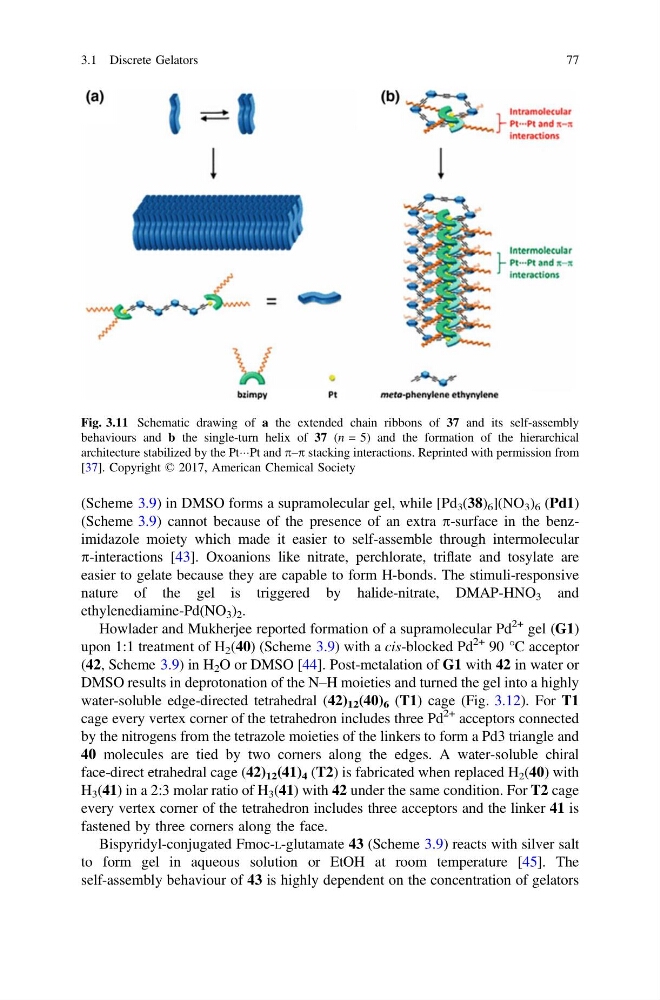
Fig. 3.11 Schematic drawing of a the extended chain ribbons of 37 and its self-assembly
behaviours and b the single-turn helix of 37 (n = 5) and the formation of the hierarchical
architecture stabilized by the PtÁÁÁPt and p–p stacking interactions. Reprinted with permission from
[37]. Copyright © 2017, American Chemical Society
3.1 Discrete Gelators
77
(Scheme 3.9) cannot because of the presence of an extra p-surface in the benzimidazole moiety which made it easier to self-assemble through intermolecular
p-interactions [43]. Oxoanions like nitrate, perchlorate, triflate and tosylate are
easier to gelate because they are capable to form H-bonds. The stimuli-responsive
nature of the gel is triggered by halide-nitrate, DMAP-HNO 3 and
ethylenediamine-Pd(NO 3 ) 2 .
Howlader and Mukherjee reported formation of a supramolecular Pd
2+ gel (G1)
upon 1:1 treatment of H 2 (40) (Scheme 3.9) with a cis-blocked Pd
2+ 90 °C acceptor
(42, Scheme 3.9) in H 2 O or DMSO [44]. Post-metalation of G1 with 42 in water or
DMSO results in deprotonation of the N–H moieties and turned the gel into a highly
water-soluble edge-directed tetrahedral (42) 12 (40) 6 (T1) cage (Fig. 3.12). For T1
cage every vertex corner of the tetrahedron includes three Pd
2+ acceptors connected
by the nitrogens from the tetrazole moieties of the linkers to form a Pd3 triangle and
40 molecules are tied by two corners along the edges. A water-soluble chiral
face-direct etrahedral cage (42) 12 (41) 4 (T2) is fabricated when replaced H 2 (40) with
H 3 (41) in a 2:3 molar ratio of H 3 (41) with 42 under the same condition. For T2 cage
every vertex corner of the tetrahedron includes three acceptors and the linker 41 is
fastened by three corners along the face.
Bispyridyl-conjugated Fmoc-L-glutamate 43 (Scheme 3.9) reacts with silver salt
to form gel in aqueous solution or EtOH at room temperature [45]. The
self-assembly behaviour of 43 is highly dependent on the concentration of gelators
Fig. 3.11 Schematic drawing of a the extended chain ribbons of 37 and its self-assembly
behaviours and b the single-turn helix of 37 (n = 5) and the formation of the hierarchical
architecture stabilized by the PtÁÁÁPt and p–p stacking interactions. Reprinted with permission from
[37]. Copyright © 2017, American Chemical Society
3.1 Discrete Gelators
77