

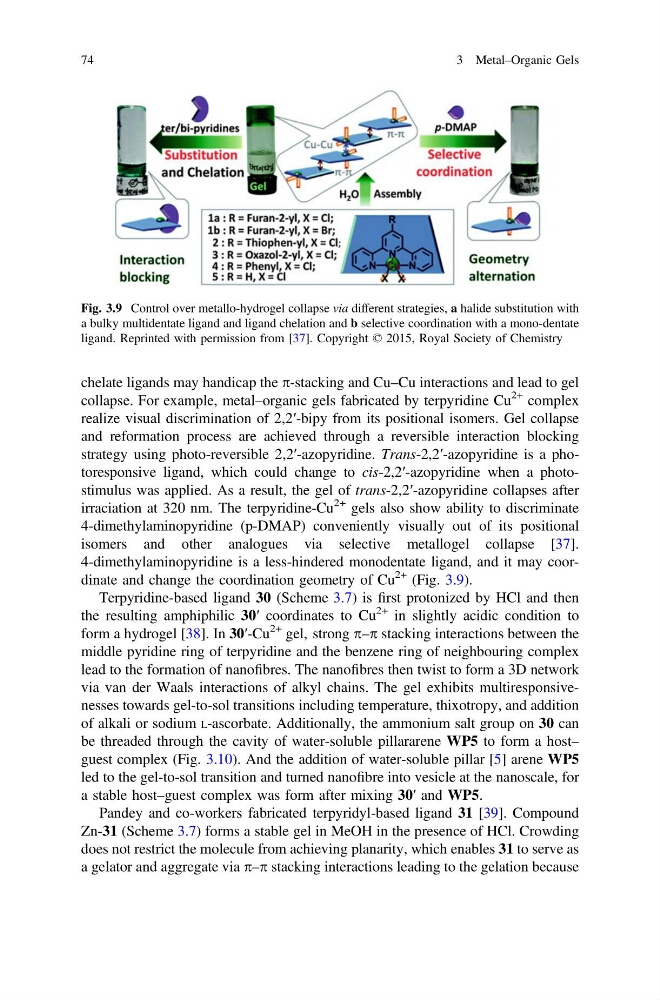
chelate ligands may handicap the p-stacking and Cu–Cu interactions and lead to gel
collapse. For example, metal–organic gels fabricated by terpyridine Cu
2+ complex
realize visual discrimination of 2,2′-bipy from its positional isomers. Gel collapse
and reformation process are achieved through a reversible interaction blocking
strategy using photo-reversible 2,2′-azopyridine. Trans-2,2′-azopyridine is a photoresponsive ligand, which could change to cis-2,2′-azopyridine when a photostimulus was applied. As a result, the gel of trans-2,2′-azopyridine collapses after
irraciation at 320 nm. The terpyridine-Cu
2+ gels also show ability to discriminate
4-dimethylaminopyridine (p-DMAP) conveniently visually out of its positional
isomers and other analogues via selective metallogel collapse [37].
4-dimethylaminopyridine is a less-hindered monodentate ligand, and it may coordinate and change the coordination geometry of Cu
2+ (Fig. 3.9).
Terpyridine-based ligand 30 (Scheme 3.7) is first protonized by HCl and then
the resulting amphiphilic 30′ coordinates to Cu
2+ in slightly acidic condition to
form a hydrogel [38]. In 30′-Cu
2+ gel, strong p–p stacking interactions between the
middle pyridine ring of terpyridine and the benzene ring of neighbouring complex
lead to the formation of nanofibres. The nanofibres then twist to form a 3D network
via van der Waals interactions of alkyl chains. The gel exhibits multiresponsivenesses towards gel-to-sol transitions including temperature, thixotropy, and addition
of alkali or sodium L-ascorbate. Additionally, the ammonium salt group on 30 can
be threaded through the cavity of water-soluble pillararene WP5 to form a host–
guest complex (Fig. 3.10). And the addition of water-soluble pillar [5] arene WP5
led to the gel-to-sol transition and turned nanofibre into vesicle at the nanoscale, for
a stable host–guest complex was form after mixing 30′ and WP5.
Pandey and co-workers fabricated terpyridyl-based ligand 31 [39]. Compound
Zn-31 (Scheme 3.7) forms a stable gel in MeOH in the presence of HCl. Crowding
does not restrict the molecule from achieving planarity, which enables 31 to serve as
a gelator and aggregate via p–p stacking interactions leading to the gelation because
Fig. 3.9 Control over metallo-hydrogel collapse via different strategies, a halide substitution with
a bulky multidentate ligand and ligand chelation and b selective coordination with a mono-dentate
ligand. Reprinted with permission from [37]. Copyright © 2015, Royal Society of Chemistry
74
3 Metal–Organic Gels
collapse. For example, metal–organic gels fabricated by terpyridine Cu
2+ complex
realize visual discrimination of 2,2′-bipy from its positional isomers. Gel collapse
and reformation process are achieved through a reversible interaction blocking
strategy using photo-reversible 2,2′-azopyridine. Trans-2,2′-azopyridine is a photoresponsive ligand, which could change to cis-2,2′-azopyridine when a photostimulus was applied. As a result, the gel of trans-2,2′-azopyridine collapses after
irraciation at 320 nm. The terpyridine-Cu
2+ gels also show ability to discriminate
4-dimethylaminopyridine (p-DMAP) conveniently visually out of its positional
isomers and other analogues via selective metallogel collapse [37].
4-dimethylaminopyridine is a less-hindered monodentate ligand, and it may coordinate and change the coordination geometry of Cu
2+ (Fig. 3.9).
Terpyridine-based ligand 30 (Scheme 3.7) is first protonized by HCl and then
the resulting amphiphilic 30′ coordinates to Cu
2+ in slightly acidic condition to
form a hydrogel [38]. In 30′-Cu
2+ gel, strong p–p stacking interactions between the
middle pyridine ring of terpyridine and the benzene ring of neighbouring complex
lead to the formation of nanofibres. The nanofibres then twist to form a 3D network
via van der Waals interactions of alkyl chains. The gel exhibits multiresponsivenesses towards gel-to-sol transitions including temperature, thixotropy, and addition
of alkali or sodium L-ascorbate. Additionally, the ammonium salt group on 30 can
be threaded through the cavity of water-soluble pillararene WP5 to form a host–
guest complex (Fig. 3.10). And the addition of water-soluble pillar [5] arene WP5
led to the gel-to-sol transition and turned nanofibre into vesicle at the nanoscale, for
a stable host–guest complex was form after mixing 30′ and WP5.
Pandey and co-workers fabricated terpyridyl-based ligand 31 [39]. Compound
Zn-31 (Scheme 3.7) forms a stable gel in MeOH in the presence of HCl. Crowding
does not restrict the molecule from achieving planarity, which enables 31 to serve as
a gelator and aggregate via p–p stacking interactions leading to the gelation because
Fig. 3.9 Control over metallo-hydrogel collapse via different strategies, a halide substitution with
a bulky multidentate ligand and ligand chelation and b selective coordination with a mono-dentate
ligand. Reprinted with permission from [37]. Copyright © 2015, Royal Society of Chemistry
74
3 Metal–Organic Gels