

complexes (20-ZnCl 2 , 20-HgCl 2 , 20-ZnBr 2 and 20-CuCl 2 ) show pentacoordination
and can be viewed as a distorted trigonal bipyramidal type ignoring the metal
identity. This is influenced by the NNN chelation from the terpyridine parts and by
two halide ions that complete a N 3 X 2 coordination sphere. The fluorous chains are
mainly packed by means of C–FÁÁÁF–C interchain geometries. From the result of
electron microscopy, the fibres of gels made with 21 are thinner than those of 20
and so are the aspect ratios. And according to the different response to the common
anions, it turns out that 20 can form more stable gel systems.
Yu, Pu and co-workers reported a chiral terpyridine derivative of BINOL (1,1′bi-2-naphthol) and its Cu
2+ complex (22, Scheme 3.7) forms a gel in CHCl 3 [33].
The gel shows enantioselective collapse towards amino alcohols. The gel remains
stable when (R)-phenylglycinol was added, while the gel collapses when more than
0.06 equiv (S)-phenylglycinol was added. Rissanen and co-workers reported that
luminescent terpyridine-Zn
2+ complex 23 (Scheme 3.7) form a hydrogel [34]. The
complex shows an unprecedented fluorescence response (*500 fold increase) and
record nanomolar sensitivity (detectable fluorescent response at 20 nM and LOD
*0.8 nM) towards pyrophosphate (PPi), biologically significant ions. The gel is
used to make gel-coated paper strips for easy, low-cost detection and selective
sensing of PPi in water.
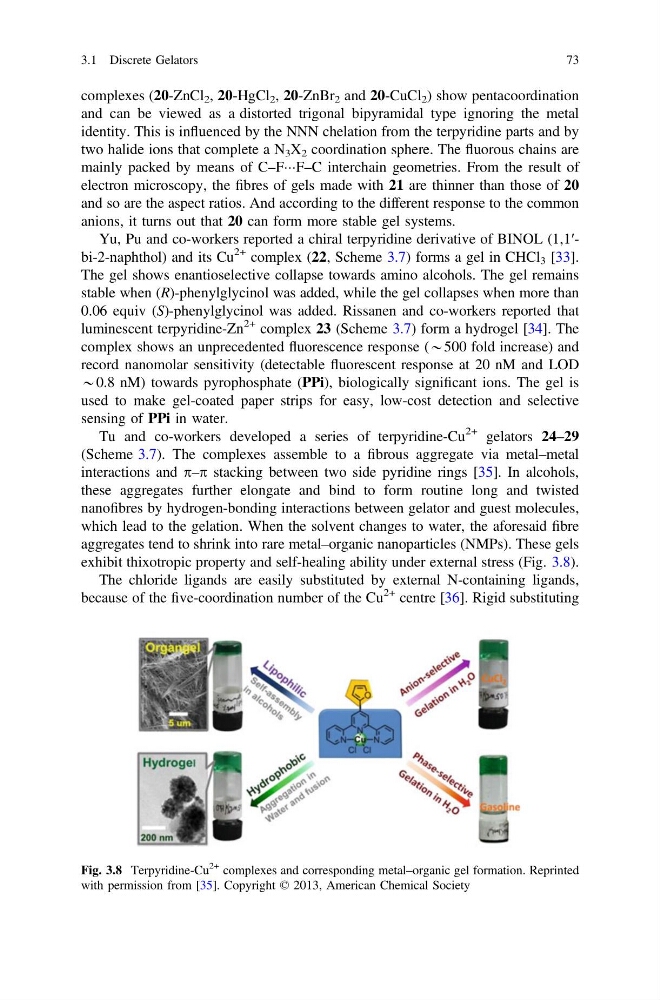
Tu and co-workers developed a series of terpyridine-Cu
2+ gelators 24–29
(Scheme 3.7). The complexes assemble to a fibrous aggregate via metal–metal
interactions and p–p stacking between two side pyridine rings [35]. In alcohols,
these aggregates further elongate and bind to form routine long and twisted
nanofibres by hydrogen-bonding interactions between gelator and guest molecules,
which lead to the gelation. When the solvent changes to water, the aforesaid fibre
aggregates tend to shrink into rare metal–organic nanoparticles (NMPs). These gels
exhibit thixotropic property and self-healing ability under external stress (Fig. 3.8).
The chloride ligands are easily substituted by external N-containing ligands,
because of the five-coordination number of the Cu
2+ centre [36]. Rigid substituting
Fig. 3.8 Terpyridine-Cu
2+ complexes and corresponding metal–organic gel formation. Reprinted
with permission from [35]. Copyright © 2013, American Chemical Society
3.1 Discrete Gelators
73
and can be viewed as a distorted trigonal bipyramidal type ignoring the metal
identity. This is influenced by the NNN chelation from the terpyridine parts and by
two halide ions that complete a N 3 X 2 coordination sphere. The fluorous chains are
mainly packed by means of C–FÁÁÁF–C interchain geometries. From the result of
electron microscopy, the fibres of gels made with 21 are thinner than those of 20
and so are the aspect ratios. And according to the different response to the common
anions, it turns out that 20 can form more stable gel systems.
Yu, Pu and co-workers reported a chiral terpyridine derivative of BINOL (1,1′bi-2-naphthol) and its Cu
2+ complex (22, Scheme 3.7) forms a gel in CHCl 3 [33].
The gel shows enantioselective collapse towards amino alcohols. The gel remains
stable when (R)-phenylglycinol was added, while the gel collapses when more than
0.06 equiv (S)-phenylglycinol was added. Rissanen and co-workers reported that
luminescent terpyridine-Zn
2+ complex 23 (Scheme 3.7) form a hydrogel [34]. The
complex shows an unprecedented fluorescence response (*500 fold increase) and
record nanomolar sensitivity (detectable fluorescent response at 20 nM and LOD
*0.8 nM) towards pyrophosphate (PPi), biologically significant ions. The gel is
used to make gel-coated paper strips for easy, low-cost detection and selective
sensing of PPi in water.
Tu and co-workers developed a series of terpyridine-Cu
2+ gelators 24–29
(Scheme 3.7). The complexes assemble to a fibrous aggregate via metal–metal
interactions and p–p stacking between two side pyridine rings [35]. In alcohols,
these aggregates further elongate and bind to form routine long and twisted
nanofibres by hydrogen-bonding interactions between gelator and guest molecules,
which lead to the gelation. When the solvent changes to water, the aforesaid fibre
aggregates tend to shrink into rare metal–organic nanoparticles (NMPs). These gels
exhibit thixotropic property and self-healing ability under external stress (Fig. 3.8).
The chloride ligands are easily substituted by external N-containing ligands,
because of the five-coordination number of the Cu
2+ centre [36]. Rigid substituting
Fig. 3.8 Terpyridine-Cu
2+ complexes and corresponding metal–organic gel formation. Reprinted
with permission from [35]. Copyright © 2013, American Chemical Society
3.1 Discrete Gelators
73