

Mitsumoto, Cameron and co-workers reported a heterometallic octanuclear gelator [Fe 4
III Ni 4
II (CN) 12 (tp) 4 (12) 4 ](BF 4 ) 4 synthesized from a hydrophobic tetrathiafulvalene (TTF) ligand 12 (Scheme 3.4) with long-chain alkyl moieties (Fig. 3.6)
[14]. The TTF moieties of 12 shows redox behaviour, with two reversible
one-electron oxidation waves of cyclic voltammogram observed at E
0
′ = 0.46 and
0.78 V (vs. SCE). In the cubic moiety [Fe 4 Ni 4 (CN) 12 ]
8+ of the gelator, a core of
four iron(III) and four nickel(II) ions are bridged by twelve cyanide ions. A red gel
forms over the course of one week in 1,2-dichlorobenzene solution at room temperature. The gel shows gel-to-sol transformations at room temperature induced by
both the oxidation and reduction through its interaction with redox agents, such as
2,3,5,6-tetrafluoro-7,7,8,8-tetracyanoquiodimethane and decamethylferrocene.
A pyridine containing anthraquinone-based ligand forms a stable three component gel in DMSO/water in the presence of Cu
2+ and chloride ions [15]. In this
work, the factors that contributed to the formation of this gel were explored. To
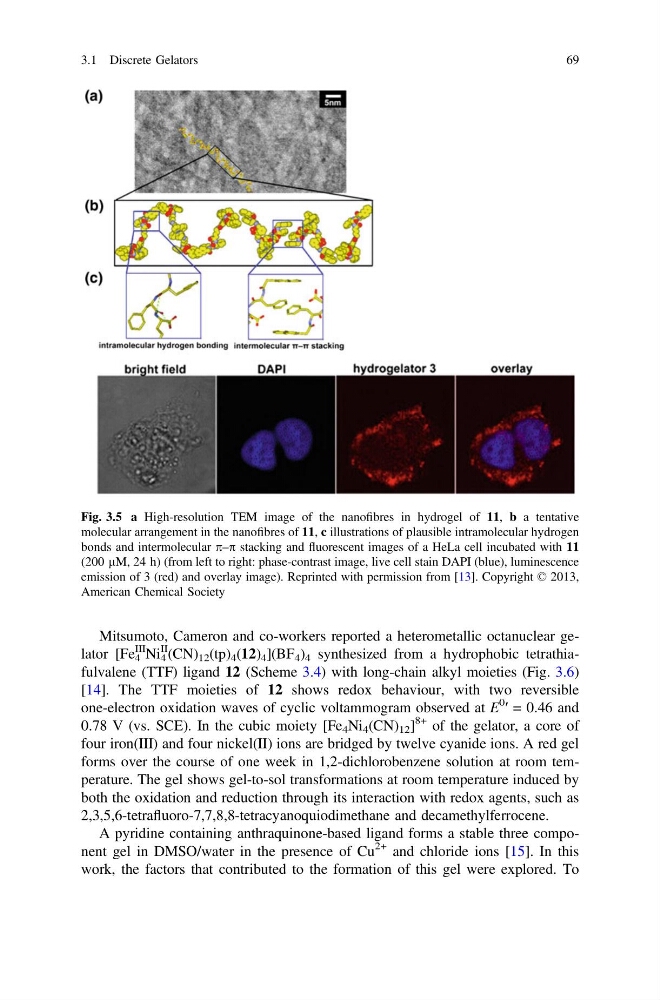
Fig. 3.5 a High-resolution TEM image of the nanofibres in hydrogel of 11, b a tentative
molecular arrangement in the nanofibres of 11, c illustrations of plausible intramolecular hydrogen
bonds and intermolecular p–p stacking and fluorescent images of a HeLa cell incubated with 11
(200 lM, 24 h) (from left to right: phase-contrast image, live cell stain DAPI (blue), luminescence
emission of 3 (red) and overlay image). Reprinted with permission from [13]. Copyright © 2013,
American Chemical Society
3.1 Discrete Gelators
69
III Ni 4
II (CN) 12 (tp) 4 (12) 4 ](BF 4 ) 4 synthesized from a hydrophobic tetrathiafulvalene (TTF) ligand 12 (Scheme 3.4) with long-chain alkyl moieties (Fig. 3.6)
[14]. The TTF moieties of 12 shows redox behaviour, with two reversible
one-electron oxidation waves of cyclic voltammogram observed at E
0
′ = 0.46 and
0.78 V (vs. SCE). In the cubic moiety [Fe 4 Ni 4 (CN) 12 ]
8+ of the gelator, a core of
four iron(III) and four nickel(II) ions are bridged by twelve cyanide ions. A red gel
forms over the course of one week in 1,2-dichlorobenzene solution at room temperature. The gel shows gel-to-sol transformations at room temperature induced by
both the oxidation and reduction through its interaction with redox agents, such as
2,3,5,6-tetrafluoro-7,7,8,8-tetracyanoquiodimethane and decamethylferrocene.
A pyridine containing anthraquinone-based ligand forms a stable three component gel in DMSO/water in the presence of Cu
2+ and chloride ions [15]. In this
work, the factors that contributed to the formation of this gel were explored. To
Fig. 3.5 a High-resolution TEM image of the nanofibres in hydrogel of 11, b a tentative
molecular arrangement in the nanofibres of 11, c illustrations of plausible intramolecular hydrogen
bonds and intermolecular p–p stacking and fluorescent images of a HeLa cell incubated with 11
(200 lM, 24 h) (from left to right: phase-contrast image, live cell stain DAPI (blue), luminescence
emission of 3 (red) and overlay image). Reprinted with permission from [13]. Copyright © 2013,
American Chemical Society
3.1 Discrete Gelators
69