

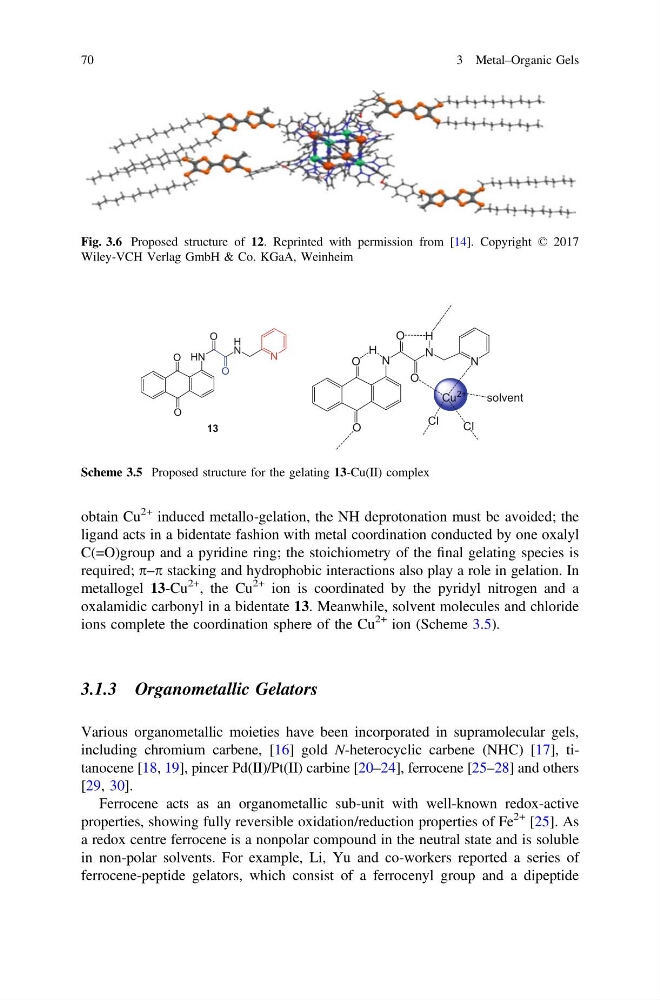
obtain Cu
2+ induced metallo-gelation, the NH deprotonation must be avoided; the
ligand acts in a bidentate fashion with metal coordination conducted by one oxalyl
C(=O)group and a pyridine ring; the stoichiometry of the final gelating species is
required; p–p stacking and hydrophobic interactions also play a role in gelation. In
metallogel 13-Cu
2+ , the Cu
2+ ion is coordinated by the pyridyl nitrogen and a
oxalamidic carbonyl in a bidentate 13. Meanwhile, solvent molecules and chloride
ions complete the coordination sphere of the Cu
2+ ion (Scheme 3.5).
3.1.3 Organometallic Gelators
Various organometallic moieties have been incorporated in supramolecular gels,
including chromium carbene, [16] gold N-heterocyclic carbene (NHC) [17], titanocene [18, 19], pincer Pd(II)/Pt(II) carbine [20–24], ferrocene [25–28] and others
[29, 30].
Ferrocene acts as an organometallic sub-unit with well-known redox-active
properties, showing fully reversible oxidation/reduction properties of Fe
2+ [25]. As
a redox centre ferrocene is a nonpolar compound in the neutral state and is soluble
in non-polar solvents. For example, Li, Yu and co-workers reported a series of
ferrocene-peptide gelators, which consist of a ferrocenyl group and a dipeptide
Fig. 3.6 Proposed structure of 12. Reprinted with permission from [14]. Copyright © 2017
Wiley-VCH Verlag GmbH & Co. KGaA, Weinheim
O
O
HN
H
N
O
O
N
13
O
O
N
N
O
O
N
H
H
Cu
2+
Cl
Cl
solvent
Scheme 3.5 Proposed structure for the gelating 13-Cu(II) complex
70
3 Metal–Organic Gels
2+ induced metallo-gelation, the NH deprotonation must be avoided; the
ligand acts in a bidentate fashion with metal coordination conducted by one oxalyl
C(=O)group and a pyridine ring; the stoichiometry of the final gelating species is
required; p–p stacking and hydrophobic interactions also play a role in gelation. In
metallogel 13-Cu
2+ , the Cu
2+ ion is coordinated by the pyridyl nitrogen and a
oxalamidic carbonyl in a bidentate 13. Meanwhile, solvent molecules and chloride
ions complete the coordination sphere of the Cu
2+ ion (Scheme 3.5).
3.1.3 Organometallic Gelators
Various organometallic moieties have been incorporated in supramolecular gels,
including chromium carbene, [16] gold N-heterocyclic carbene (NHC) [17], titanocene [18, 19], pincer Pd(II)/Pt(II) carbine [20–24], ferrocene [25–28] and others
[29, 30].
Ferrocene acts as an organometallic sub-unit with well-known redox-active
properties, showing fully reversible oxidation/reduction properties of Fe
2+ [25]. As
a redox centre ferrocene is a nonpolar compound in the neutral state and is soluble
in non-polar solvents. For example, Li, Yu and co-workers reported a series of
ferrocene-peptide gelators, which consist of a ferrocenyl group and a dipeptide
Fig. 3.6 Proposed structure of 12. Reprinted with permission from [14]. Copyright © 2017
Wiley-VCH Verlag GmbH & Co. KGaA, Weinheim
O
O
HN
H
N
O
O
N
13
O
O
N
N
O
O
N
H
H
Cu
2+
Cl
Cl
solvent
Scheme 3.5 Proposed structure for the gelating 13-Cu(II) complex
70
3 Metal–Organic Gels