

Similarly, ALS chiral pincer platinum(II) metallogelators 63 (Scheme 2.12) was
prepared by Tu and co-workers. When addition of 0.1 eq. of the S enantiomer of
bulky phosphine chiral ligands leads to the collapse of the gel, while the
R enantiomer remains the gel stable [147].
2.5 Conclusions
LMWGs based on supramolecular self-assembly by non-covalent are sensitive to
external stimulus, and the multiple stimulus responsive to heat, light, sound,
chemicals, potentially makes supramolecular gels “smart” gels with typical variety,
specificity, reversibility of the reactive behaviours. On account of these properties,
the systems may be advantageous in delivering drugs, binding pollutants or catalysing reactions. In addition, an ambitious goal is that complex dynamic
multi-responsive system in the cell with the development of smart gellosomes to
mimic the cell architecture such as intracellular filaments, muscle tissue and sensory
receptors in the near future.
Though a range of smart gels have been investigated to date, the chemical
variation, the use of co-gelators, additives or solvent mixtures may provide potential
chances to adjust the physical or chemical properties of gels for a wide variety of
applications. However, the design of LMWGs is mainly dependent on well-defined
scaffolds and reactive groups to achieve the desired responsive characteristics in
supramolecular systems, which may be limited in the development of multifarious
properties of gels. By exploring a number of potential structural motifs, it’s a useful
scope to introduce non-gelating functional materials, such as polymers, nanoparticles, metal–organic frameworks into traditional LMWGs to evolve hybrid systems,
which provide access to more varied and switchable behaviours. Additionally,
the incomplete model of gel formation may limit the design of gelators. Because the
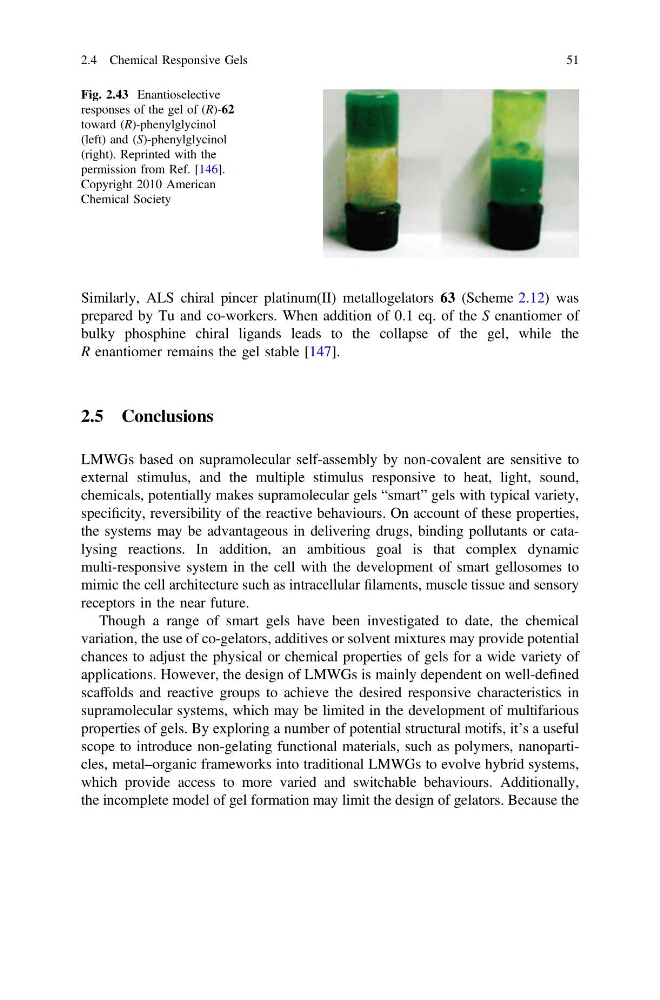
Fig. 2.43 Enantioselective
responses of the gel of (R)-62
toward (R)-phenylglycinol
(left) and (S)-phenylglycinol
(right). Reprinted with the
permission from Ref. [146].
Copyright 2010 American
Chemical Society
2.4 Chemical Responsive Gels
51
prepared by Tu and co-workers. When addition of 0.1 eq. of the S enantiomer of
bulky phosphine chiral ligands leads to the collapse of the gel, while the
R enantiomer remains the gel stable [147].
2.5 Conclusions
LMWGs based on supramolecular self-assembly by non-covalent are sensitive to
external stimulus, and the multiple stimulus responsive to heat, light, sound,
chemicals, potentially makes supramolecular gels “smart” gels with typical variety,
specificity, reversibility of the reactive behaviours. On account of these properties,
the systems may be advantageous in delivering drugs, binding pollutants or catalysing reactions. In addition, an ambitious goal is that complex dynamic
multi-responsive system in the cell with the development of smart gellosomes to
mimic the cell architecture such as intracellular filaments, muscle tissue and sensory
receptors in the near future.
Though a range of smart gels have been investigated to date, the chemical
variation, the use of co-gelators, additives or solvent mixtures may provide potential
chances to adjust the physical or chemical properties of gels for a wide variety of
applications. However, the design of LMWGs is mainly dependent on well-defined
scaffolds and reactive groups to achieve the desired responsive characteristics in
supramolecular systems, which may be limited in the development of multifarious
properties of gels. By exploring a number of potential structural motifs, it’s a useful
scope to introduce non-gelating functional materials, such as polymers, nanoparticles, metal–organic frameworks into traditional LMWGs to evolve hybrid systems,
which provide access to more varied and switchable behaviours. Additionally,
the incomplete model of gel formation may limit the design of gelators. Because the
Fig. 2.43 Enantioselective
responses of the gel of (R)-62
toward (R)-phenylglycinol
(left) and (S)-phenylglycinol
(right). Reprinted with the
permission from Ref. [146].
Copyright 2010 American
Chemical Society
2.4 Chemical Responsive Gels
51