

to interact with hydrophilic moieties by H-bonding interactions. And the responsive
cyclodextrins (CDs) hydrogels can be obtained based on the host-guest interactions.
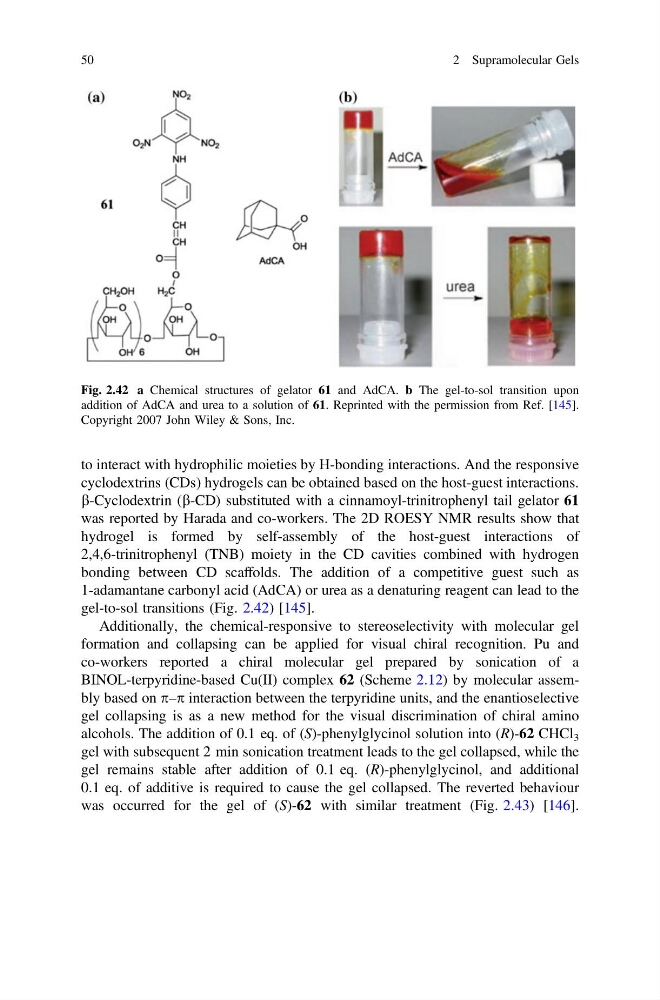
b-Cyclodextrin (b-CD) substituted with a cinnamoyl-trinitrophenyl tail gelator 61
was reported by Harada and co-workers. The 2D ROESY NMR results show that
hydrogel is formed by self-assembly of the host-guest interactions of
2,4,6-trinitrophenyl (TNB) moiety in the CD cavities combined with hydrogen
bonding between CD scaffolds. The addition of a competitive guest such as
1-adamantane carbonyl acid (AdCA) or urea as a denaturing reagent can lead to the
gel-to-sol transitions (Fig. 2.42) [145].
Additionally, the chemical-responsive to stereoselectivity with molecular gel
formation and collapsing can be applied for visual chiral recognition. Pu and
co-workers reported a chiral molecular gel prepared by sonication of a
BINOL-terpyridine-based Cu(II) complex 62 (Scheme 2.12) by molecular assembly based on p–p interaction between the terpyridine units, and the enantioselective
gel collapsing is as a new method for the visual discrimination of chiral amino
alcohols. The addition of 0.1 eq. of (S)-phenylglycinol solution into (R)-62 CHCl 3
gel with subsequent 2 min sonication treatment leads to the gel collapsed, while the
gel remains stable after addition of 0.1 eq. (R)-phenylglycinol, and additional
0.1 eq. of additive is required to cause the gel collapsed. The reverted behaviour
was occurred for the gel of (S)-62 with similar treatment (Fig. 2.43) [146].
Fig. 2.42 a Chemical structures of gelator 61 and AdCA. b The gel-to-sol transition upon
addition of AdCA and urea to a solution of 61. Reprinted with the permission from Ref. [145].
Copyright 2007 John Wiley & Sons, Inc.
50
2 Supramolecular Gels
cyclodextrins (CDs) hydrogels can be obtained based on the host-guest interactions.
b-Cyclodextrin (b-CD) substituted with a cinnamoyl-trinitrophenyl tail gelator 61
was reported by Harada and co-workers. The 2D ROESY NMR results show that
hydrogel is formed by self-assembly of the host-guest interactions of
2,4,6-trinitrophenyl (TNB) moiety in the CD cavities combined with hydrogen
bonding between CD scaffolds. The addition of a competitive guest such as
1-adamantane carbonyl acid (AdCA) or urea as a denaturing reagent can lead to the
gel-to-sol transitions (Fig. 2.42) [145].
Additionally, the chemical-responsive to stereoselectivity with molecular gel
formation and collapsing can be applied for visual chiral recognition. Pu and
co-workers reported a chiral molecular gel prepared by sonication of a
BINOL-terpyridine-based Cu(II) complex 62 (Scheme 2.12) by molecular assembly based on p–p interaction between the terpyridine units, and the enantioselective
gel collapsing is as a new method for the visual discrimination of chiral amino
alcohols. The addition of 0.1 eq. of (S)-phenylglycinol solution into (R)-62 CHCl 3
gel with subsequent 2 min sonication treatment leads to the gel collapsed, while the
gel remains stable after addition of 0.1 eq. (R)-phenylglycinol, and additional
0.1 eq. of additive is required to cause the gel collapsed. The reverted behaviour
was occurred for the gel of (S)-62 with similar treatment (Fig. 2.43) [146].
Fig. 2.42 a Chemical structures of gelator 61 and AdCA. b The gel-to-sol transition upon
addition of AdCA and urea to a solution of 61. Reprinted with the permission from Ref. [145].
Copyright 2007 John Wiley & Sons, Inc.
50
2 Supramolecular Gels