

eye due to the selective photochromic response at a very low concentration of
analytes that predominantly operates only in the gel state, as compared with the
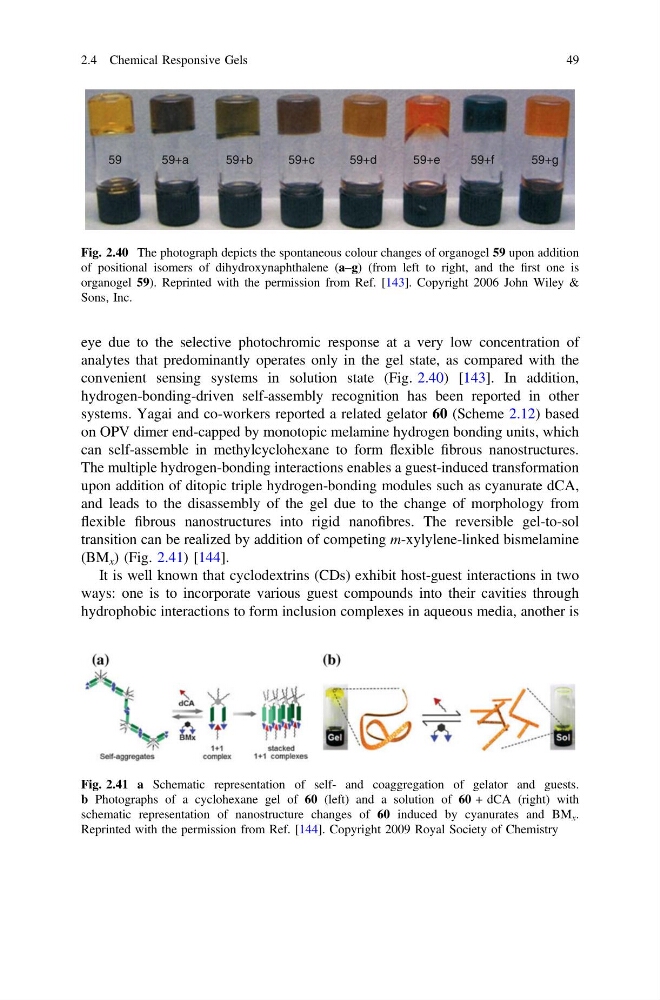
convenient sensing systems in solution state (Fig. 2.40) [143]. In addition,
hydrogen-bonding-driven self-assembly recognition has been reported in other
systems. Yagai and co-workers reported a related gelator 60 (Scheme 2.12) based
on OPV dimer end-capped by monotopic melamine hydrogen bonding units, which
can self-assemble in methylcyclohexane to form flexible fibrous nanostructures.
The multiple hydrogen-bonding interactions enables a guest-induced transformation
upon addition of ditopic triple hydrogen-bonding modules such as cyanurate dCA,
and leads to the disassembly of the gel due to the change of morphology from
flexible fibrous nanostructures into rigid nanofibres. The reversible gel-to-sol
transition can be realized by addition of competing m-xylylene-linked bismelamine
(BM x ) (Fig. 2.41) [144].
It is well known that cyclodextrins (CDs) exhibit host-guest interactions in two
ways: one is to incorporate various guest compounds into their cavities through
hydrophobic interactions to form inclusion complexes in aqueous media, another is
59
59+a
59+b
59+c
59+d
59+e
59+f
59+g
Fig. 2.40 The photograph depicts the spontaneous colour changes of organogel 59 upon addition
of positional isomers of dihydroxynaphthalene (a–g) (from left to right, and the first one is
organogel 59). Reprinted with the permission from Ref. [143]. Copyright 2006 John Wiley &
Sons, Inc.
Fig. 2.41 a Schematic representation of self- and coaggregation of gelator and guests.
b Photographs of a cyclohexane gel of 60 (left) and a solution of 60 + dCA (right) with
schematic representation of nanostructure changes of 60 induced by cyanurates and BM x .
Reprinted with the permission from Ref. [144]. Copyright 2009 Royal Society of Chemistry
2.4 Chemical Responsive Gels
49
analytes that predominantly operates only in the gel state, as compared with the
convenient sensing systems in solution state (Fig. 2.40) [143]. In addition,
hydrogen-bonding-driven self-assembly recognition has been reported in other
systems. Yagai and co-workers reported a related gelator 60 (Scheme 2.12) based
on OPV dimer end-capped by monotopic melamine hydrogen bonding units, which
can self-assemble in methylcyclohexane to form flexible fibrous nanostructures.
The multiple hydrogen-bonding interactions enables a guest-induced transformation
upon addition of ditopic triple hydrogen-bonding modules such as cyanurate dCA,
and leads to the disassembly of the gel due to the change of morphology from
flexible fibrous nanostructures into rigid nanofibres. The reversible gel-to-sol
transition can be realized by addition of competing m-xylylene-linked bismelamine
(BM x ) (Fig. 2.41) [144].
It is well known that cyclodextrins (CDs) exhibit host-guest interactions in two
ways: one is to incorporate various guest compounds into their cavities through
hydrophobic interactions to form inclusion complexes in aqueous media, another is
59
59+a
59+b
59+c
59+d
59+e
59+f
59+g
Fig. 2.40 The photograph depicts the spontaneous colour changes of organogel 59 upon addition
of positional isomers of dihydroxynaphthalene (a–g) (from left to right, and the first one is
organogel 59). Reprinted with the permission from Ref. [143]. Copyright 2006 John Wiley &
Sons, Inc.
Fig. 2.41 a Schematic representation of self- and coaggregation of gelator and guests.
b Photographs of a cyclohexane gel of 60 (left) and a solution of 60 + dCA (right) with
schematic representation of nanostructure changes of 60 induced by cyanurates and BM x .
Reprinted with the permission from Ref. [144]. Copyright 2009 Royal Society of Chemistry
2.4 Chemical Responsive Gels
49