

Of course, metal ions as important and convenient cations have been investigated in many studies. They have been used to construct gel systems by metallogels
or metal–organic gels, and the content will be talked about in detail in Chap. 3.
2.4.4 Neutral Species
Apart from charged guest such as cations or anions, the addition of neutral species
may involve specific non-covalent interactions between accessible binding sites of
the gelators and complementary functional groups of the small molecule, which is
similar with biological protein-substrate binding. The interaction and recognition
processes represent a response to physical or chemical properties of gel and guest,
and the non-covalent interactions like p–p stacking, H-bonding, and van der Waals
forces play a pivotal role in the self-assembly processes.
Shinkai and co-workers reported one of the first example of an organogel matrix
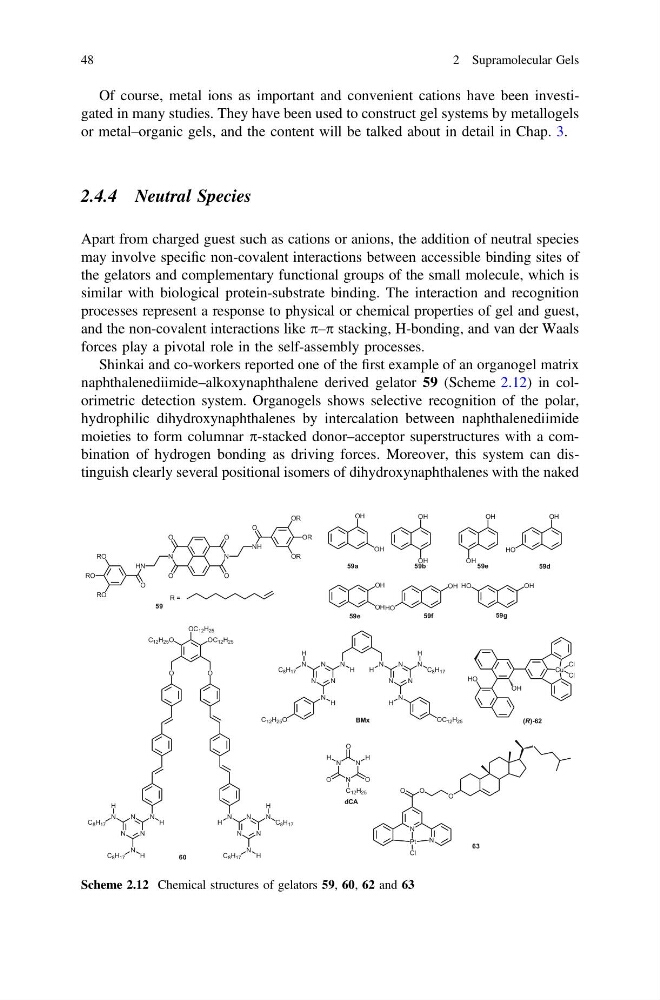
naphthalenediimide–alkoxynaphthalene derived gelator 59 (Scheme 2.12) in colorimetric detection system. Organogels shows selective recognition of the polar,
hydrophilic dihydroxynaphthalenes by intercalation between naphthalenediimide
moieties to form columnar p-stacked donor–acceptor superstructures with a combination of hydrogen bonding as driving forces. Moreover, this system can distinguish clearly several positional isomers of dihydroxynaphthalenes with the naked
RO
RO
RO
HN
O
N
O
N
O
O
O
NH
O
OR
OR
OR
R =
59
OH
OH
OH
OH
OH
OH
OH
OH
HO
OH
OH
OH
HO
HO
59a
59b
59e
59d
59e
59f
59g
C12H25O
OC12H25
OC12H25
O
O
N
N
N
N
N
N
N
N
H
H
N
N
N
N
C8H17
H
C8H17
H
H
C8H17
C8H17
H
60
N
N H
H
N
N
N
N
N
N
N
H
C8H17
N
H
C8H17
N H
C12H25O
N
H
OC12H25
BMx
N
N
N
O
O
O
C12H25
H
H
dCA
OH
HO
Cu
Cl
Cl
(R)-62
N
N
Pt
O
O
O
Cl
63
Scheme 2.12 Chemical structures of gelators 59, 60, 62 and 63
48
2 Supramolecular Gels
or metal–organic gels, and the content will be talked about in detail in Chap. 3.
2.4.4 Neutral Species
Apart from charged guest such as cations or anions, the addition of neutral species
may involve specific non-covalent interactions between accessible binding sites of
the gelators and complementary functional groups of the small molecule, which is
similar with biological protein-substrate binding. The interaction and recognition
processes represent a response to physical or chemical properties of gel and guest,
and the non-covalent interactions like p–p stacking, H-bonding, and van der Waals
forces play a pivotal role in the self-assembly processes.
Shinkai and co-workers reported one of the first example of an organogel matrix
naphthalenediimide–alkoxynaphthalene derived gelator 59 (Scheme 2.12) in colorimetric detection system. Organogels shows selective recognition of the polar,
hydrophilic dihydroxynaphthalenes by intercalation between naphthalenediimide
moieties to form columnar p-stacked donor–acceptor superstructures with a combination of hydrogen bonding as driving forces. Moreover, this system can distinguish clearly several positional isomers of dihydroxynaphthalenes with the naked
RO
RO
RO
HN
O
N
O
N
O
O
O
NH
O
OR
OR
OR
R =
59
OH
OH
OH
OH
OH
OH
OH
OH
HO
OH
OH
OH
HO
HO
59a
59b
59e
59d
59e
59f
59g
C12H25O
OC12H25
OC12H25
O
O
N
N
N
N
N
N
N
N
H
H
N
N
N
N
C8H17
H
C8H17
H
H
C8H17
C8H17
H
60
N
N H
H
N
N
N
N
N
N
N
H
C8H17
N
H
C8H17
N H
C12H25O
N
H
OC12H25
BMx
N
N
N
O
O
O
C12H25
H
H
dCA
OH
HO
Cu
Cl
Cl
(R)-62
N
N
Pt
O
O
O
Cl
63
Scheme 2.12 Chemical structures of gelators 59, 60, 62 and 63
48
2 Supramolecular Gels