

Besides, there some examples with other functional groups can also show
stimuli-responsive to cations for tuning of gel properties, leading to gel-to-sol
transition. Smith and co-workers reported the first example of the Ag
+
–alkene
interactions as the driving force for the gel-to-sol transitions. The ethyl acetate gel
of alkene-terminated gelator 57 (Scheme 2.11) shows selective response to Ag
+ or
Li
+ cation compared to Na
+ or K
+
. The Ag
+
–alkene interactions play a vital role in
mediating a response in soft matter systems, providing fundamental insight into the
nature of this interaction and acting as a step on the way to development of
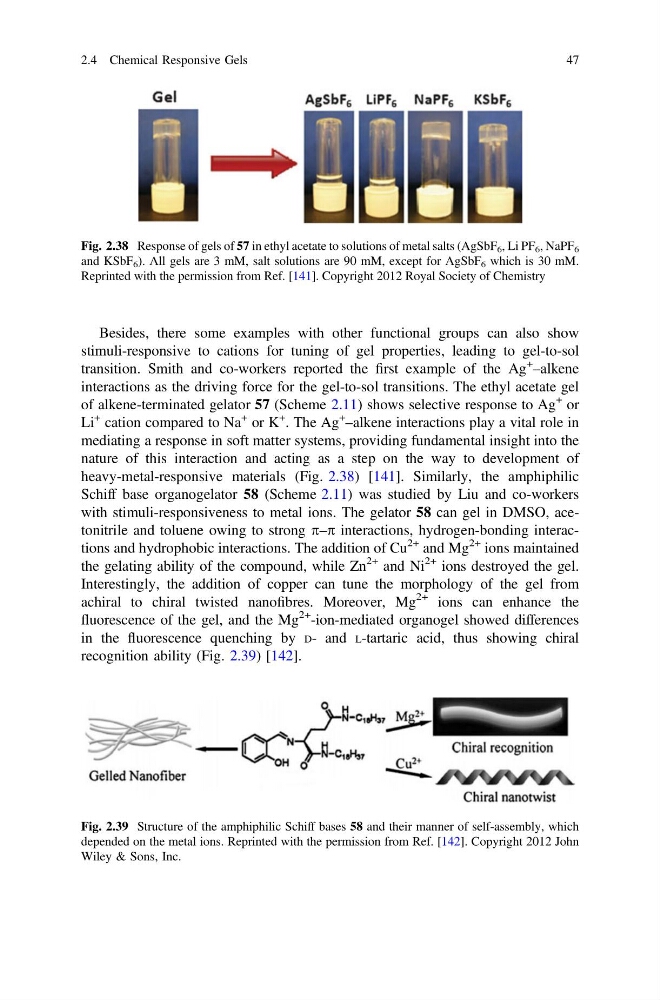
heavy-metal-responsive materials (Fig. 2.38) [141]. Similarly, the amphiphilic
Schiff base organogelator 58 (Scheme 2.11) was studied by Liu and co-workers
with stimuli-responsiveness to metal ions. The gelator 58 can gel in DMSO, acetonitrile and toluene owing to strong p–p interactions, hydrogen-bonding interactions and hydrophobic interactions. The addition of Cu
2+ and Mg
2+ ions maintained
the gelating ability of the compound, while Zn
2+ and Ni
2+ ions destroyed the gel.
Interestingly, the addition of copper can tune the morphology of the gel from
achiral to chiral twisted nanofibres. Moreover, Mg
2+ ions can enhance the
fluorescence of the gel, and the Mg
2+ -ion-mediated organogel showed differences
in the fluorescence quenching by D- and L-tartaric acid, thus showing chiral
recognition ability (Fig. 2.39) [142].
Fig. 2.38 Response of gels of 57 in ethyl acetate to solutions of metal salts (AgSbF 6 , Li PF 6 , NaPF 6
and KSbF 6 ). All gels are 3 mM, salt solutions are 90 mM, except for AgSbF 6 which is 30 mM.
Reprinted with the permission from Ref. [141]. Copyright 2012 Royal Society of Chemistry
Fig. 2.39 Structure of the amphiphilic Schiff bases 58 and their manner of self-assembly, which
depended on the metal ions. Reprinted with the permission from Ref. [142]. Copyright 2012 John
Wiley & Sons, Inc.
2.4 Chemical Responsive Gels
47
stimuli-responsive to cations for tuning of gel properties, leading to gel-to-sol
transition. Smith and co-workers reported the first example of the Ag
+
–alkene
interactions as the driving force for the gel-to-sol transitions. The ethyl acetate gel
of alkene-terminated gelator 57 (Scheme 2.11) shows selective response to Ag
+ or
Li
+ cation compared to Na
+ or K
+
. The Ag
+
–alkene interactions play a vital role in
mediating a response in soft matter systems, providing fundamental insight into the
nature of this interaction and acting as a step on the way to development of
heavy-metal-responsive materials (Fig. 2.38) [141]. Similarly, the amphiphilic
Schiff base organogelator 58 (Scheme 2.11) was studied by Liu and co-workers
with stimuli-responsiveness to metal ions. The gelator 58 can gel in DMSO, acetonitrile and toluene owing to strong p–p interactions, hydrogen-bonding interactions and hydrophobic interactions. The addition of Cu
2+ and Mg
2+ ions maintained
the gelating ability of the compound, while Zn
2+ and Ni
2+ ions destroyed the gel.
Interestingly, the addition of copper can tune the morphology of the gel from
achiral to chiral twisted nanofibres. Moreover, Mg
2+ ions can enhance the
fluorescence of the gel, and the Mg
2+ -ion-mediated organogel showed differences
in the fluorescence quenching by D- and L-tartaric acid, thus showing chiral
recognition ability (Fig. 2.39) [142].
Fig. 2.38 Response of gels of 57 in ethyl acetate to solutions of metal salts (AgSbF 6 , Li PF 6 , NaPF 6
and KSbF 6 ). All gels are 3 mM, salt solutions are 90 mM, except for AgSbF 6 which is 30 mM.
Reprinted with the permission from Ref. [141]. Copyright 2012 Royal Society of Chemistry
Fig. 2.39 Structure of the amphiphilic Schiff bases 58 and their manner of self-assembly, which
depended on the metal ions. Reprinted with the permission from Ref. [142]. Copyright 2012 John
Wiley & Sons, Inc.
2.4 Chemical Responsive Gels
47