

In stimuli-responsive gels capable of interacting with cations, it is typical to
design the gelators functionalized with crown ether moieties, which mainly focus on
their stimuli-responsiveness, especially those based on host–guest interactions.
Various kinds of crown ether moieties might interact with alkali metal cations,
primary alkylammonium cations (PAA), and secondary ammonium cations etc., and
further tune the gel properties through self-assembly processes. A crown-appended
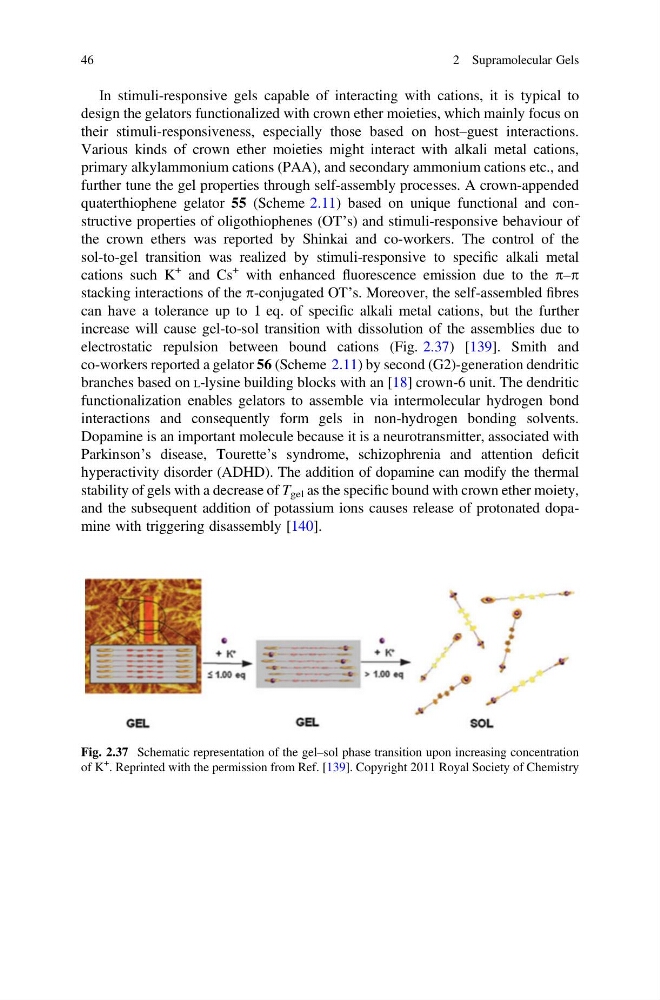
quaterthiophene gelator 55 (Scheme 2.11) based on unique functional and constructive properties of oligothiophenes (OT’s) and stimuli-responsive behaviour of
the crown ethers was reported by Shinkai and co-workers. The control of the
sol-to-gel transition was realized by stimuli-responsive to specific alkali metal
cations such K
+ and Cs
+ with enhanced fluorescence emission due to the p–p
stacking interactions of the p-conjugated OT’s. Moreover, the self-assembled fibres
can have a tolerance up to 1 eq. of specific alkali metal cations, but the further
increase will cause gel-to-sol transition with dissolution of the assemblies due to
electrostatic repulsion between bound cations (Fig. 2.37) [139]. Smith and
co-workers reported a gelator 56 (Scheme 2.11) by second (G2)-generation dendritic
branches based on L-lysine building blocks with an [18] crown-6 unit. The dendritic
functionalization enables gelators to assemble via intermolecular hydrogen bond
interactions and consequently form gels in non-hydrogen bonding solvents.
Dopamine is an important molecule because it is a neurotransmitter, associated with
Parkinson’s disease, Tourette’s syndrome, schizophrenia and attention deficit
hyperactivity disorder (ADHD). The addition of dopamine can modify the thermal
stability of gels with a decrease of T gel as the specific bound with crown ether moiety,
and the subsequent addition of potassium ions causes release of protonated dopamine with triggering disassembly [140].
Fig. 2.37 Schematic representation of the gel–sol phase transition upon increasing concentration
of K
+ . Reprinted with the permission from Ref. [139]. Copyright 2011 Royal Society of Chemistry
46
2 Supramolecular Gels
design the gelators functionalized with crown ether moieties, which mainly focus on
their stimuli-responsiveness, especially those based on host–guest interactions.
Various kinds of crown ether moieties might interact with alkali metal cations,
primary alkylammonium cations (PAA), and secondary ammonium cations etc., and
further tune the gel properties through self-assembly processes. A crown-appended
quaterthiophene gelator 55 (Scheme 2.11) based on unique functional and constructive properties of oligothiophenes (OT’s) and stimuli-responsive behaviour of
the crown ethers was reported by Shinkai and co-workers. The control of the
sol-to-gel transition was realized by stimuli-responsive to specific alkali metal
cations such K
+ and Cs
+ with enhanced fluorescence emission due to the p–p
stacking interactions of the p-conjugated OT’s. Moreover, the self-assembled fibres
can have a tolerance up to 1 eq. of specific alkali metal cations, but the further
increase will cause gel-to-sol transition with dissolution of the assemblies due to
electrostatic repulsion between bound cations (Fig. 2.37) [139]. Smith and
co-workers reported a gelator 56 (Scheme 2.11) by second (G2)-generation dendritic
branches based on L-lysine building blocks with an [18] crown-6 unit. The dendritic
functionalization enables gelators to assemble via intermolecular hydrogen bond
interactions and consequently form gels in non-hydrogen bonding solvents.
Dopamine is an important molecule because it is a neurotransmitter, associated with
Parkinson’s disease, Tourette’s syndrome, schizophrenia and attention deficit
hyperactivity disorder (ADHD). The addition of dopamine can modify the thermal
stability of gels with a decrease of T gel as the specific bound with crown ether moiety,
and the subsequent addition of potassium ions causes release of protonated dopamine with triggering disassembly [140].
Fig. 2.37 Schematic representation of the gel–sol phase transition upon increasing concentration
of K
+ . Reprinted with the permission from Ref. [139]. Copyright 2011 Royal Society of Chemistry
46
2 Supramolecular Gels